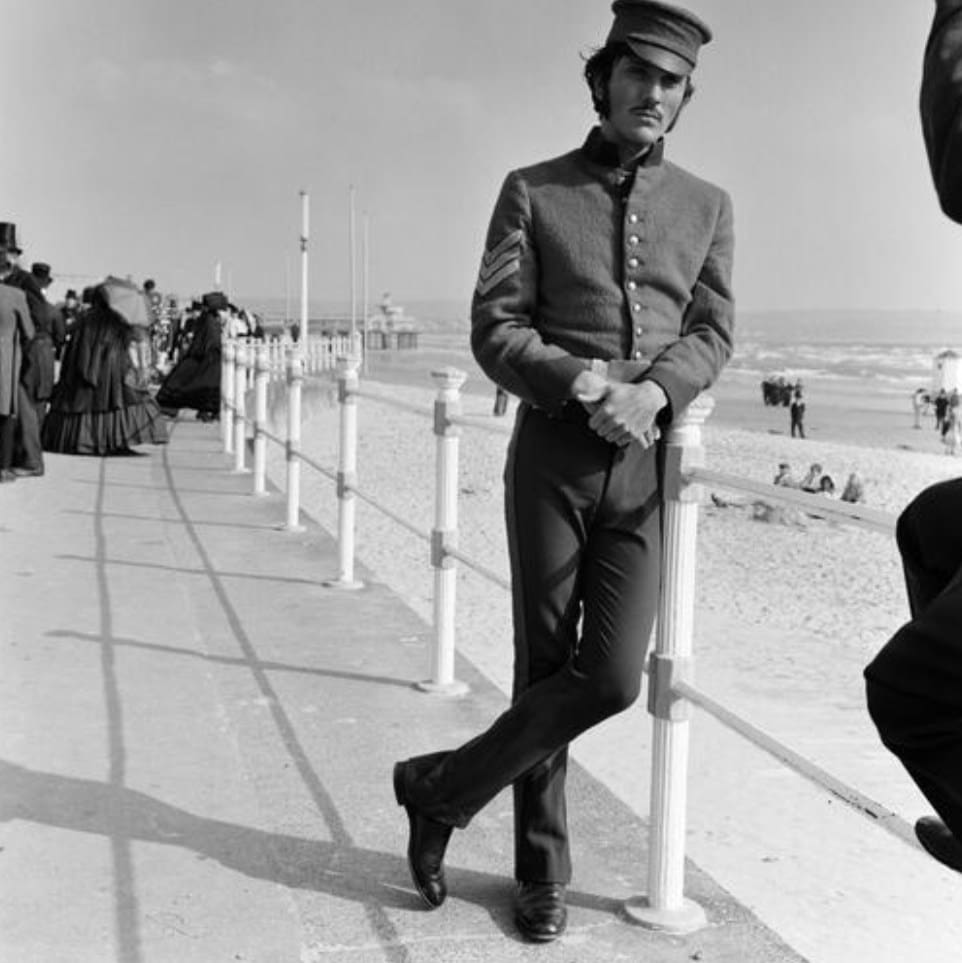
Terence Henry Stamp died on 17 August 2025, aged 87. Known for his sophisticated villain roles, he was named by Empire as one of the 100 Sexiest Film Stars of All Time in 1995. He received various accolades, including a Golden Globe Award, a Cannes Film Festival Award, and a Silver Bear, as well as nominations for an Academy Award and two BAFTA Awards. (Carole Dorran).
Filming Far From The Madding Crowd
In the mid-1960s, Dorset’s rolling countryside and rugged coastline were transformed into the backdrop for one of British cinema’s most enduring literary adaptations: John Schlesinger’s Far From the Madding Crowd (1967). Among the cast was Terence Stamp, the strikingly handsome young actor whose presence on screen captivated audiences and critics alike.
Stamp, who had already gained international recognition for his roles in Billy Budd (1962) and The Collector (1965), was cast as Sergeant Frank Troy, the dashing but reckless soldier who becomes entangled with Bathsheba Everdene, played by Julie Christie. His swordplay scene on the cliffs near Durdle Door remains one of the film’s most memorable images, a striking combination of Hardy’s passion and the natural beauty of the Dorset coast.
Filming took place across Hardy country, with locations including the fields around Dorchester, the village of Shaftesbury—where the iconic Gold Hill was immortalised on film—and notably, Weymouth. The seaside town hosted both cast and crew for several weeks, and Stamp himself could often be seen walking along the Esplanade or visiting local cafés. The community embraced the production, with many locals employed as extras during the large-scale fair and market scenes. Stamp’s striking presence did not go unnoticed, and older residents still recall the stir he caused as he strode through town in his bright scarlet uniform.
His performance, at once charismatic and unsettling, perfectly embodied Hardy’s flawed character. For Stamp, Dorset was not just a filming location but a landscape that deepened the authenticity of his portrayal. The rural settings and coastal expanses underscored the tempestuous nature of Frank Troy and gave audiences one of the most vivid adaptations of Hardy’s world. The shoot left a lasting impression on the local communities, many of whom treasured the glamour and excitement that arrived in their midst.
Obituary: Terence Stamp (1938 – 2025)
Terence Stamp, the distinguished British actor whose career spanned more than six decades, has died at the age of 86. Known for his striking looks, magnetic presence, and versatility, Stamp was a performer who consistently defied categorisation.
Born in Stepney, East London, in 1938, Stamp emerged from modest beginnings to become one of the most recognisable figures of 1960s cinema. His breakthrough came with Billy Budd (1962), for which he earned an Academy Award nomination. Over the following years, he worked with directors such as William Wyler, Joseph Losey, and Federico Fellini, building a reputation as both a matinee idol and a serious actor.
While roles in The Collector (1965) and Far From the Madding Crowd (1967) cemented his status, his career took unpredictable turns, ranging from the cult classic The Limey (1999) to his memorable performance as General Zod in Superman II (1980). He also delighted audiences with his portrayal of Bernadette in The Adventures of Priscilla, Queen of the Desert (1994), demonstrating his remarkable range.
For Dorset and particularly Weymouth, his work on Far From the Madding Crowd remains a cherished memory. The production brought a vibrancy to the county, and Stamp’s time there—whether performing under the cliffs, rehearsing in the countryside, or mingling with townsfolk—left behind a wealth of stories that local people still recount. His presence linked Hardy’s landscapes with the magic of cinema in a way that has endured for generations.
Off-screen, Stamp was known for his wit, intelligence, and spiritual interests, spending periods of his life in India exploring Eastern philosophies. Though famously private, he remained a charismatic public figure, admired by generations of filmgoers.
He is survived by his siblings and a body of work that will continue to resonate. Terence Stamp’s career was a testament to the enduring power of screen presence, and he will be remembered as one of British cinema’s true icons.
The Terence Stamp and Julie Christie Inspiration For Waterloo Sunset By The Kinks
“Waterloo Sunset” by The Kinks has long been rumoured to have been inspired by the glittering 1960s romance between Terence Stamp and Julie Christie, two of the most iconic figures of Swinging London. At the time, both were at the height of their fame – Christie fresh from Darling and Doctor Zhivago, and Stamp celebrated for his brooding presence in films like Billy Budd and Far from the Madding Crowd. Their relationship was seen as the epitome of London cool, the golden couple strolling through a city buzzing with cultural energy. Against this backdrop, Ray Davies’ wistful lyrics, with their imagery of lovers meeting under the evening glow of Waterloo Bridge, seemed to many to be a direct reflection of Christie and Stamp’s romance.
Although Davies himself often downplayed or gave differing accounts of the song’s origins, the association stuck. The “Terry and Julie” mentioned in the lyrics became, in the public imagination, shorthand for Stamp and Christie, crossing the Thames on their way to a rendezvous away from the bustle of the city. Whether intentional or not, the song captured the fragile optimism of the era, a sunset over London, a moment of peace in the midst of chaos, and two young lovers embodying the dreams of a generation. The myth has endured, in part because it fits so perfectly with the spirit of the time, tying together one of pop’s most poignant ballads with two of cinema’s brightest stars.
Stamp was one of the most enigmatic actors of all time, and his performances will long be remembered. The UK has lost yet another of its treasures.