Earlier this week, Claire Coutinho called for increased North Sea gas development, arguing it would strengthen energy security and help bring down costs. Central to her pitch is the Conservative Party’s proposed “Cheap Power Plan”, which promises to cut electricity bills by 20% for households and businesses.
At first glance, that sounds like a straightforward solution to a very real problem. Energy bills remain stubbornly high, and many households are still feeling the strain after years of volatility. But beneath the surface, this approach risks taking the UK backwards—both economically and environmentally.
A step back after decades of progress
For nearly 30 years, the UK has been steadily reducing its reliance on fossil fuels. That shift has delivered remarkable results. According to analysis highlighted by Carbon Brief, by 2025 UK greenhouse gas emissions had fallen to 54% below 1990 levels, even as the economy nearly doubled in size.
This decoupling of economic growth from carbon emissions is no small achievement. It has been driven largely by the decline of coal and a steady reduction in gas use, which is now at its lowest level since 1992.
From a climate perspective, this is exactly what success looks like.
And yet, despite using less fossil fuel energy than at any point in decades, consumers are still paying high electricity prices. That contradiction sits at the heart of the current debate.
The real issue: how electricity is priced
The uncomfortable truth is that high energy bills in the UK are not primarily caused by a lack of domestic gas production. Instead, they are largely the result of how the wholesale electricity market is structured.
The system works on a “marginal pricing” model. In simple terms:
- Energy generators submit bids based on their costs
- The National Grid forecasts demand
- The most expensive source needed to meet demand, typically gas, sets the price for all electricity
This means that even if renewable energy like wind or solar is far cheaper to produce, it is still sold at the same price as gas-generated electricity.
So while the cost of renewables has plummeted, those savings are not consistently passed on to consumers. Instead, they are absorbed within the market.
The result? Households are effectively paying gas prices for electricity, even when gas makes up a relatively small share of the energy mix.
Why more drilling won’t lower bills
Calls to expand North Sea drilling are often framed as a way to bring down costs. But this argument overlooks a fundamental reality: oil and gas are traded on global markets.
Whether a barrel is extracted in the North Sea or shipped through the Strait of Hormuz, it is sold at the same international price. Increasing domestic supply does not shield consumers from global price fluctuations.
In other words, drilling more gas in UK waters will not meaningfully reduce energy bills.
Paying for gas we barely use
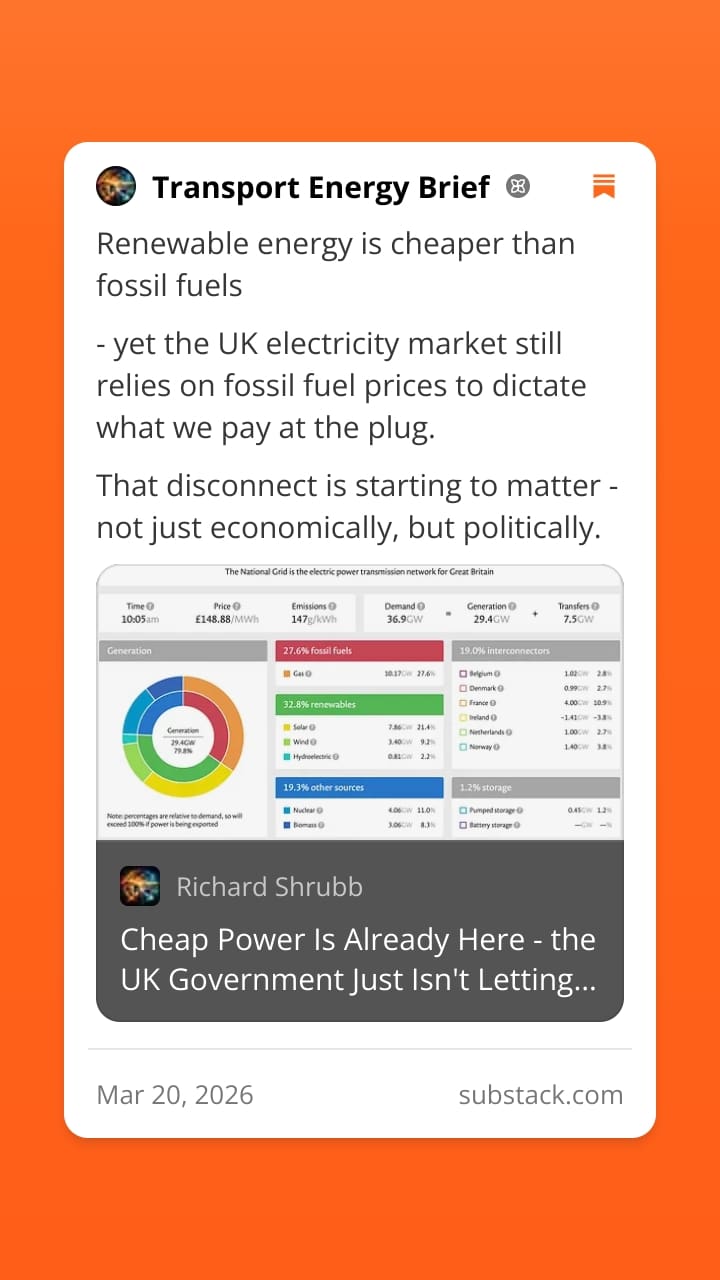
On a typical day, a significant portion of the UK’s electricity already comes from low-carbon sources. In one recent snapshot, more than half of supply was climate-neutral or climate-positive, while gas accounted for less than 30%.
Yet prices still reflect a system dominated by gas.
This disconnect is not accidental; it is baked into the design of the market. As long as gas sets the marginal price, it sets the price for everything.
The “dunkelflaute” argument
Critics of renewable energy often point to the so-called “dunkelflaute”—periods with little wind or sunlight—as justification for continued reliance on gas.
But in the UK, such conditions occur only around 7–8 days per year, roughly 2% of the time.
That is not insignificant, but it is hardly a reason to maintain a system that keeps prices artificially high year-round. Alternatives such as energy storage, grid flexibility, and interconnection can address these short gaps without locking in long-term fossil fuel dependence.
A better path forward
If the savings from cheap renewable energy were passed directly to consumers, the entire debate would shift.
Electricity would become genuinely affordable. Fossil fuels would no longer appear to be the “practical” solution, they would simply be the more expensive option.
The case for expanding gas production would weaken overnight, not because of ideology, but because it would fail on price.
A political choice, not a technical failure
The UK has not failed to build a low-carbon electricity system. In many ways, it has succeeded.
What has failed is the mechanism that translates those achievements into lower bills for consumers.
This is not just an economic issue—it is a political one. By maintaining a pricing system that ties electricity costs to gas, policymakers are inadvertently fuelling the very arguments for recarbonisation they claim to oppose.
Fix the market, and the narrative changes.
Until then, proposals like the “Cheap Power Plan” risk solving the wrong problem while undoing decades of real progress.
This article is a derivation of my article on Substack