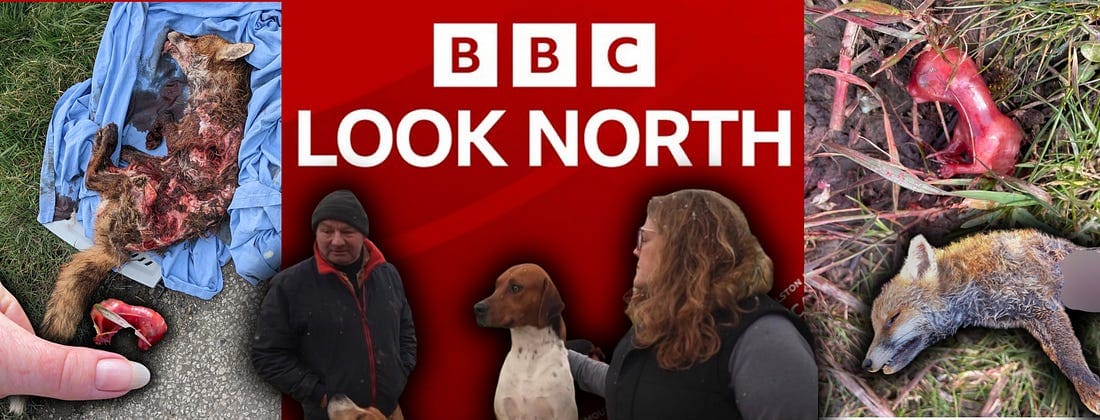
On 5 January 2026, BBC Look North broadcast a report on the Holderness Hunt that contained a serious and misleading factual error, according to wildlife monitors who have documented the hunt’s activities for years.
In the opening line of the report, covering East Riding of Yorkshire and Lincolnshire, reporter Amanda White told viewers:
“These Old English foxhounds have never been fox hunting; it became illegal long before they were born.”
That claim is demonstrably false.
Local monitoring group Hull Wildlife Protectors (HWP) says it holds extensive video and photographic evidence showing that the very same Holderness Hunt hounds have repeatedly chased, caught and killed foxes long after the Hunting Act 2004 came into force.
A documented history of kills
HWP has recorded multiple serious incidents involving the Holderness Hunt hounds over recent years:
- 2019: Holderness Hunt hounds chased and killed a vixen. Despite the strength of the footage, the Crown Prosecution Service dropped the case. The video clearly shows hounds pursuing and killing a fox.
- 2023: The hounds caught and killed another fox.
- January 2024: The hounds were involved in the killing of a badger, the killing of a deer, and the pursuit of a protected species. This incident has resulted in an ongoing court case, scheduled for 16 and 17 March 2026.
- November 2024: The hounds trespassed into a woman’s garden and reportedly killed a fox. While police said there was insufficient evidence for a Hunting Act prosecution, the hunt was issued with a Community Protection Notice (CPN).
- February 2025: The hounds caught and killed another fox during what was reported to be a Holderness Pony Club meet. Former huntsman Tom Wright was charged under section 1 of the Hunting Act 2004 for hunting a wild mammal with dogs.
- March 2025: The hounds killed a pregnant vixen. HWP recovered body parts and found foetuses, torn from her womb and left behind.
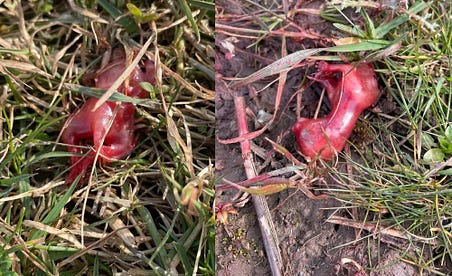
Against this record, campaigners say, the BBC’s assertion that these hounds have “never been fox hunting” is indefensible.
Charges, court cases and a misleading narrative
The issue is not one of opinion but of basic factual accuracy.
Hounds cannot repeatedly kill foxes, while a former huntsman faces multiple Hunting Act charges, yet simultaneously be described to viewers as animals that have “never been fox hunting”.
At a minimum, critics argue, the BBC could have stated that the Holderness Hunt has not yet been convicted in every case, but has been charged and is facing multiple court proceedings. That distinction matters. What the programme instead presented was a sanitised and untrue narrative that erased a long and well-documented pattern of wildlife harm.
By failing to make that distinction, BBC Look North did not merely simplify a complex issue; it misled its audience.
Why this matters
The BBC is bound by its Editorial Guidelines on Accuracy, which require it to avoid misleading audiences and to correct serious factual errors when they occur. This obligation exists precisely because unchallenged misinformation, once broadcast, quickly hardens into accepted fact.
Campaigners stress that this is not about campaigning against the BBC but about holding it to its own standards. When public service broadcasting minimises or misrepresents evidence of wildlife crime, it undermines public understanding and accountability.
Calling for a correction
Wildlife groups and supporters are now calling on the BBC to:
- Publicly correct the error
- Issue an apology or clarification
- Acknowledge that the original report was misleading
They are urging viewers to submit formal complaints, noting that every complaint must be logged and assessed. A high volume of complaints can trigger internal editorial reviews, escalate matters to the BBC’s Executive Complaints Unit, and, if necessary, lay the groundwork for Ofcom intervention.
As campaigners point out, this is how accountability works in practice. If the BBC gets something wrong, it should correct it publicly. But that only happens when audiences insist on accuracy.
Those wishing to complain can do so via the BBC’s complaints process, selecting News, BBC Look North, and Inaccuracy or misleading content, referencing the 5 January 2026 broadcast.
For critics of the report, the issue is simple: accurate journalism matters, and when it fails, it must be challenged.
Suggested Complaint Text (You Can Copy & Paste)
Please feel free to adapt this in your own words; personal variations are encouraged.
‘I am writing to formally complain about a factual inaccuracy broadcast on BBC Look North on 5 January 2026 in a report about the Holderness Hunt.
In the opening statement, reporter Amanda White said:
“These Old English foxhounds have never been fox hunting; it became illegal long before they were born.”This statement is factually incorrect and materially misleading. There is documented evidence that Holderness Hunt hounds have repeatedly chased and killed foxes in recent years and that former huntsman Tom Wright has been charged under the Hunting Act 2004 in relation to these hounds.
Presenting the claim that these hounds “have never been fox hunting” as fact misleads viewers and undermines accurate public understanding of hunting and wildlife crime.
I am requesting that the BBC correct this error publicly and issue a clarification or apology in line with its Editorial Guidelines on Accuracy.’