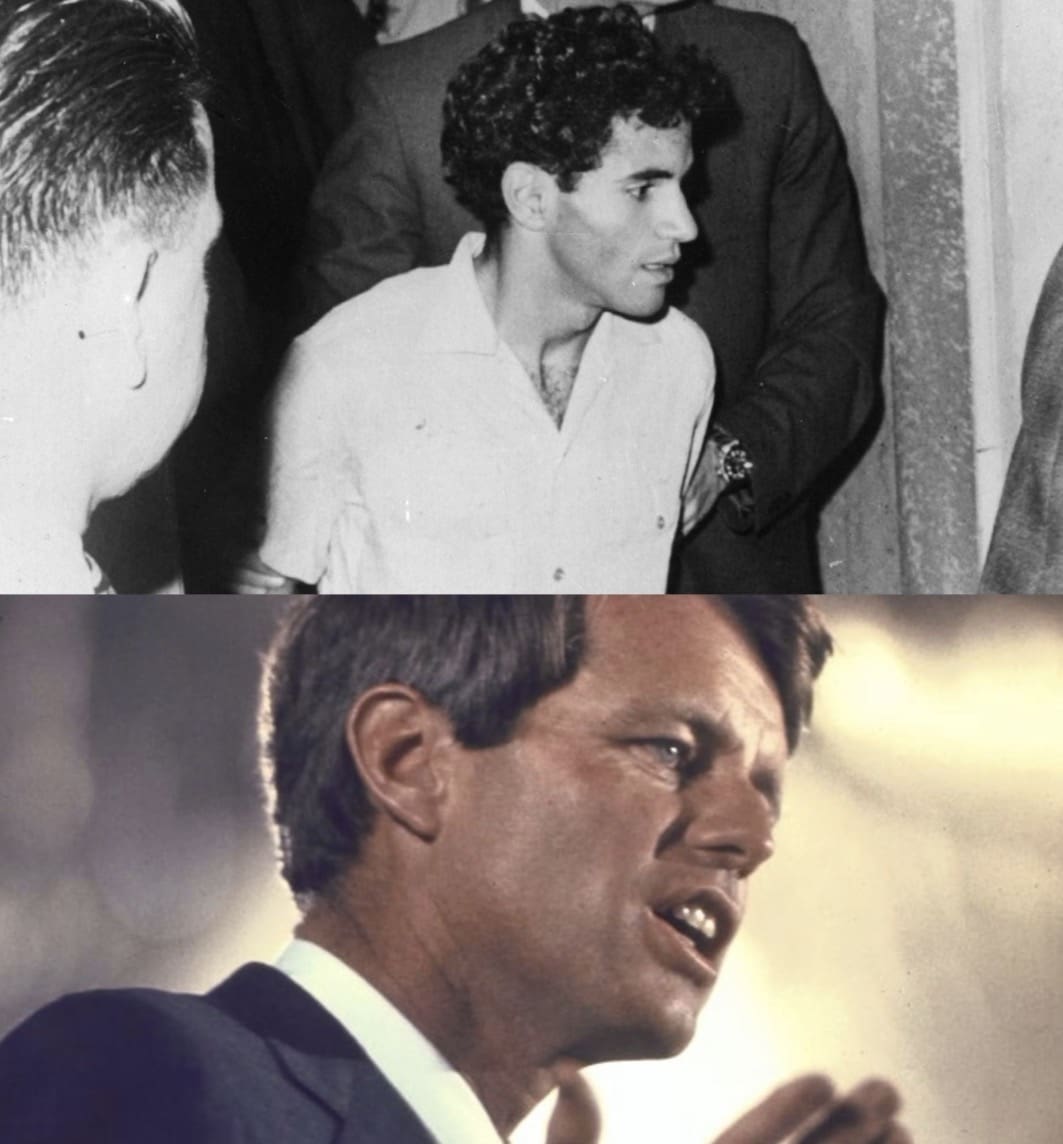
On 5 June 1968, moments after celebrating victory in the California Democratic presidential primary, Robert F. Kennedy was shot in the kitchen pantry of the Ambassador Hotel in Los Angeles. The man who fired the shots, Sirhan Sirhan, would later state that his actions were driven by political anger, specifically, by Kennedy’s support for Israel in the aftermath of the 1967 Six-Day War.
From the outset, Sirhan framed his act in political terms. Following his arrest at the scene, he told police that he had acted because he felt betrayed by Kennedy’s public position on Israel. In the months leading up to the assassination, Kennedy had expressed strong support for Israel’s security and had backed the proposed sale of advanced U.S. military aircraft, including Phantom jets, to the Israeli government. To Sirhan, a Palestinian born in Jerusalem, this was not simply routine foreign policy. It was, in his view, a direct affront tied to the displacement and suffering of Palestinians following the 1967 conflict.
Central to Sirhan’s testimony and the evidence presented at trial were his handwritten notebooks. In them, he repeatedly scrawled variations of the phrase “RFK must die.” The entries referenced 5 June 1968, the first anniversary of the outbreak of the Six-Day War, suggesting that the date carried symbolic meaning for him. The war had dramatically reshaped the Middle East, resulting in Israel’s capture of the West Bank, Gaza Strip, East Jerusalem, the Sinai Peninsula and the Golan Heights. For Palestinians and many across the Arab world, the conflict deepened grievances and dispossession. Sirhan’s writings reveal that he connected Kennedy’s political stance to those events.
During police questioning, Sirhan stated that he felt Kennedy had deliberately chosen to support Israel at the expense of Arab people. He spoke of anger and resentment, describing Kennedy’s backing of military assistance as something he could not accept. At no point in his statements did Sirhan claim that Kennedy personally supplied weapons or directed military operations. Rather, his focus was on Kennedy’s political advocacy, his endorsement of U.S. military aid and his vocal support for Israel’s right to defend itself.
At trial, the prosecution presented Sirhan’s notebooks as evidence of premeditation. The defence did not dispute that he had fired the shots. Instead, they argued diminished responsibility, suggesting that Sirhan’s mental state may have impaired his judgment. Nevertheless, Sirhan himself maintained that his actions were politically motivated. In subsequent parole hearings decades later, he reiterated that his anger had been directed at Kennedy’s pro-Israel stance.
To understand Sirhan’s stated motive, it is necessary to consider the broader climate of 1968. The United States was deeply entangled in the Vietnam War. The civil rights movement was reshaping domestic politics. Just two months before Kennedy’s assassination, Martin Luther King Jr. had been murdered in Memphis. Internationally, the Middle East was still reeling from the Six-Day War. American political leaders across party lines largely supported Israel’s security, viewing the country as a strategic ally during the Cold War. Kennedy’s position was consistent with much of the American political mainstream at the time.
Sirhan, however, did not see it that way. In his testimony and later reflections, he described feeling personally connected to the Palestinian cause. He had emigrated to the United States from the Middle East as a child. The 1967 war and the displacement that followed, appears to have intensified his sense of grievance. His writings reveal an emotional, almost obsessive focus on Kennedy’s stance, as though it embodied a wider injustice.
Historians examining the assassination have generally concluded that Sirhan acted alone and that his motive, as he described it, centred on opposition to Kennedy’s support for Israel. While conspiracy theories have circulated for decades, the official record, including court findings and investigative reviews, identifies Sirhan as the sole gunman and attributes his motive to political anger over Middle East policy.
It is important, however, to distinguish between Sirhan’s perception and the broader historical reality. Kennedy, as a U.S. senator and presidential candidate, was not an arms dealer nor a military commander. His support for Israel was expressed through speeches and policy endorsements within the framework of American foreign policy. Decisions about military sales involved executive branch processes and congressional approval. Sirhan’s framing of Kennedy as directly responsible for Palestinian suffering reflected his personal interpretation rather than a literal operational role.
In the years since, Sirhan’s testimony has remained consistent on one central point: he linked his act to Kennedy’s pro-Israel position and to the anniversary of the Six-Day War. Whether viewed as political extremism, personal radicalisation, or a tragic convergence of anger and opportunity, his own words place Middle East politics at the centre of his stated motive.
The assassination of Robert F. Kennedy shocked the United States and the world. It extinguished the presidential campaign of a figure many saw as a bridge between divided constituencies in a turbulent era. For Sirhan Sirhan, the act was, by his account, a response to a policy stance he believed symbolised injustice. For history, it remains one of the defining tragedies of 1968, a year when political violence repeatedly altered the course of nations.
More than half a century later, the testimony of Sirhan Sirhan continues to be scrutinised, debated and interpreted. Yet the documentary record is clear on what he himself claimed: that his anger over Kennedy’s support for Israel, particularly in the wake of the 1967 war, drove him to commit the act for which he was convicted.
For those who still believe that the conflict in Gaza and Palestine began on October 7, 2023, they really should give their heads a wobble.