

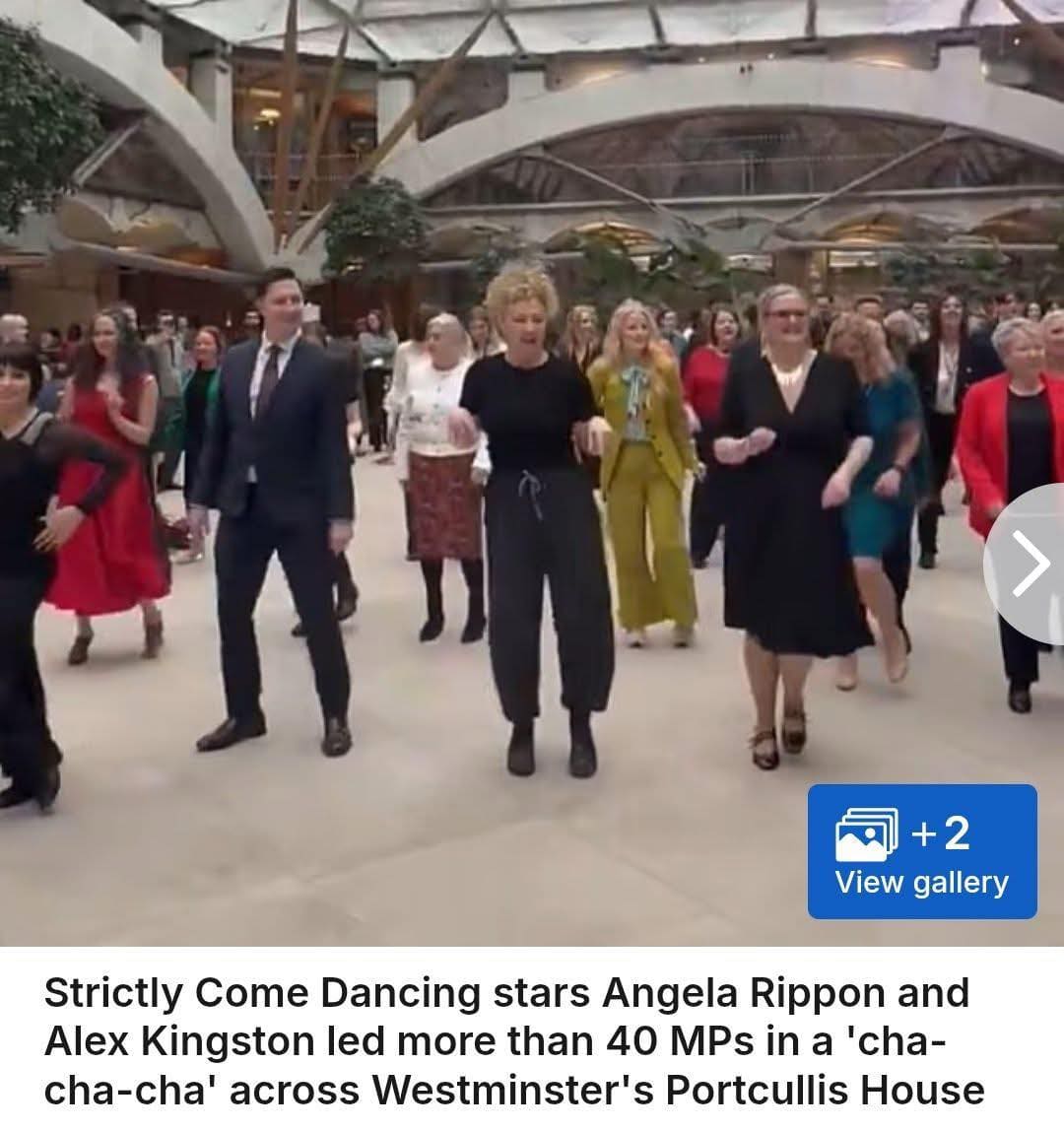
This is the far-right media outlet Guido Fawkes take on MPs’ dancing for a health campaign with the heading: ‘MPs on £98,599 Take Mass Dance Class While Middle East Breaks Out Into War’. They are not the only ones. And it is not only the far right who are guilty of such moral judgements. Some on the ‘left’ have fallen for it too. My message to them all is ‘go get a life and stop boring the paint off of the walls.
This particular type of outrage has become as predictable as it is exhausting. It emerges on cue, scans the horizon for something that can be framed as insensitive and then pounces. The latest target? A group of MPs dancing in Westminster as part of a cross-party health campaign promoting the benefits of movement.
The event, held in Portcullis House and led by broadcaster Angela Rippon and actor Alex Kingston, saw around 40 MPs take part. It was designed to highlight the physical and mental health benefits of dance, particularly for older people, and to encourage more active lifestyles. That was it. No foreign policy messaging. No grandstanding about global events. No coded diplomatic signalling.
Yet, because the United States under President Donald Trump had launched military strikes on Iran, some critics decided that MPs had committed a moral crime by… dancing.
Apparently, at a time of international crisis, no one in public life should be seen smiling, moving, or participating in a health campaign. According to this logic, Westminster must enter a permanent state of performative solemnity, calibrated to the most distressing headline of the day.
This is not seriousness. It is moral exhibitionism.
The modern moral arbiter thrives on juxtaposition. “While bombs fall, you dance.” “While people suffer, you celebrate.” It is an easy rhetorical device, emotionally potent and intellectually thin. It assumes that human activity must be sequential rather than simultaneous; that because tragedy exists in one corner of the globe, normal life everywhere else must be suspended.
But politics, like life, does not operate in that binary way. Governments manage domestic health policy while wars rage abroad. Hospitals treat patients while elections unfold. Schools continue teaching while markets crash. The idea that MPs participating in a pre-planned public health initiative is somehow an affront to global suffering rests on the assumption that visible joy equals indifference.
It doesn’t.
If anything, public health campaigns are needed precisely because the world is heavy. Physical activity reduces stress, improves cardiovascular health, supports mental wellbeing and combats isolation. Dance in particular has been shown to improve balance and cognitive resilience in older adults. Encouraging participation in something joyful and accessible is not trivial. It is preventative healthcare.
The event itself was cross-party. That detail matters. In an era when political tribalism dominates every conversation, around 40 MPs from different backgrounds set aside partisan divisions to promote something uncontroversial: moving your body is good for you. There was no attempt to exploit geopolitics. No slogans about the Middle East. No self-congratulation. Just participation.
Yet for some observers, everything must now be filtered through the prism of global catastrophe or even ideology. It is as if the existence of one crisis invalidates every other responsibility.
This constant scanning for moral infractions produces a flattening effect. Nuance disappears. Context collapses. Timing becomes weaponised. The assumption becomes that public figures must curate their expressions, ensuring that nothing remotely positive is visible when something terrible is happening somewhere else.
That is not moral seriousness; it is performative austerity.
There is also something deeply self-regarding about this style of condemnation. The critic places themselves in the role of ethical gatekeeper, publicly signalling their sensitivity and global awareness. “I would never dance at a time like this,” they imply, as though solemnity were a competitive sport. But politics is not a theatre of perpetual mourning.
Nor is it credible to suggest that MPs dancing for a health campaign trivialises international conflict. The strikes on Iran were matters of executive military decision-making in Washington and Tel Aviv. They were not influenced, accelerated, or excused by a dance routine in Portcullis House.
Public life cannot function if it is hostage to the idea that all domestic activity must pause in deference to events beyond our control. If that were the case, there would never be a suitable day to launch a cancer awareness drive, open a new hospital wing, celebrate a community festival, or promote mental health initiatives. There is always a war, a disaster, a famine, or a crisis somewhere.
This does not mean indifference. It means recognising that human societies are capable of holding multiple realities at once.
There is a difference between being morally aware and being morally theatrical. The former acknowledges suffering while continuing constructive work. The latter demands visible penance from anyone who fails to mirror its tone.
The MPs who danced did not mock the victims of war. They did not dismiss geopolitical tensions. They did not turn foreign policy into a punchline. They took part in a health campaign led by respected public figures to encourage physical activity. That is a normal function of political life.
Perhaps the deeper issue is discomfort with politicians appearing human. Dancing is disarming. It punctures the carefully managed image of seriousness. It introduces levity into an arena often defined by confrontation. For some critics, that alone is intolerable. Politics must remain grim, controlled, perpetually stern.
But voters regularly complain that politicians seem robotic, disconnected, and joyless. When they momentarily step outside that mould, not to score points, but to promote wellbeing, they are accused of insensitivity.
At some point, the outrage cycle becomes self-parody.
A healthy democracy requires scrutiny. It requires criticism. But it also requires proportion. Not every juxtaposition is a scandal. Not every smile is a betrayal. Not every dance is a diplomatic statement.
Sometimes a cross-party health campaign is just that.
And sometimes the most radical act in an age of relentless condemnation is to pause, take a breath and resist the urge to be the loudest moral arbiter in the room. Puritanism, as it says on the can, is boring.







