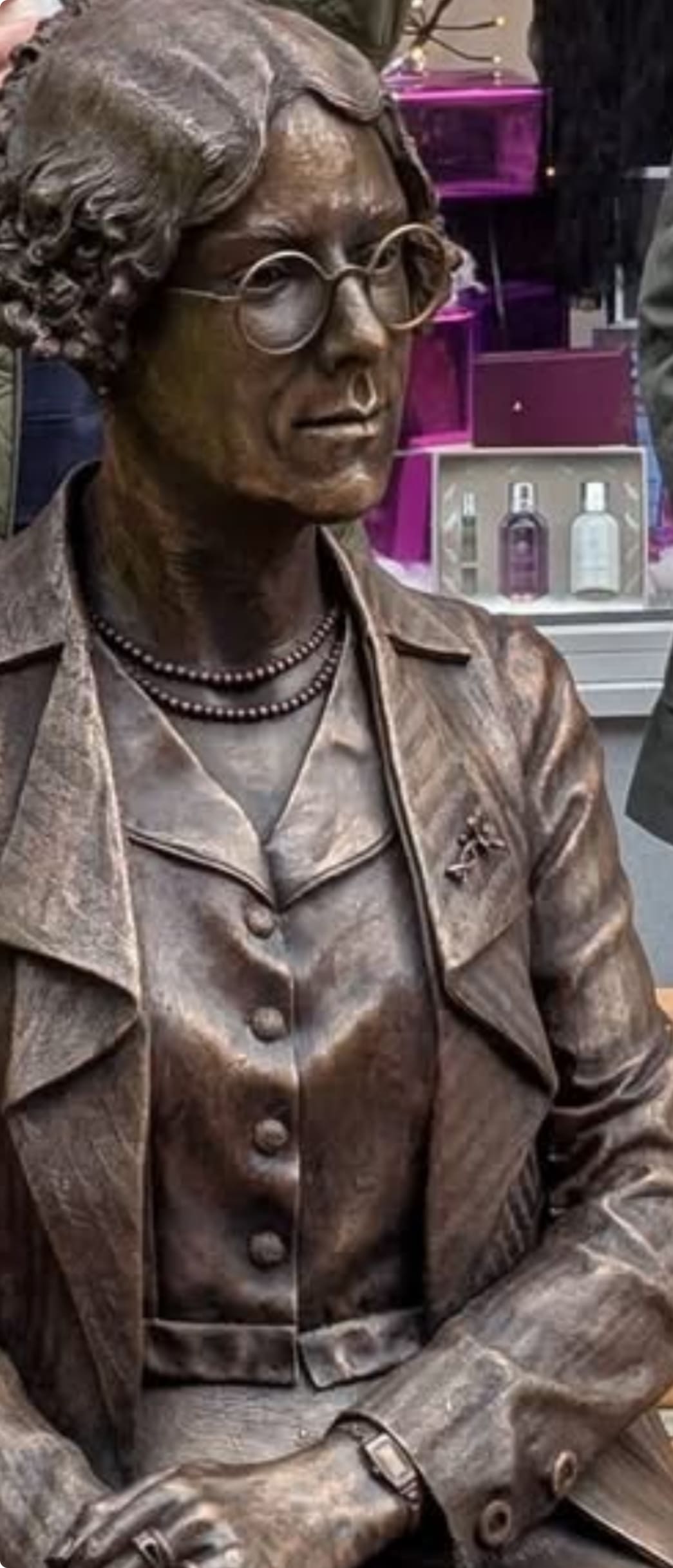
The statue of Sylvia Townsend Warner is being installed at 13.00 on Sunday lunchtime (14/12/25) in South Street. But who is Sylvia Townsend Warner?
Sylvia Townsend Warner (1893–1978) remains one of the most distinctive, quietly radical figures in twentieth-century British letters. A novelist, poet, biographer, and short-story writer, she carved a literary path defined by independence of mind, stylistic precision, and an unmistakable blend of wit, melancholy, and subversion. Although her name is less immediately familiar than some of her contemporaries, Warner’s work has enjoyed a sustained revival, owing to its modern sensibilities and striking originality.
Early Life and Musical Beginnings
Born in Harrow, Middlesex, Warner grew up in a scholarly household; her father was a housemaster at Harrow School. Before turning to fiction, she trained as a musicologist and contributed to the monumental Oxford History of Music. This formative discipline—analytical, attentive, structured—left a subtle imprint on her prose, which is notable for its clarity, rhythm, and fine calibration.
A Life Rooted in Dorset
Though Warner travelled widely and maintained literary connections across Britain and abroad, it was Dorset that became the emotional centre of her life. In 1937 she settled near Dorchester, in the small parish of Frome Vauchurch, with her lifelong partner, the poet Valentine Ackland. The move was prompted by a desire for quiet, companionship, and creative space, and the county’s landscapes—the chalk hills, wooded valleys, and river meadows—became intimately woven into Warner’s daily existence.
Dorchester, the nearest town, served not only as a practical hub but also as a backdrop to much of Warner’s social and domestic life. She mingled with the local literary and artistic circles, and her diaries reflect regular descriptions of its shops, streets, and characters. Dorset offered her a stability and sense of belonging she had not always found elsewhere; it became both a sanctuary and a source of creative nourishment.
Warner remained in Dorset for the rest of her life, and she is buried in the churchyard at Chaldon Herring—an enduring testament to her deep connection with the region.
The Novelist: Subtle Revolutions
Warner’s first novel, Lolly Willowes (1926), brought her immediate success. At first appearing to be a social comedy about a middle-aged woman escaping an oppressive family, the novel unexpectedly blossoms into a tale of witchcraft and self-emancipation. This blend of the domestic and the uncanny announced Warner as a writer of quietly subversive instincts.
Throughout her career she continued to defy genre expectations. Mr Fortune’s Maggot (1927) explored missionary doubt with elegance and moral complexity, while The Corner That Held Them (1948), often considered her masterpiece, offered a panoramic depiction of life in a medieval convent. Its brilliance lies not in plot but in its richly textured evocation of communal life and the unhurried passing of time.
Short Fiction: Precision and Radical Empathy
Warner was an exceptionally gifted writer of short stories, many published in The New Yorker over several decades. These stories exhibit sharp observation, gentle irony, and an ability to probe the emotional undercurrents of ordinary lives. She often centred those on society’s margins—eccentrics, dreamers, unmarried women—rendering their experiences with grace and radical sympathy.
Political Commitment and Personal Life
Warner’s political convictions were deeply held. She joined the Communist Party of Great Britain in the 1930s and travelled to Spain during the Civil War. While her politics informed her worldview, they never overwhelmed her fiction; rather, they underscored her interest in justice, equality, and the dignity of overlooked individuals.
Her partnership with Valentine Ackland was central to her personal happiness and creative development. Their Dorset home became a shared refuge, and Warner’s later diaries and letters reveal the tenderness and complexity of their relationship, set against the shifting social and political landscape of the mid-twentieth century.
Legacy and Renewed Recognition
In recent years Warner’s work has experienced a resurgence through new editions and a growing appreciation for writers who challenge traditional narratives of gender, sexuality, and society. Her prose feels strikingly contemporary—dry, incisive, and cultivated without pretension.
Sylvia Townsend Warner’s contribution to English literature lies in her exquisite attention to the subtleties of human experience and her willingness to bend, if not wholly break, literary convention. Her life in Dorset, particularly near Dorchester, grounded her work in a sense of place that enriched both her writing and her personal story. She remains a writer whose quiet brilliance continues to captivate readers in search of fiction that is both enchanting and defiantly individual.