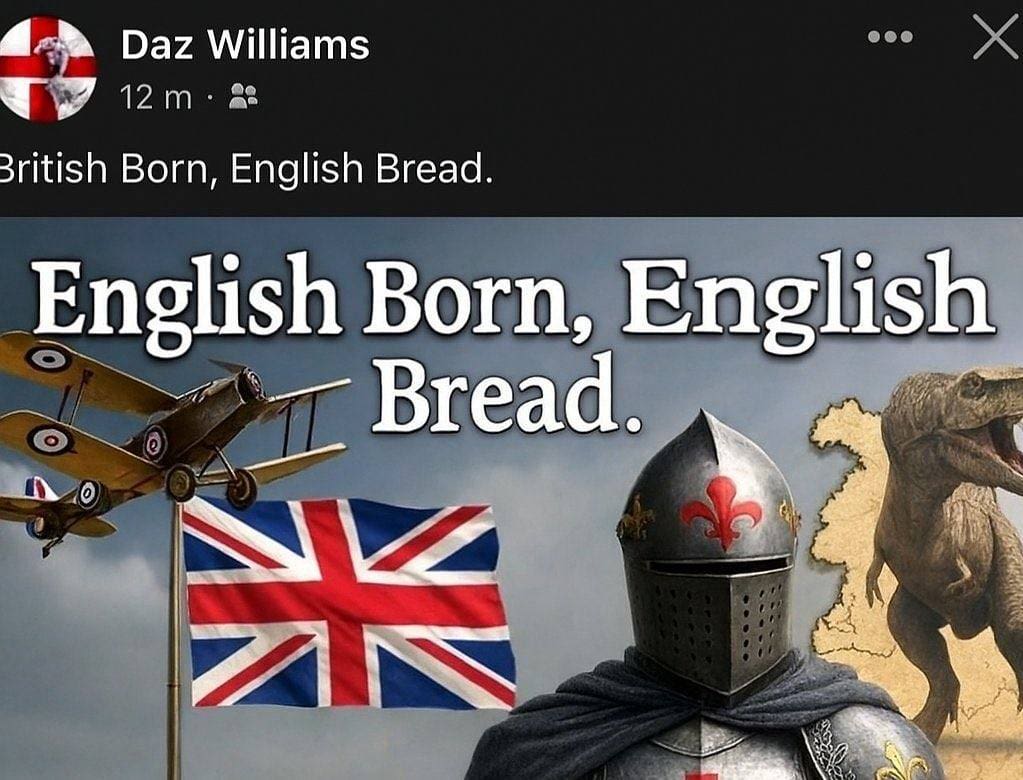
‘Could be far left trying to discredit the patriotic worried people re there children and wife’s’.
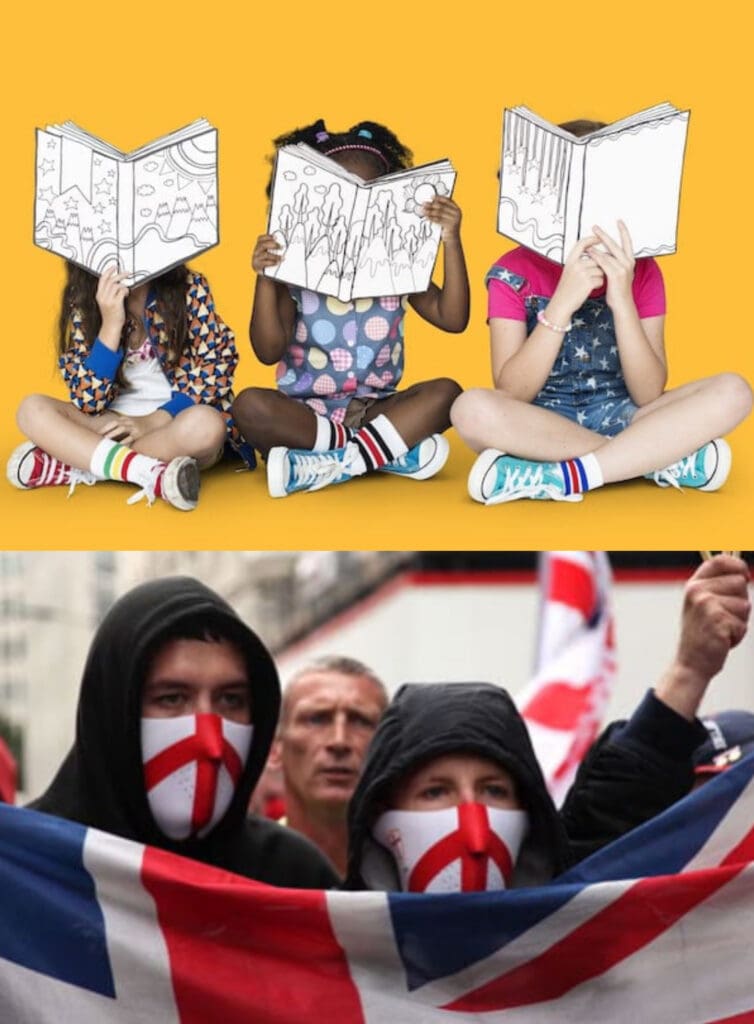
The statement “people can either be far-right or they can be literate, but they cannot be both” is not meant to be a literal, empirical claim about the reading ability of every individual who holds far-right views. Instead, it is a rhetorical and polemical device designed to make a specific argument.
Its core meaning is this: The ideologies of the far-right are so fundamentally based on falsehoods, historical revisionism, emotional manipulation, and a rejection of evidence-based reasoning that a truly literate person, i.e., someone skilled at critical thinking, analysing sources, and understanding complex information, would inevitably see through them and reject them.
In British English, “literate” often implies more than just the ability to read and write; it suggests being well-read, critically engaged, and discerning.
Origins and Context
This kind of adage emerges from a long-standing intellectual tradition that positions fascism and extreme nationalism as anti-intellectual movements. Key influences include:
- The Enlightenment: The far-right, particularly fascism, is often seen as a direct rejection of Enlightenment values like reason, tolerance, scepticism, and universalism.
- 20th Century Anti-Fascism: Thinkers like George Orwell, who fought against Franco’s fascists in Spain, consistently argued that fascism relied on “smelly little orthodoxies” and the abandonment of objective truth for partisan loyalty.
- Modern Discourse: The adage has gained renewed popularity online in response to the rise of populist far-right movements, which are frequently accused of spreading misinformation and “post-truth” politics.
Arguments For the Adage’s Validity
Proponents would argue the following:
- Rejection of Expert Consensus: Far-right positions on climate change, vaccine efficacy, economics, and history often explicitly reject the consensus of experts in those fields. A literate person, they argue, would trust peer-reviewed science over populist rhetoric.
- Reliance on Conspiracy Theories: Much of far-right rhetoric is underpinned by conspiracy theories (e.g., “Cultural Marxism,” “The Great Replacement,” misinformation about COVID-19). Engaging with these theories requires suspending critical evaluation of sources.
- Emotional over Rational Appeal: Far-right messaging often prioritises visceral emotions—fear of the “other,” nostalgia for a idealised past, anger at elites—over rational, evidence-based argument. Literacy, in the broader sense, is about engaging with the argument, not just the emotion.
- Historical Revisionism: Far-right movements frequently distort or deny well-documented historical events (e.g., the Holocaust, the nature of the British Empire). A literate person engaged with historical scholarship would recognise these distortions.
Arguments Against the Adage’s Validity
Critics, and those arguing in good faith, would point out its flaws:
- Intellectual Dishonesty: It’s a sweeping generalisation and an ad hominem attack. It dismisses an entire group of people not by engaging with their ideas but by questioning their basic intelligence and education. This is ineffective persuasion.
- Existence of Intelligent Proponents: History and the present day are full of highly educated, articulate, and “literate” individuals who have held far-right views. They can use their literacy to construct sophisticated, though often flawed, arguments for their ideology. To claim they are “illiterate” is simply false.
- Definition of Literacy: It conflates functional literacy (the skill) with intellectual alignment (the outcome). One can be highly skilled at processing information but come to different conclusions based on foundational values, priorities, or interpretations of that information.
- Misdiagnoses the Appeal: The adage assumes people are far-right because they are stupid or unread. The reasons are often more complex: economic anxiety, cultural displacement, social alienation, and a perception that mainstream sources of authority (government, media) have failed them. A person can be literate and still feel these things.
The British Context
In Britain, this debate plays out in specific ways:
- The Brexit Debate: Claims that Leave voters were “illiterate” or uneducated were common and were heavily criticised. While there was a correlation between educational attainment and voting patterns, it was a vast oversimplification to dismiss 17 million people as illiterate. Many literate, intelligent people voted Leave for reasoned, albeit controversial, arguments.
- Think Tanks and Media: Britain has far-right or strongly nationalist think tanks and publications (e.g., The Salisbury Review, parts of Spiked Online) that are produced by academically qualified individuals. Their arguments are presented in a literate, intellectual style.
- Orwell’s Legacy: Ironically, George Orwell—a hero of the left—is frequently co-opted by the British right, who use his critiques of Stalinism and “newspeak” to argue that the left is now the threat to literacy and free thought. This demonstrates how the tools of literacy can be used by various sides.
To summarise the statement is not literally true. It is a polemical exaggeration, not a factual observation. It is possible to be both highly literate and hold far-right views.
However, the spirit of the adage contains a kernel of a broader truth: that far-right ideology often, though not always, flourishes in an environment where critical literacy—the ability to deconstruct rhetoric, check sources, and think empirically—is low or willingly set aside in favour of tribal identity and emotional satisfaction.
Therefore, a more accurate, though less punchy, formulation might be:
“While it is possible for literate individuals to hold far-right beliefs, the movement itself relies on a widespread rejection of critical literacy, evidence-based reasoning, and intellectual honesty to gain and maintain popular support.”
Ultimately, the adage is best understood as a rhetorical weapon in the culture war, not as a serious tool for political analysis.