
Thomas Aquinas was a Roman Catholic priest, theologian, and philosopher who is considered one of the most important figures in Catholic thought and is known as a Doctor of the Church. He famously stressed the importance of reasoning, stating that it is through the “God-given gift of reason” that we come to understand both political realities and theological truths.
The Book of Enoch has long stirred debates among theologians, historians, and believers. Dismissed in most Western traditions as apocryphal and excluded from the canonical Bible, it has often been labelled a “false” book. Yet, when approached with reason, the very tool Aquinas urged Christians to employ in theological debate, one may arrive at a different conclusion. Instead of dismissing the book outright, it is worth re-examining its origins, significance, and theological contributions.
Applying the framework of asking the “5WH” questions: who, what, when, where, why, and how – we can reason through why the Book of Enoch should not be entirely discredited.
The Historical Background of Enoch
Enoch, believed to be the seventh generation from Adam, is revered in biblical tradition as a man who “walked with God.” The Book of Enoch itself was written well before the time of Christ, with its oldest sections dating from the 3rd century BCE to the 1st century CE. It emerged during the intertestamental period, a time rich in apocalyptic and visionary writings.
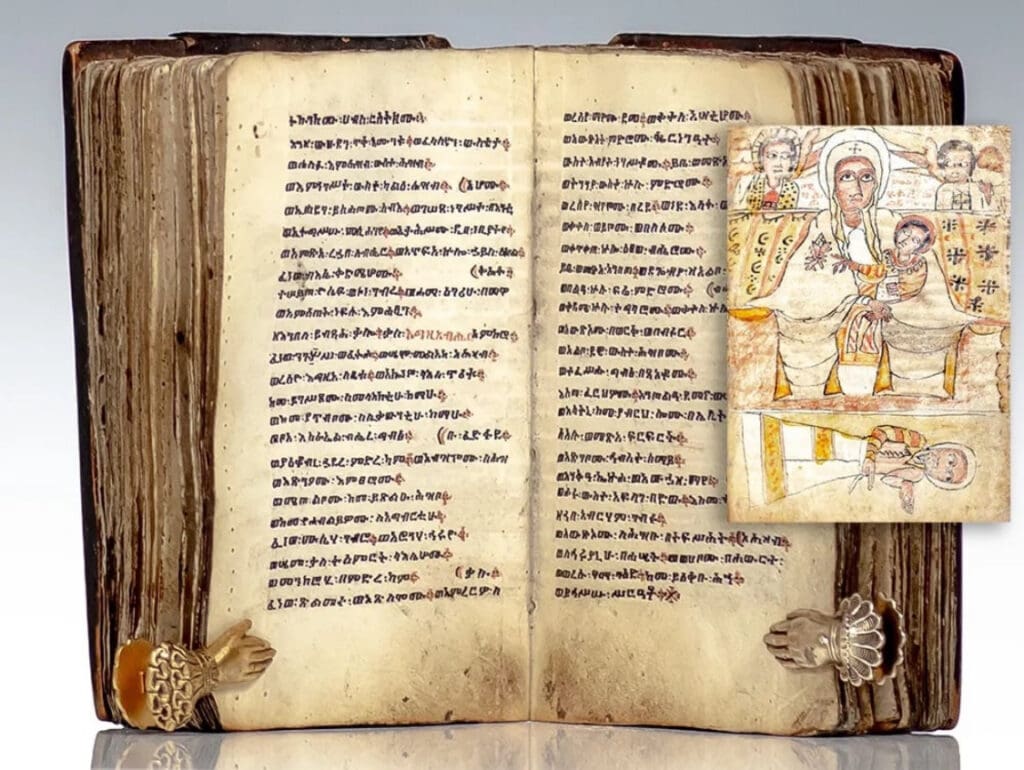
While the book was eventually excluded from most Western canons, it was preserved in Ethiopia. Manuscripts of the book survive to this day, with carbon dating of one version confirming its antiquity, dating between 330 and 650 CE. Among the most remarkable testaments to its preservation is an Ethiopian Bible, handwritten on delicate goatskin nearly 1,600 years ago. Regarded as the oldest and most complete illustrated Christian Bible in existence, it bears witness to a tradition that safeguarded texts often lost to the West. Though its ink has faded and its edges are worn by time, the theological richness of its pages endures.

Reason One: Quotation in the New Testament
The Book of Enoch is not merely an obscure text referenced by fringe traditions; it is explicitly quoted in the canonical New Testament. In Jude 1:14–15, the prophecy of Enoch (1:9) is cited nearly verbatim: “Behold, he comes with ten thousands of his holy ones to execute judgment upon all, and to destroy all the ungodly. ”
For Jude to invoke Enoch’s prophecy is to acknowledge its relevance and authenticity within early Christian thought. This alone should caution against wholesale dismissal of the text. If the New Testament grants Enoch a voice, the book cannot be entirely false.
Reason Two: Continuity with Old Testament Communication
The Old Testament provides numerous examples of God speaking directly to chosen figures. Moses encountered God in the burning bush (Exodus 3:2–5), received the Law on Sinai (Exodus 20), and spoke with God “face to face, as a man speaks to his friend” (Exodus 33:11). These accounts demonstrate a consistent pattern: God communicates divine wisdom through chosen prophets.
Given Enoch’s reputation for righteousness, it is entirely reasonable to suggest that he too was entrusted with divine visions and knowledge. His role as an intermediary between heaven and earth fits squarely within this biblical precedent.
Reason Three: A Theological Syllogism
The argument can be distilled into a logical syllogism:
• Premise 1: Moses, a man of the Old Testament, received direct communication from God.
• Premise 2: God communicated with prophets during the Old Testament period.
• Conclusion: It is therefore plausible that God also communicated with Enoch, whose writings survive in manuscripts dating back to antiquity.
This reasoning aligns with Aquinas’s call to rely on God-given logic and provides a rational foundation for reconsidering Enoch’s writings.
Reason Four: Scientific and Historical Evidence
The survival of the Ethiopian manuscripts, carbon-dated to the early medieval period, offers compelling scientific evidence of the text’s ancient origins. Furthermore, historians remind us that ancient authors typically wrote not with an eye toward fiction or political influence, but to record what they believed to be true – whether visions, revelations, or lived experiences.
Unlike much modern writing, often shaped by ideology or self-interest, texts from antiquity sought to preserve realities as their authors perceived them. This context strengthens the case that the Book of Enoch reflects authentic theological and cosmological insights from its era.
Reason Five: Theological and Ontological Significance
Beyond history and science, the Book of Enoch carries immense theological weight. It addresses themes of divine justice, angelic hierarchies, cosmic order, and the triumph of righteousness, topics that resonate deeply with biblical theology. Its exploration of the unseen realm offers insights into the relationship between humanity, spiritual forces, and God’s sovereignty.
Dismissing the book outright as “false” risks discarding a text that illuminates the intellectual and spiritual environment of Second Temple Judaism and early Christianity. In fact, the book enriches our understanding of how ancient communities wrestled with questions of evil, judgment, and divine order, questions that remain pressing today.
A Call for Reasoned Reflection
Thomas Aquinas emphasized that faith and reason are not in conflict but complementary. It is through reason, he argued, that believers discern reality and engage theology responsibly. Applying this lens to the Book of Enoch, it becomes clear that the text cannot be simply cast aside as a fabrication.
Instead, it should be studied, understood, and appreciated for the insights it offers into the ancient mind of faith. Whether viewed as inspired scripture, apocalyptic literature, or theological commentary, the Book of Enoch deserves a place at the table of scholarly and spiritual discussion. After all, to reject it wholesale without reasoning would be to neglect the very gift Aquinas urged us to use: the God-given gift of reason.