“Civil war is inevitable.” This is the mantra of the extremists on the far right. From supporters of Tommy Robinson to members of Reform UK, the language of civil war is being used as a threat to those who do not allow the far right to take power. The echoes of Nazi Germany just get louder and louder. However, the overriding fact is that the vast majority want nothing to do with it. They just want to get on with their lives.
When Elon Musk posted that “civil war is inevitable” during the 2024 riots in the UK, the reaction was immediate and furious. A spokesperson for Keir Starmer dismissed the comment as unjustified and inflammatory. Much of the media treated it as reckless hyperbole. Yet among sections of the radical right, it was celebrated as truth finally spoken aloud.
Eighteen months later, what once seemed absurd no longer feels fringe. The idea that Britain is drifting toward civil conflict has moved from obscure message boards into podcasts, Substacks, YouTube channels and prime-time interviews. It is now a narrative with numbers behind it.
Polling of 8,000 UK adults in January 2026 found that 35% had heard content discussing the prospect of civil war. Among 18–24-year-olds, the figure was 40%. Among those who voted for Reform UK in 2024, it rose to 54%. Among supporters of Tommy Robinson’s Unite the Kingdom movement, 58% had encountered civil war narratives. For those who “strongly like” Robinson, the number reached 68%.
More concerning still is belief in likelihood. Eight percent of the public think civil war in Britain is “very likely” within five years; another 23% think it “quite likely”. Among Reform UK voters that climbs to 56%, and among those who strongly like Robinson, to 66%.
That does not mean civil war is imminent. But it does mean the expectation of conflict is becoming normalised — and that matters.
The Intellectual Roots of the Narrative
The concept did not originate with Musk. For two decades, strands of the self-described counter-jihad movement have argued that Europe faces inevitable internal war because Islam is allegedly incompatible with Western civilisation. Blogs such as Gates of Vienna circulated apocalyptic fiction and essays predicting communal bloodshed.
The 2011 Norwegian terrorist Anders Breivik cited these writings extensively in his manifesto, believing violence would accelerate a wider European civil war.
More recently, the theory gained new legitimacy when Professor David Betz of King’s College London argued in Military Strategy magazine that Western societies now exhibit core components associated with civil conflict: collapsing trust, polarisation, identity fragmentation and economic malaise. In a widely shared interview on the Maiden Mother Matriarch podcast, Betz went further, suggesting Britain could see serious internal conflict within five years.
His warnings were amplified by commentators across the right. Paul Embery described the argument as no longer fanciful. Douglas Murray warned that Britons risk becoming “homeless in our own house”. Retired Colonel Richard Kemp spoke of looming communal conflict. Even political strategist Dominic Cummings referenced intelligence discussions of racial and gang violence risks.
When high-status voices entertain worst-case scenarios, they lend credibility to what were once fringe fears.
Amplification and Algorithmic Escalation
If Betz intellectualised the concern, Musk globalised it. His posts on X predicting British civil war have drawn tens of millions of views. In one reply, he wrote: “Civil war already began quietly several years ago, but only the other side was fighting.”
Such framing is powerful. It suggests conflict is not hypothetical but underway and asymmetrical. That language resonates strongly among audiences primed by writers like Gad Saad, whose book Suicidal Empathy argues that Western liberalism is facilitating civilisational collapse. Saad frequently blurs distinctions between extremists and ordinary Muslims, portraying demographic change as existential threat.
This rhetoric shifts debate from policy disagreements to survival narratives. Once politics becomes existential, compromise appears betrayal and escalation appears defensive.
The Psychology of Inevitability
The danger is not simply that some believe conflict likely. It is that belief in inevitability can become self-fulfilling.
Among respondents who think civil war is “very likely”, 71% believe multiculturalism is failing, 75% think immigration has been bad for Britain, and 76% believe there are areas governed by Sharia law where non-Muslims cannot go — a claim repeatedly debunked but widely circulated online. Among Robinson supporters who see war as very likely, 59% say political violence can be necessary in certain circumstances.
When individuals are persuaded that:
- Their culture is under existential threat.
- The political class has abandoned them.
- Conflict is unavoidable.
The psychological barrier to endorsing or participating in violence lowers.
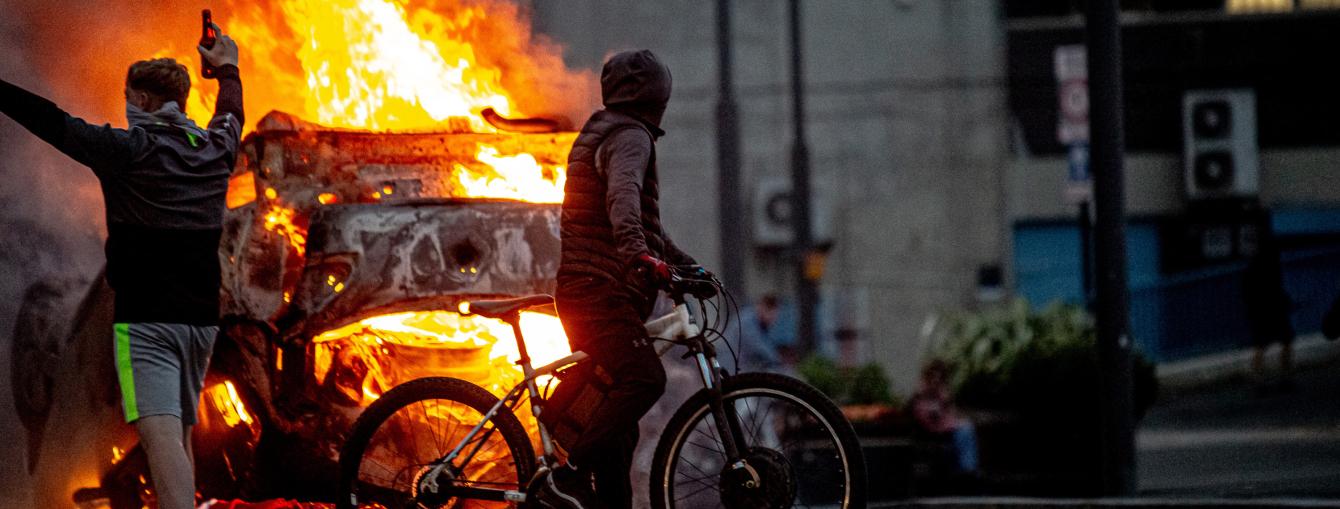
We saw flashes of this dynamic during unrest in Southport in 2024, after the murder of three young girls drew extremists to the town. Similar patterns followed the killing of Lee Rigby in 2013 and during 2020’s Black Lives Matter protests. What might once have remained localised now spreads instantly through national and international networks.
Small far-right “Active Clubs”, blending fitness training with ideological messaging, openly describe preparing for “race war”. Terrorism prosecutions increasingly feature individuals citing civil war fantasies as motivation.
Political Expediency and Polarisation
Civil war rhetoric also serves political ends. Some figures deploy it as a warning: support us or face chaos. Others use it to mobilise anger. French President Emmanuel Macron warned in 2024 that extremist victories could spark unrest, illustrating that apocalyptic framing is not confined to one ideology.
In Britain, polling reveals a worrying openness to strong-leader politics. While 60% overall favour liberal democracy, support for a decisive leader able to override Parliament rises sharply among certain voter blocs. That does not equal authoritarianism, but it reflects frustration with gridlock and distrust of institutions.
Trust erosion, economic stagnation, regional inequality and digital echo chambers combine to create volatility. Regions such as the North East and East Midlands show higher belief in impending conflict, as do people in social housing. Material grievance intertwines with identity grievance.
Resilience — and Fragility
It is important not to overstate the threat. Two thirds of Britons describe their communities as peaceful and friendly. Nearly three quarters enjoy mixing across ethnic and religious lines. The UK retains strong institutions: the NHS, universities, trade unions and local councils that buffer shocks.
Professor Dominic Abrams has argued Britain is adept at absorbing tension. Historically, that has been true. The UK navigated IRA terrorism, economic crises and social upheaval without descending into civil war.
But resilience is not immunity. Digital platforms accelerate outrage, foreign actors amplify division, and domestic opportunists exploit grievance. The concept of civil war has shifted from unthinkable to discussable. That shift alone alters behaviour.
Why the Narrative Itself Is the Risk
The UK may not be on the brink of civil war in the conventional sense, i.e., organised armies battling for state control. But it is on a knife edge in another way: between a society that contains its conflicts and one that begins to expect them.
Expectation shapes action. If enough people believe violence is coming, some will prepare for it. If enough believe politics is a zero-sum existential struggle, moderation collapses.
The most serious danger is not a coordinated nationwide uprising. It is escalating cycles of localised unrest, retaliatory violence and heavy-handed responses that deepen mistrust; it’s a slow burn rather than a single explosion.
Preventing that trajectory requires more than policing. It demands credible political leadership, economic renewal, cross-community engagement and a clear narrative of shared identity that does not deny diversity but integrates it.
Civil war is not inevitable. But the casualness with which the phrase is now deployed reveals something deeply unsettled in Britain’s political culture. When talk of internal war moves from the margins to dinner tables, from anonymous forums to billionaires’ feeds, it signals a society wrestling with its cohesion.
The knife edge is not destiny. It is a warning that we must not ignore.