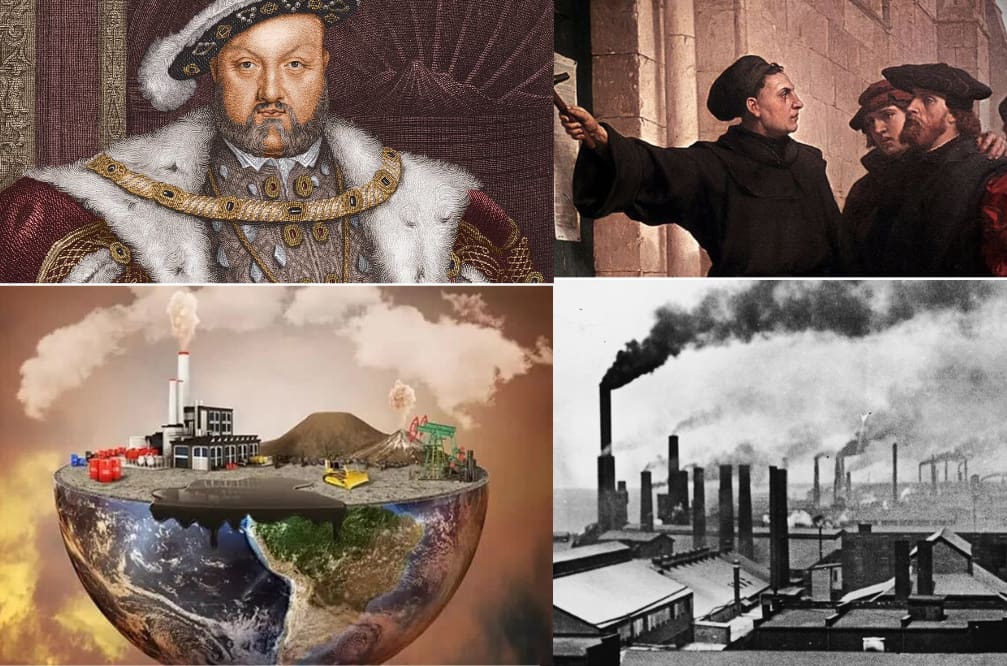
In the tumultuous tapestry of human history, it is rare that religious upheavals and environmental crises are spoken of in the same breath. Yet, when we examine the long arc from the Protestant Reformation through the rise of modern capitalism and industrial society, we see a chain of ideas and institutions that help explain how humanity arrived at today’s climate emergency. It is a story that begins with theological revolt and ends with an unsustainable reliance on fossil fuels that is driving global climate breakdown.
I. The Reformation: Breaking With Rome, Not With the World
On 31 October 1517, Martin Luther, a German monk, nailed his 95 Theses to the door of the Castle Church in Wittenberg, challenging the Roman Catholic Church’s sale of indulgences and assertions of clerical authority. This act is commonly taken as the opening salvo of the Protestant Reformation, a series of religious ruptures that would reshape European Christendom. Crucially, it also reconfigured how people understood their place in the world.
Luther’s emphasis on justification by faith alone subverted the medieval Catholic model in which the church – its sacraments, hierarchy and ascetic withdrawal from worldly concerns – mediated salvation. Instead, Luther and other reformers asserted that believers had direct access to God and that all vocations, including secular work, had spiritual significance. In Luther’s theology, no job was inherently secular: farmers, merchants and artisans could serve God through diligent labour and honest life. This was a subtle but profound shift — one that helped erode the medieval divide between the sacred and the secular.
At roughly the same time in England, Henry VIII severed ties with the papacy, establishing the Church of England after the Pope refused to annul his marriage to Catherine of Aragon. This was a political as much as a religious rupture, empowered and administered by Thomas Cromwell, Henry’s chief minister. In dissolving monasteries and appropriating church lands, Henry and Cromwell helped dismantle the institutional pillars of medieval Catholic society in England — institutions that had long anchored economic and social life in agrarian communities.
Together, this combination of theological and political fragmentation helped transform Europe’s social fabric: religion was no longer the sole frame for meaning and authority, and individual vocation, including economic activity, was newly valorised.
II. The Protestant Ethic: Work, Worldliness and Weber’s Metaphor
Here sociologist Max Weber (1864–1920) brings intellectual clarity to a connection often overlooked: the link between early Protestant thought and the rise of modern capitalism. In The Protestant Ethic and the Spirit of Capitalism (1904–05), Weber proposed that a distinctive ethic developed in Protestant regions, especially under Calvinism, that emphasised hard work, discipline, thrift, and the valorisation of everyday labour.
According to Weber, some strands of Protestant theology, particularly Calvinist doctrines of predestination, created psychological pressure on believers to seek signs of being among the “elect”. This led to a deep commitment to disciplined work and an aversion to frivolous consumption; traits that Weber argued laid the cultural groundwork for capitalist enterprise. In this worldview, accumulating wealth was not merely acceptable but could be seen, mistakenly, Weber suggested, as a potential sign of divine favour.
It is vital to note that Weber himself did not argue that Protestantism caused capitalism in a simple, deterministic way; rather, he identified an “elective affinity”; a mutually reinforcing set of attitudes and behaviours that made Protestant regions receptive to capital accumulation and rational economic organisation.
Weber likened this emerging logic not to greed or avarice but to a rationalisation of life in the world: ordinary labour and economic activity became morally meaningful and subject to systematic organisation and calculation. Pre-Reformation Christendom had tended to valorise spiritual contemplation and monastic withdrawal from secular life; Protestant reformers (especially Luther and the Calvinists) instead sanctified work in the world.
In Weber’s schema, such a mindset contributed to the emergence of what he called the “spirit of capitalism”; a distinct cultural ethos that prized diligence, calculation, reinvestment of profits, and long-term economic planning.
III. Capitalism, Industrialisation and the Coal Age
Long before 1750, Europe had seen commercial growth, urbanisation and financial innovation. Yet it was the Industrial Revolution, beginning in Britain in the late 18th century and spreading across Western Europe and North America, that fully institutionalised mechanisms of large-scale production, mechanised labour, and fossil fuel-powered industry.
Starting around 1760, economies began shifting from agrarian modes of production to industrial ones: coal powered steam engines, iron production surged, textile factories multiplied, and railways knitted together regional markets. This transition was not merely technological, but organisational: factory discipline, division of labour, and investment in machinery embodied the rationalising ethos Weber had described; a world in which labour and capital were systematised, measurable and profit-oriented.
Today historians recognise that the Industrial Revolution was driven by a complex interplay of factors ie geography, natural resources (especially coal), political stability, colonial markets, and financial institutions as well as cultural forces; Weber’s work ethic thesis offers one interpretive lens rather than a comprehensive explanation. Nevertheless, his critique remains influential in understanding how cultural values intersected with material conditions to enable capitalism’s explosive growth.
One might argue that the Reformation’s valorisation of worldly labour helped undermine medieval assumptions about vocation and the proper relationship between the individual and the community, indirectly facilitating a cultural environment receptive to capitalist enterprise. In this sense, Protestantism’s world-embracing logic played an important role, even if the causal chain was neither simple nor inevitable.
IV. Industrial Power and the Origins of the Climate Crisis
The Industrial Revolution did not just transform how goods were made, it transformed the Earth’s atmosphere.
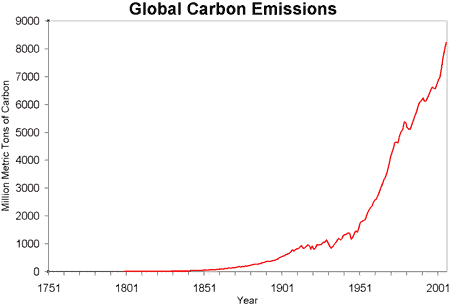
Before 1750, carbon dioxide (CO₂) levels in the atmosphere hovered around 278 parts per million (ppm). Since industrialisation, the concentration of CO₂ has climbed dramatically, now exceeding 420 ppm, roughly 50% higher than pre-industrial levels. This unprecedented increase is attributable to the burning of fossil fuels (coal, oil and gas) and industrial processes, and scientists link it directly to rising global temperatures and climate destabilisation.
Data on CO₂ emissions illustrate the scale of this change. Between 1750 and 2022, human-produced CO₂ emissions rose from near negligible levels to tens of billions of tonnes per year. Before the Industrial Revolution, emissions were very low; by 1950, global emissions had reached about 6 billion tonnes annually, and today they exceed 35 billion tonnes each year.
Moreover, global CO₂ emissions in 2022 were roughly 182 times higher than in 1850, showing the explosive growth driven by industrial and economic expansion.
This dramatic rise in greenhouse gases has increased the greenhouse effect, trapping more heat in the atmosphere, raising global average temperatures, accelerating ice melt, increasing sea levels, and driving more extreme weather events; collectively known as climate breakdown. The World Meteorological Organisation’s 2024 report confirmed that planet-heating pollutants are at record levels, reinforcing that ongoing fossil fuel combustion continues to drive warming.
V. From Mercantile Trade to Full-Blown Capitalism
Historically, capitalism took shape in stages. Early modern Europe’s mercantile capitalism (roughly 16th–18th centuries) involved expanding trade networks, colonial markets and proto-industrial production, largely fuelled by imperial trade and state-sponsored commercial enterprises.
With the Industrial Revolution, this mercantile stage deepened into industrial capitalism, wherein production itself became mechanised, capital-intensive, and fossil-fuel dependent. Banks and financial markets facilitated massive investment in industrial infrastructure, enabling economies of scale that dwarfed earlier artisanal or trading enterprises.
Weber’s contribution to understanding this shift lies in foregrounding the cultural shifts that accompanied economic transformation. By seeing work as a moral calling and profit as a legitimate worldly goal rather than spiritual corruption, Protestant regions (by the early modern era) were predisposed to adopt and innovate capitalist institutions, from joint-stock companies to modern banking.
While Weber did not see Protestantism as the sole cause of industrial capitalism and indeed acknowledged the importance of technical, institutional and political factors, his thesis remains a compelling framework for understanding how ethical dispositions helped normalise capitalist rationalisation.
VI. The Long Shadow: Environmental Consequences of Industrial Capitalism
Capitalism’s historical evolution, from early mercantile ventures to today’s globalised industrial complex, relied on continuous expansion of production, consumption and energy use. This model drove imperial extraction, colonial exploitation, and systemic inequalities; it also institutionalised fossil fuel use as the foundational energy source of modern economies.
The climate impact cannot be overstated. The sharp rise in greenhouse gas emissions since the Industrial Revolution is the primary cause of modern global warming; a conclusion supported by atmospheric measurements and climate science.
This chain, from Reformation to emissions, is not linear or monocausal. Yet it highlights a crucial point: ideas about the world, economic organisation and human purpose can have enormously consequential material effects over centuries. The Protestant emphasis on rational labour and worldly vocation contributed to cultural predispositions that helped legitimise capitalist enterprise and capitalist enterprise, once unleashed on an industrial scale, became fossil fuel-dependent and ecologically transformative.
VII. Conclusion: An Unfinished Legacy
It would be simplistic to claim that climate catastrophe was caused by Luther, Henry VIII or Cromwell alone. But the intellectual lineage from Reformation values to the capitalist industrial order reminds us that belief systems shape long-term social structures, economic institutions and environmental trajectories.
Weber’s sociological insights illuminate the cultural substratum of capitalism; the ways in which religious ideas can enable economic systems that later take on lives of their own. And empirical data on CO₂ emissions remind us that the economic expansion born of industrial capitalism has now put the Earth’s climate system in peril.
In grappling with climate breakdown today, therefore, we confront not only the consequences of industrial technology and fossil fuel dependency, but also the deeper genealogies of values, social organisation and economic imperatives that made it thinkable and seemingly inevitable. The challenge of our age, then, is to rethink not only energy systems but the very foundations of an economic ethos that, for centuries, has prioritised growth over ecological balance.
Sources
- Weber, Max. The Protestant Ethic and the Spirit of Capitalism (1904–05).
- Protestant Ethic, Encyclopædia Britannica.
- Modernisation and Protestantism link, Encyclopædia Britannica.
- Our World in Data: Historical CO₂ emissions.
- WRI analysis on historical CO₂ emissions growth.
- Climate.gov atmospheric CO₂ data.
- WMO report on record greenhouse gas levels.
Update:
Planet Earth has just endured its third-warmest year on record, with 2025 averaging 1.47°C above pre-industrial levels, perilously close to the 1.5°C limit governments promised not to breach. Antarctica recorded its hottest year ever, shattering the illusion that any part of the planet is insulated from climate breakdown. The heat supercharged extreme weather: deadly monsoon floods in Pakistan, a more violent Hurricane Melissa in the Caribbean, and “nationally significant” water stress during the UK’s hottest summer on record. With the past three years averaging 1.5°C, scientists now warn the world could lock in this threshold as a long-term reality by 2030; ten years earlier than expected.
What makes 2025 especially alarming is that the El Niño effect had faded, stripping away excuses and exposing relentless, human-driven warming in real time. Every fraction of a degree now amplifies danger, to food systems, homes, insurance, and economic stability. Yet just as the crisis accelerates, political resolve is faltering: the UK’s net-zero consensus has collapsed, and the US is retreating from global climate leadership under Donald Trump. The science is blunt and unforgiving; temperatures will keep rising until fossil fuels are phased out and net-zero emissions are reached. Delay is no longer a debate; it is a decision to accept escalating catastrophe.