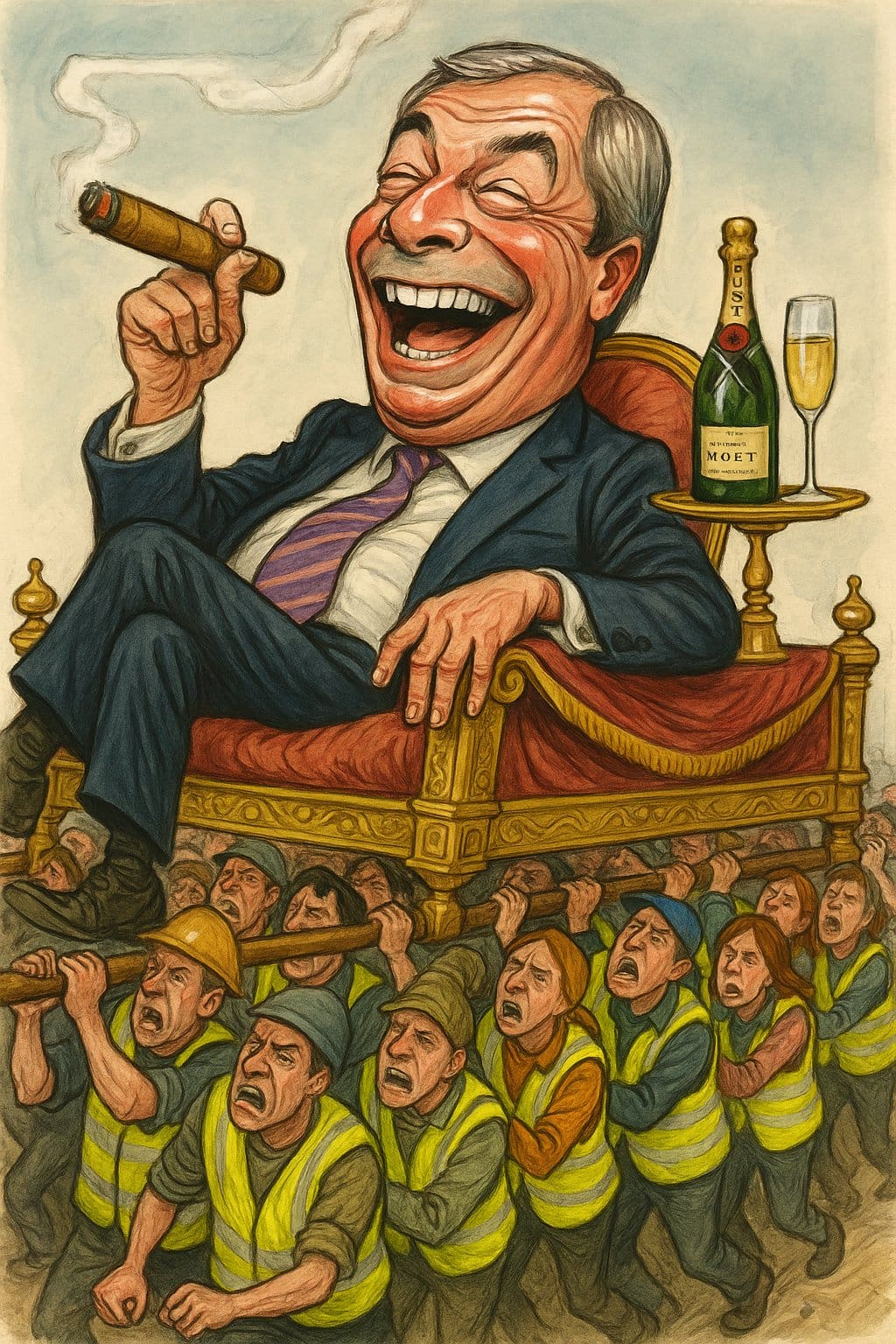
In Britain today, the story of Nigel Farage’s rise is being sold as a populist revolt; a people’s rebellion against a distant, complacent political class. But scratch the surface, and another picture emerges. Farage’s path to 10 Downing Street is not paved by democratic will. It is being carefully engineered by the very forces he claims to rail against: the rich, the powerful, and the entrenched establishment that owns and operates Britain’s corporate media.
The Myth of Populism, the Reality of Power
Farage presents himself as the consummate outsider; pint in hand, voice of the ordinary Briton, enemy of elites. Yet his rise has been anything but organic. Behind the bluster lies a network of billionaires, hedge-fund investors, media barons and offshore tycoons who have a clear interest in promoting his brand of politics. Their goal is straightforward: to dismantle what remains of Britain’s public institutions and replace them with a system that funnels ever more wealth upwards. In this story, Farage is not the architect, but the instrument.
The media: newspapers, broadcasters, and online platforms, are the machinery through which this project is executed. It is here that the conditions for Farage’s rise are manufactured, his ideas normalised, and his image rebranded from fringe agitator to inevitable Prime Minister.
GB News: Hedge Fund Populism Disguised as Free Speech
Perhaps no channel symbolises this process more clearly than GB News. Launched in 2021, it billed itself as a new voice for the unheard majority. In practice, it became a megaphone for Farage and his fellow travellers. Night after night, cultural grievance and anti-migrant rhetoric are presented as mainstream common sense. Farage himself was given his own prime-time slot, effectively blurring the line between politician and broadcaster.
The money behind GB News tells its own story. Majority-owned by hedge-fund manager Sir Paul Marshall (of Marshall Wace) and the Dubai-based investment fund Legatum, GB News was never about grassroots populism. It was about asset protection and profit. Marshall, a billionaire who also poured millions into anti-BBC campaigns, has described the Corporation as a “giant toad” to be broken apart. Legatum, meanwhile, has deep ties to right-wing think tanks and free-market lobbying groups. Between them, they poured tens of millions into creating a channel that could reframe Britain’s political conversation.
Documents filed at Companies House reveal Marshall’s group providing not only capital but editorial influence. Meanwhile, Legatum’s foundation has funded climate change scepticism, “anti-woke” culture war projects, and a network of lobbyists linked to Tufton Street think tanks. The creation of GB News was never about plurality; it was about capturing the narrative.
Ofcom has repeatedly rapped GB News for breaches of impartiality, including politicians presenting news programmes. But these rulings barely dented its influence. The channel has paid Conservative MPs hundreds of thousands in appearance fees, creating a cosy ecosystem where political messaging and media exposure feed into one another. In this world, Farage is not just a guest, he is the central character, his every quip amplified, his worldview unchallenged.
The Telegraph and Spectator: Offshore Mouthpieces of the Right
For decades, the Daily Telegraph and The Spectator have acted as intellectual hubs of the British right. Their ownership history tells us why. Long controlled by the secretive Barclay brothers, both publications were managed from tax havens like Jersey and Monaco. Editorially, they provided relentless support for Conservative governments, austerity, Brexit, and of course, Nigel Farage.
Investigations by Byline Times revealed that the Barclays’ media empire operated through a web of offshore shell companies designed to minimise tax liabilities. This offshore model mirrored the editorial stance of their papers: promoting low tax, deregulation, and a disdain for state intervention. It was never accidental.
The fall of the Barclays due to debt opened the door to fresh buyers. Among the most controversial bidders was RedBird IMI, a consortium fronted by former CNN boss Jeff Zucker but backed by the UAE’s sovereign wealth fund. The prospect of a foreign authoritarian regime effectively owning the Tory press of record alarmed even some Conservatives. Yet the saga underlined a deeper truth: Britain’s key media institutions are not neutral guardians of democracy. They are assets traded among billionaires and offshore interests, each with their own political and economic agendas.
The Spectator, once edited by Boris Johnson, remains a crucible for ideas that later become Conservative policy; from culture war skirmishes to privatisation plans. Farage’s views on immigration and deregulation, once considered fringe, are treated seriously in its pages.
Murdoch: The Original Kingmaker
No discussion of British media power is complete without Rupert Murdoch. For decades, Murdoch’s empire—The Sun, The Times, and until recently, a major stake in Sky—has acted as a kingmaker in British politics. Murdoch himself has admitted he acts as a “traditional proprietor”, personally intervening on major editorial lines such as which party to endorse.
When ministers want access, they line up: Murdoch’s outlets met with government figures over 200 times in just two years, and he met Boris Johnson personally within 72 hours of his election victory. Internal memos from News Corp reveal direct instructions about editorial positioning on Brexit and Scottish independence.
The Murdoch papers have been relentless in stoking the politics of resentment. Migrants, the EU, the Labour left—each has been presented as an existential threat to Britain. Farage’s worldview is not an aberration but the distilled essence of Murdoch’s editorial line, piped into millions of households daily. By the time Farage takes the podium, the work of priming public opinion has already been done.
Even now, with Murdoch’s empire under strain, the culture it fostered remains deeply embedded in Britain’s media landscape. The “Sun says” style of campaigning journalism has normalised the idea that media barons, not voters, set the terms of debate.
The BBC and Sky: The Illusion of Balance
Even broadcasters that present themselves as impartial are not immune. Sky News, though respected for its journalism, has historically reflected the framing of Murdoch’s empire, in which it was a major part until Comcast’s takeover. Editorial culture rarely deviates from the logic of neoliberal economics and a sceptical view of the public sector.
The BBC faces even greater pressure. Legally bound to impartiality, it has nonetheless been drawn into the gravitational pull of right-wing narratives. Its obsession with “balance” has often meant pitting progressive voices against far-right demagogues, giving racism and conspiracy theories the oxygen of legitimacy. As academic studies show, this “both sides” model has steadily shifted Britain’s centre ground rightward.
Behind the scenes, political appointees with links to the Conservative Party have been installed on the BBC board, pressuring it to avoid controversy and to elevate establishment voices. Meanwhile, billionaire-funded campaigns have sought to delegitimise the licence fee, cutting off the BBC’s independence at its roots. As one FT interview revealed, Paul Marshall’s goal is to break the BBC entirely, leaving space for channels like GB News to dominate.
The Tabloids: A Daily Drumbeat of Division
The right-wing tabloids remain perhaps the most potent force of all. The Daily Mail, The Sun, The Express; these papers provide the daily drumbeat of fear and division. Migrants in dinghies. “Woke” teachers. Benefit “scroungers”. Each story, however sensationalised, feeds into a broader narrative: Britain under siege, enemies within and without, salvation only through a strongman.
Ownership again is the key. The Daily Mail is controlled by Lord Rothermere, who lives in tax exile in France. The Sun remains Murdoch’s weapon. The Express, owned by Reach plc, pursues a relentless anti-immigrant, pro-Brexit line. Their editors are not accountable to readers; they answer to proprietors whose wealth depends on tax cuts, deregulation, and keeping Britain hostile to redistributive politics.
By the time election season rolls around, the script has been internalised. Farage does not need to campaign aggressively: the groundwork has been laid for him daily, for years.
The Establishment Behind the Curtain
To view Farage’s rise as spontaneous is to ignore the vast machinery of influence behind him. Hedge funds like Marshall Wace. Investment outfits like Legatum. Offshore tycoons like the Barclays. Global oligarchs like Murdoch. Each controls a slice of Britain’s information system. Together, they create the illusion of plurality while delivering a single, coordinated message: that Farage is not just relevant, but inevitable.
The project is as audacious as it is dangerous. With Farage in power, the path is cleared for further privatisation of the NHS, for the commodification of education, for deregulation of housing and transport. Every corner of public life is treated as a profit-making opportunity. The losers are ordinary Britons, left with rising costs, shrinking services and a political system that no longer answers to them.
Engineering 2029
The goal is 2029. The narrative being constructed is one of inevitability: that Farage is everywhere, that he speaks for the nation, that resistance is futile. Each media outlet plays its part. GB News provides the populist theatre. The Telegraph and Spectator supply intellectual cover. Murdoch’s tabloids deliver mass-market messaging. The BBC, cowed by balance rules, legitimises it. The result is a feedback loop where Farage is not debated but assumed.
This is not journalism. It is stage management. It is not democracy. It is choreography.
The Quiet Coup
What Britain faces is a quiet coup. Not tanks in the streets, but headlines fired repeatedly into our consciouness. Not generals in uniform, but billionaires in boardrooms. Power is not seized but stage-managed, consent manufactured through repetition until it feels like common sense. When Farage finally takes office, it will be presented as the will of the people. In truth, it will be the will of the establishment. The establishment call it democracy but anyone who is even slightly awake knows that it is something very different.