
On a Friday night in Orpington, chants of “get them out” and “save our children” echoed outside the TLK hotel, where asylum seekers are being housed. On one side, anti-immigration protesters waved placards demanding the “abolition of the asylum system.” On the other, counter-demonstrators marched with banners reading “Refugees welcome, stop the far right.”
By Saturday morning, the scene was repeating itself across the country. Bournemouth, Bristol, Liverpool, Wakefield, Newcastle, Aberdeen, Cannock, Exeter, and dozens more towns were braced for rallies and counter-rallies, with at least 33 protests planned over the bank holiday weekend. The slogans differ, but the atmosphere is the same: anger, fear, and polarisation.
At first glance, it might look like another chapter in Britain’s long and bitter struggle over immigration. But something more troubling is unfolding. These scenes are not just about hotels, or small boats, or asylum policy. They are the visible product of a much larger political strategy, one that Reform UK has seized upon with ruthless calculation.
The scapegoating machine
Nigel Farage is promising “mass deportations” — five flights a day, thousands of people expelled — if his party ever forms a government. He has vowed to tear Britain out of the European Convention on Human Rights (ECHR), dismissing international law and its safeguards as a burden.
When asked if this would mean deporting Afghan nationals at risk of torture or death, his reply was chilling: “I’m really sorry, but we can’t be responsible for everything that happens in the whole of the world.”
This is not the language of pragmatism. It is the language of dehumanisation. Asylum seekers are no longer treated as people with histories, families, and traumas, but as an amorphous “problem” to be removed, loudly and visibly, for the cameras.
And crucially, it is a distraction.
The rights at stake
The European Convention on Human Rights was not drafted for “foreigners” or “outsiders.” It was born from the ashes of the Second World War, when Britain and its allies swore never again to allow governments unchecked power over life, liberty, and justice.
The rights it enshrines—freedom from torture, the right to a fair trial, and freedom of expression—are not partisan luxuries. They are the very guardrails that protect ordinary citizens from abuse by the state.
Leaving the ECHR would not just harm asylum seekers. It would harm everyone. It would mean ministers could rip up hard-won protections, from workers’ rights to privacy safeguards, with minimal recourse.
Yet by training the spotlight on small boats and asylum hotels, Reform UK diverts attention from this much more radical agenda.
The privatisation project
For all the noise about immigration, the heart of Reform UK’s project lies elsewhere: in the wholesale remodelling of Britain into a deregulated, privatised economy where profit trumps the public good.
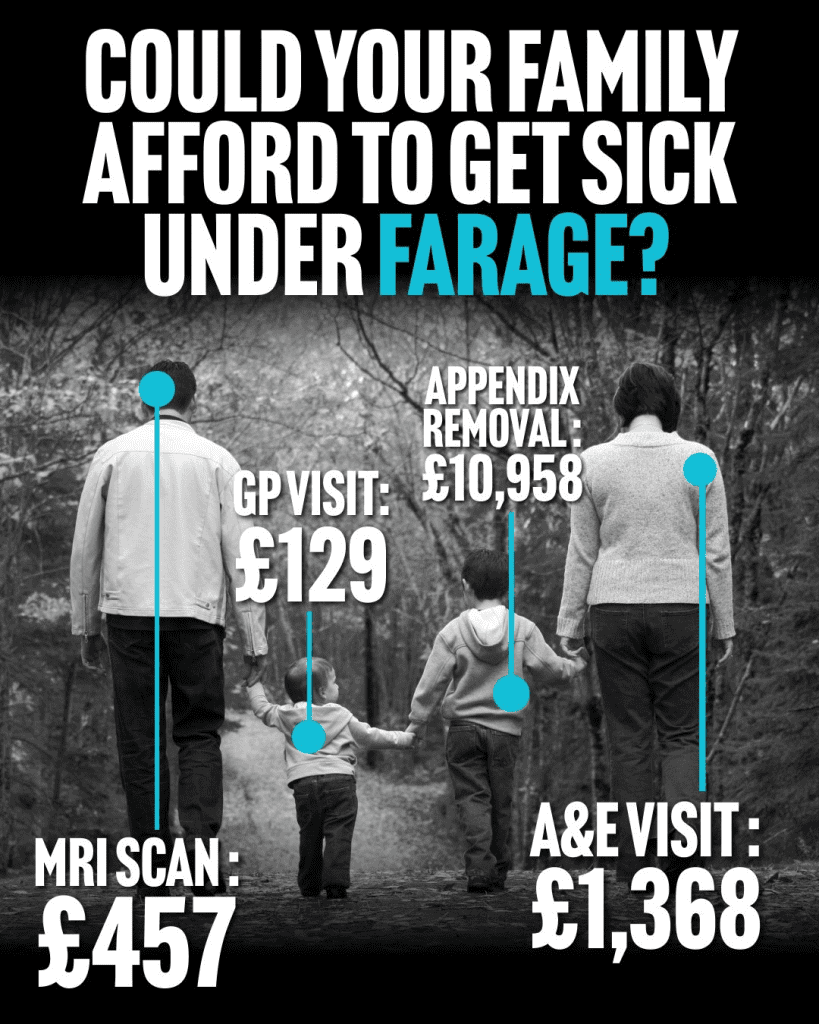
Farage himself has long championed the American healthcare model. Senior Reform figures have floated the idea of “insurance-based systems” to replace parts of the NHS. Their broader economic platform hinges on reducing the state to a shell, outsourcing public services to private firms, and stripping back regulations in the name of “freedom.”
That is why the outrage over asylum seekers is so useful. It generates heat without light. It keeps the headlines focused on “invasions” and “illegals,” rather than on the quiet dismantling of public services and social protections that would directly harm millions of Britons.
The media’s complicity
Sections of the press amplify this dynamic. Coverage of asylum protests rarely dwells on the facts: that Britain takes far fewer asylum seekers than most European nations; that the rise in hotel use reflects bureaucratic backlog rather than “invasion”; that asylum seekers are overwhelmingly ordinary people fleeing extraordinary danger.
Instead, lurid anecdotes dominate — a crime linked to one migrant, a local row about one hotel. These stories are then weaponised to stoke the sense of national emergency.
Meanwhile, the bigger picture — Reform’s economic agenda, its hostility to human rights law, its vision of a Britain stripped of protections — is barely discussed.
Who benefits from the anger?
It is easy to feel despair at the sight of Britons screaming abuse at strangers who have fled war zones. But the greater tragedy is how deliberately their anger is being redirected.
Councils have legitimate grievances about hotels being imposed without consultation. Communities have a right to ask how resources are managed. But instead of challenging the government departments that make these decisions or the politicians who design the system, the fury is too often aimed downwards — at those with the least power to change anything.

And that suits Reform UK perfectly. Because while Britain shouts at frightened families in hotels, Reform’s leaders can prepare to auction off the NHS, deregulate the economy, and strip away rights.
The real casualty
The asylum debate is often framed as a question of compassion versus control. But in truth, it is a mirror held up to Britain’s political soul. The cruelty shown towards asylum seekers is not only morally corrosive; it is strategically corrosive. It blinds us to the dismantling of the very protections that safeguard all our lives.
Reform UK, like the Tories before them, does not want to fix the asylum system. It wants to exploit it—to keep it broken, visible, and divisive — while pursuing an agenda that would leave Britain less fair, less free, and less humane.
And unless the public sees through this sleight of hand, the real casualty will not be just the asylum seekers vilified outside hotels. It will be the Britain those protesters believe they are defending — a Britain with human rights, universal healthcare, and basic decency at its core.