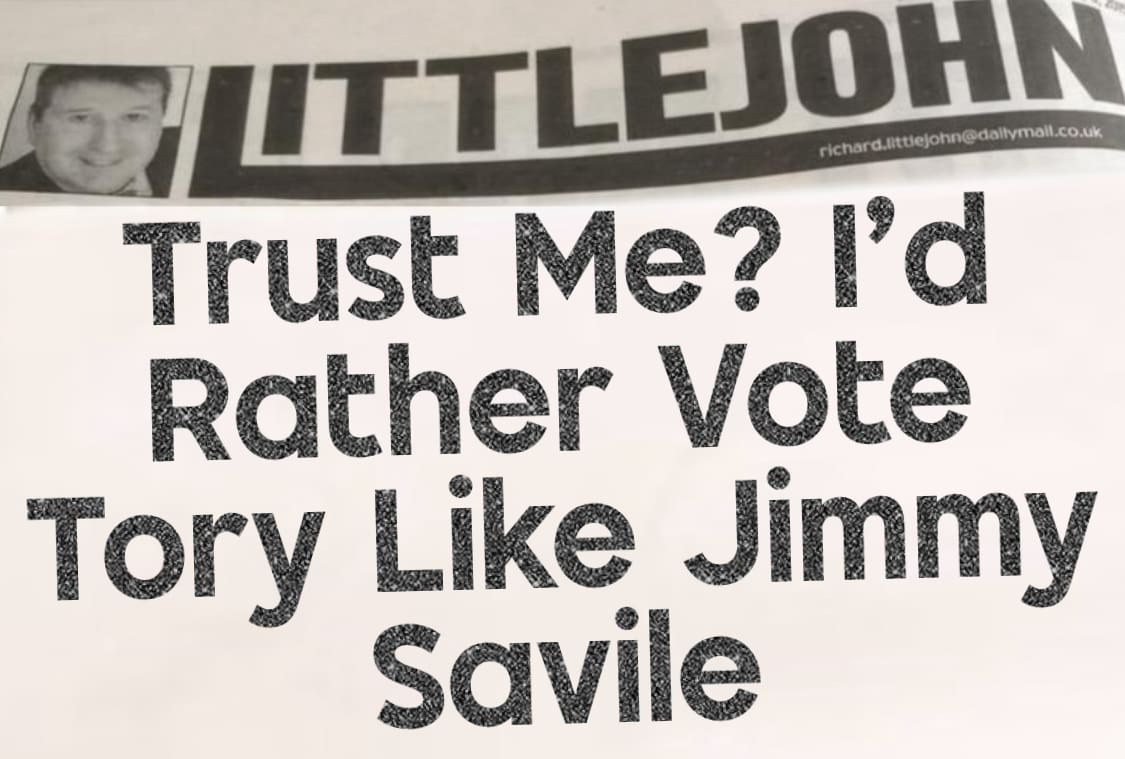
Richard Littlejohn is a columnist for the Daily Mail and a former columnist for The Sun. His career has been marked by numerous controversies relating to his comments on various minority groups. Critics, including fellow journalists, activists, and public figures, have consistently argued that his methodology is not merely polemical but crosses into bullying and vindictive targeting, while his political framing lacks substantive definition.
1. A Pattern of Targeting and Bullying Minorities
A recurring criticism of Littlejohn’s work is that he singles out vulnerable or minority individuals and groups for ridicule and attack, in a manner construed as personal and vindictive.
- The Case of Lucy Meadows: The most stark example involves primary school teacher Lucy Meadows, a transgender woman. In a 2009 column, Littlejohn did not merely comment on a broader social issue but focused directly on her, repeatedly using her former male name and male pronouns. He described her transition as a “personal, self-indulgent, sometimes grotesque decision” and questioned why she was allowed to teach children. The coroner at the inquest into her subsequent suicide explicitly criticised the press, stating, “And to the press, I say shame, shame on you.” Critics argued this was not robust debate, but a direct and cruel bullying of an individual, leveraging her personal life for a column.
- Singling Out Individuals: This pattern extends to other columns where he focuses on specific, often non-public, individuals to make broader points. This includes writing about a transgender woman with the headline “Dinnerlady Discovered He Was Really A Dinnerbloke” and other instances where he names and misgenders individuals. The tactic is criticised as using people as punchlines for a mass audience, exposing them to public scorn and potential harm without their consent.
2. The Construction of “The Left” as a Vague Antagonist
Littlejohn frequently employs the term “the Left” as a catch-all antagonist in his columns. However, analysis of his work shows he often forgoes defining the term or engaging with specific left-wing policies or thinkers.
- Following the Murder of Stephen Lawrence: After convictions in the Stephen Lawrence case, Littlejohn wrote a column dismissing the wider societal impact. He characterised the Macpherson Report’s findings on institutional racism as being exploited by “the Left, anti-police agitators and professional race relations fanatics.” The column did not specify which left-wing groups or politicians he was referring to, nor did it engage with the report’s specific recommendations. Critics argued that “the Left” was used here as a vague flag of disparity—a simplistic label to dismiss complex arguments about racism without substantive engagement.
- A Broad-Brush Pejorative: In his columns on immigration, welfare, and social policy, “the Left” is routinely invoked as a monolithic entity embodying political correctness, woolly liberalism, and an anti-British sentiment. The term is seldom tied to a specific manifesto, policy document, or elected representative, but is instead used as a nebulous bogeyman responsible for societal ills he identifies. This approach allows for the condemnation of a wide range of attitudes and actions without the need to rebut specific, well-formed arguments.
3. Depiction of Asylum Seekers, Migrants, and Travellers
The criticism of bullying extends to his treatment of broader minority groups, where his language is seen as deliberately pejorative and dehumanising.
- Asylum Seekers and Migrants: He consistently uses the term “illegal asylum seekers,” a phrase critics point out is often inaccurate and inflammatory. His framing of asylum seekers as a threat or a burden—describing Britain as a “soft touch” and a “hotel for the world’s waifs and strays”—is seen as a vindictive characterisation that ignores the complexities of international law and individual circumstances. The tone is interpreted not as constructive criticism of policy, but as scornful dismissal of people seeking safety.
- Traveller Communities: His repeated use of slurs like “pikeys” and “tinkers” to describe Traveller communities, alongside columns that almost exclusively associate them with criminality, is cited as evidence of a vindictive and bullying stance. Critics argue this is not social commentary but the reinforcement of bigoted stereotypes against a marginalised group.
4. Regulatory Findings and Public Condemnation
The public and regulatory response to his columns further illustrates the perception of his work as harmful.
- The press regulator IPSO has found against him for inaccuracy, notably in a 2015 column about a transgender woman.
- While many discrimination complaints have not been upheld due to protections for opinion, the volume of complaints and the consistent condemnation from figures in public life, including MPs and equality charities, underscore the view that his journalism operates as a form of powerful, institutional bullying targeted at minorities.
Bigotry For The Bigots
The accumulated evidence of Richard Littlejohn’s career presents an inescapable conclusion: this is not the work of a mere provocateur or a simple contrarian. It is a sustained project of prejudice, one that deliberately seeks out society’s most marginalised to cast them as villains in a manufactured culture war. The bullying of individuals like Lucy Meadows, the dehumanising slurs directed at Travellers, and the cynical misrepresentation of asylum seekers are not isolated lapses in taste; they are the foundational bricks of his column.
His method relies on a deliberate, two-pronged strategy: first, the vindictive targeting of individuals too vulnerable to fight back against the might of the Daily Mail, and second, the deployment of a nebulous, all-purpose “Left” as a spectral enemy to justify any cruelty. This is not political commentary. It is a moral abdication disguised as common sense, a licence to hate masquerading as free speech.
The tragedy is not that such views exist, but that they are granted a prime platform in one of the nation’s most influential newspapers. Littlejohn’s work does not simply reflect bigotry; it institutionalises it, launders it, and serves it up to millions as a legitimate worldview. The coroner’s plea of “shame” after Lucy Meadows’ death was a verdict that extended beyond one column. It stands as a permanent indictment of a journalism that trades in dignity for destruction and of a commentator whose legacy is written in the pain of those he has chosen to persecute.