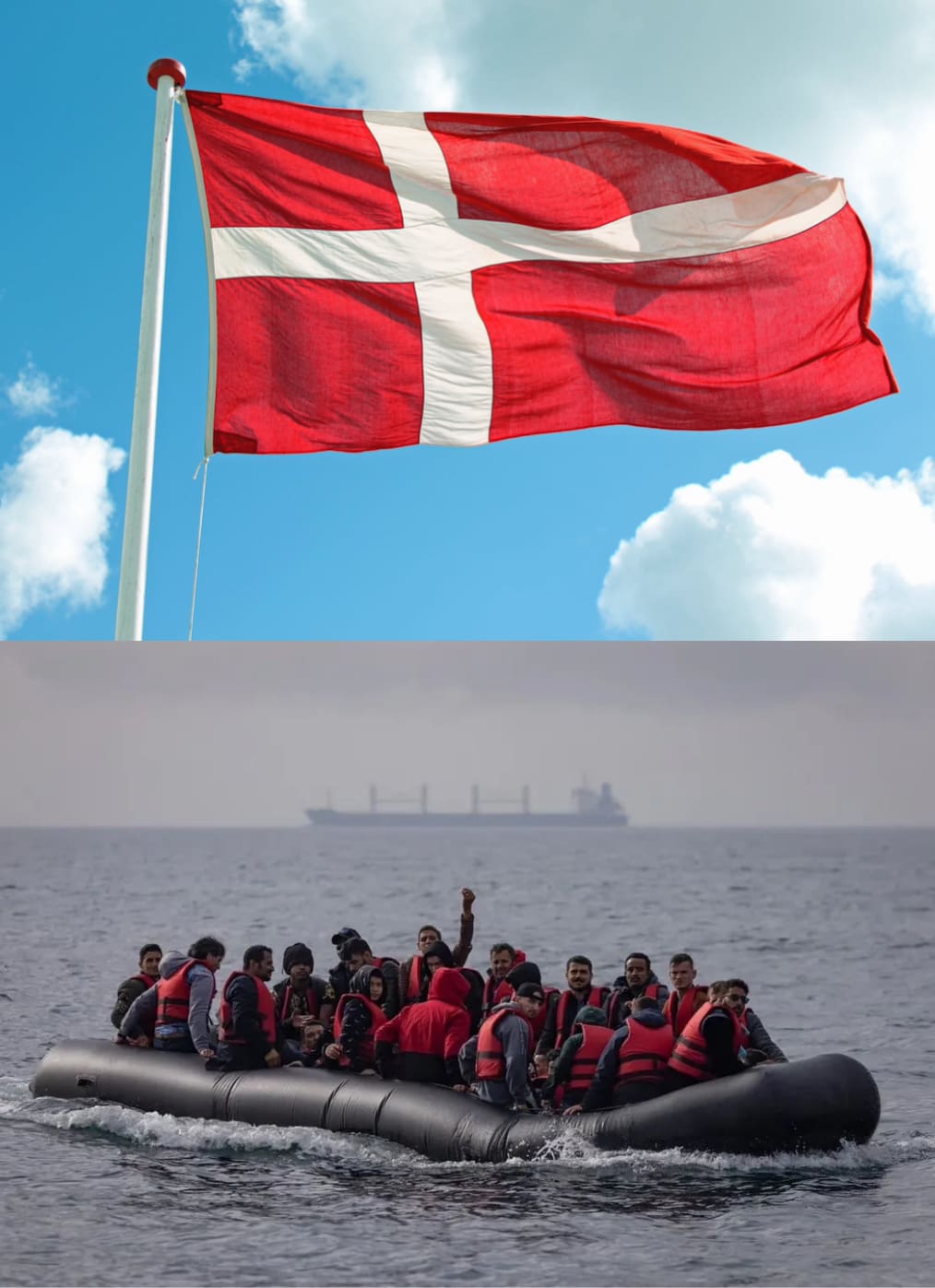
Facing explosive public anger over small boat crossings and asylum hotels, Keir Starmer’s government is desperate for a solution. With the rampant rise of Reform UK and plummeting approval ratings, the new Labour administration has looked north for inspiration, explicitly modelling its emerging asylum policy on the tough approach of Denmark.
While politically tempting, this strategy is fundamentally flawed. Transplanting the “Denmark model” to the UK ignores the profound differences between the two nations, making it a recipe for failure on its own terms.
The Danish case is undeniably compelling for a centre-left government battling a populist right. Under Prime Minister Mette Frederiksen, a centre-left leader, Denmark has developed some of Europe’s most stringent illegal migration policies. This “zero refugees” stance has not only proven wildly popular but has also effectively neutered her right-wing opponents. The result? Asylum claims have plummeted to a 40-year low, with 95% of failed claimants deported.
It’s no wonder that figures like Red Wall MP Jo White have enthusiastically welcomed this focus. As she argues, by tackling the issue head-on, a democratic socialist leadership can “fill the space” occupied by the far right and reclaim control of the political narrative. Home Secretary Shabana Mahmood appears to agree; her officials have already travelled to Copenhagen to study Denmark’s tight restrictions on family reunification and its use of temporary visas.
However, this focus on political tactics overlooks the starkly different realities on the ground. The crucial reason the Danish model cannot work in Britain is one of simple geography and connectivity. Denmark is a peripheral EU nation; the UK is a global hub.
Desperate refugees are drawn to Britain for specific, powerful reasons that do not apply to Denmark: they speak English, and they have existing networks of family and friends here. These “pull factors” create a powerful momentum that Danish-style deterrence is ill-equipped to counter. A policy that works in Copenhagen, where the numbers are lower and the incentives different, will crumble when faced with the Channel-crossing phenomenon.
As Steve Smith of the charity Care for Calais argues, “The deterrence isn’t going to work, because you’re dealing with people who are fleeing something far worse. These are desperate people and trying to put in desperate measures isn’t going to work, because those desperate measures can never be as desperate.”
Furthermore, the political context is not as easily transferable as it seems. Denmark’s reputation as one of the world’s happiest countries, the home of hygge and social welfare, provides a form of political cover for its hardline stance—a paradox that a Danish government can navigate more easily. The UK lacks this same foundational cosiness. More importantly, as the revelations about the UK’s Danish-inspired plans emerged, the silence from both the Conservatives and Reform UK was deafening. This suggests an uncomfortable truth for Ms. Mahmood: if the right-wing parties thoroughly agree with your robust approach, you have not outmanoeuvred them, but merely adopted their territory. The goalposts will simply shift.
The Danish model also contains deeply alarming elements that would tear the UK’s social fabric apart. Policies such as confiscating valuables from migrants or demolishing apartment blocks based on the ethnic background of residents have rightly been described by Labour MPs like Nadia Whittome and Clive Lewis as “hardcore,” “dangerous,” and “far right.” While these more extreme ideas are vanishingly unlikely to be on Ms. Mahmood’s agenda, their existence in the Danish system taints the entire model and highlights a philosophical divergence that many in the Labour Party will find unacceptable.
Therefore, the government’s fascination with Denmark is understandable politically but is practically myopic. The UK is not Denmark. Our language, our diaspora communities, and our geographical position create a unique set of challenges. While Home Secretary Shabana Mahmood has promised to do “whatever it takes,” simply replicating a system designed for a different country, with different incentives, is unlikely to break the cycle. It may temporarily appease the far right, but it will not stop the boats, and in attempting to do so, it risks compromising the very principles that should guide a progressive government.