
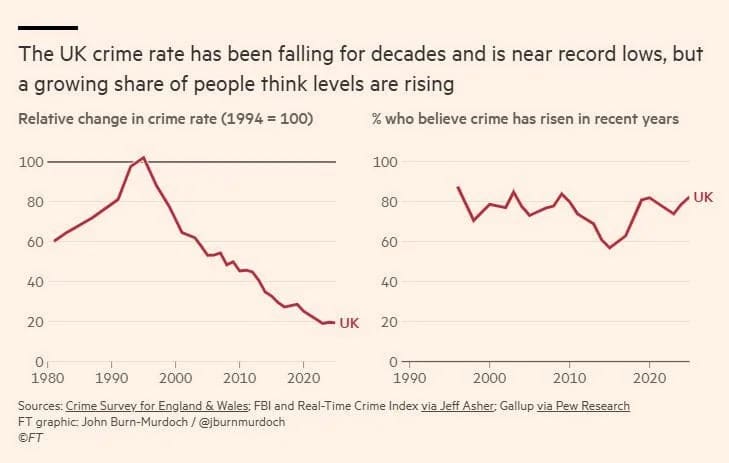
Public perceptions of crime in Britain are persistently out of step with empirical reality, and sociology offers a rich set of explanations for why this gap endures. Rather than treating public misunderstanding as simple ignorance, sociologists locate it within broader structures of media, power, culture and cognition.
A useful starting point is the work of Stanley Cohen, whose concept of moral panic remains central. In his study Folk Devils and Moral Panics (1972), Cohen showed how relatively minor youth disturbances involving Mods and Rockers in the 1960s were amplified by the media into a perceived national crisis. The press constructed “folk devils” and exaggerated the threat they posed, prompting disproportionate public anxiety and punitive responses. Contemporary crime reporting often follows a similar pattern: isolated or statistically rare knife crimes, stranger abductions, or youth violence is framed as evidence of widespread social breakdown. The result is not just misperception but also a socially produced sense of crisis.
This insight connects directly to Stuart Hall and his colleagues at the Centre for Contemporary Cultural Studies. In Policing the Crisis (1978), Hall analysed how the concept of “mugging” in 1970s Britain was constructed as a major social problem despite limited statistical evidence. He argued that crime narratives are not neutral reflections of reality but are shaped by political needs, in this case, legitimising tougher policing and reinforcing authority during a period of economic instability. This aligns with a broader neo-Marxist perspective: perceptions of crime are actively shaped to maintain social order and justify state power.
Media influence is further theorised through the work of George Gerbner. His cultivation theory suggests that long-term exposure to media content, particularly television, cultivates a distorted view of reality. Heavy viewers of crime-heavy media come to believe the world is more dangerous than it is, a phenomenon Gerbner termed the “mean world syndrome”. In a contemporary British context, this effect is magnified by rolling news cycles and social media platforms, where crime stories are not only frequent but algorithmically prioritised for emotional impact.
The role of social media can also be understood through the lens of Zygmunt Bauman. Bauman argued that in “liquid modernity”, individuals experience heightened insecurity due to rapid social change and the erosion of stable institutions. Crime becomes a key site onto which these anxieties are projected. Online environments intensify this process: fragmented, fast-moving information flows create what Bauman might describe as an unsettled sense of threat, where the distinction between local incident and national trend collapses.
From a different angle, Ulrich Beck offers the concept of the risk society. Beck argued that modern societies are increasingly preoccupied with managing risks, many of which are invisible or difficult to quantify. Crime fits neatly into this framework: it is unpredictable, personalised, and often framed as something that could happen to anyone. As a result, even statistically low-probability events, such as violent stranger attacks, loom large in public consciousness. The perception of risk becomes detached from actual probability.
At the micro level, cognitive sociology and social psychology help explain how individuals process information about crime. While not a sociologist strictly speaking, Daniel Kahneman’s work on heuristics is widely used in sociological analysis. The availability heuristic explains why people overestimate the prevalence of dramatic crimes: vivid examples are easier to recall and therefore seem more common. Sociologists integrate this with cultural context, noting that what is “available” to memory is heavily shaped by media and social discourse.
Another important strand comes from Anthony Giddens, whose theory of structuration emphasises the interplay between structure and agency. Public perceptions of crime are not simply imposed from above; they are reproduced through everyday practices, conversations, neighbourhood gossip, and online sharing. Individuals draw on media narratives, but in doing so they also reinforce and circulate them. Perception becomes a recursive process, embedded in daily life.
Fear of crime itself has been a major topic of British criminology. Jock Young, a key figure in left realism, argued that fear of crime is not irrational, even when it exceeds statistical risk. In The Exclusive Society (1999), Young linked fear to social exclusion and relative deprivation. In communities marked by inequality and marginalisation, crime (and the fear of it) becomes part of lived experience. Thus, while national crime rates may fall, localised realities can sustain high levels of fear, contributing to the broader perception gap.
This connects with Loïc Wacquant, who highlights how marginalised urban areas are often stigmatised as “crime-ridden”, both reflecting and reinforcing social inequalities. Media representations of such can lead those outside them to generalise extreme conditions to society as a whole, further distorting perception.
Trust in institutions is another crucial factor. Niklas Luhmann argued that trust is essential for reducing social complexity. When trust in institutions, such as the police or official statistics, declines, individuals rely more heavily on informal sources of knowledge. In the context of crime, this means anecdotes, media narratives and personal networks can outweigh empirical data, widening the gap between perception and reality.
Finally, Michel Foucault provides a broader theoretical frame. In Discipline and Punish, Foucault argued that discourses about crime and punishment are central to the exercise of power. The constant visibility of crime, through news, surveillance, and political rhetoric, serves to regulate behaviour and justify control. From this perspective, the exaggeration of crime is not merely accidental but functional: it sustains systems of governance and social discipline.
Taken together, these sociological perspectives show that the mismatch between perceived and actual crime is not a simple error to be corrected. It is the outcome of interconnected processes: media amplification (Cohen, Gerbner), political construction (Hall), late-modern insecurity (Bauman, Beck), cognitive bias (Kahneman), social inequality (Young, Wacquant), institutional trust (Luhmann), and power relations (Foucault). Public fear of crime, therefore, is not just about crime itself; it is a window into how contemporary society produces and manages anxiety.