

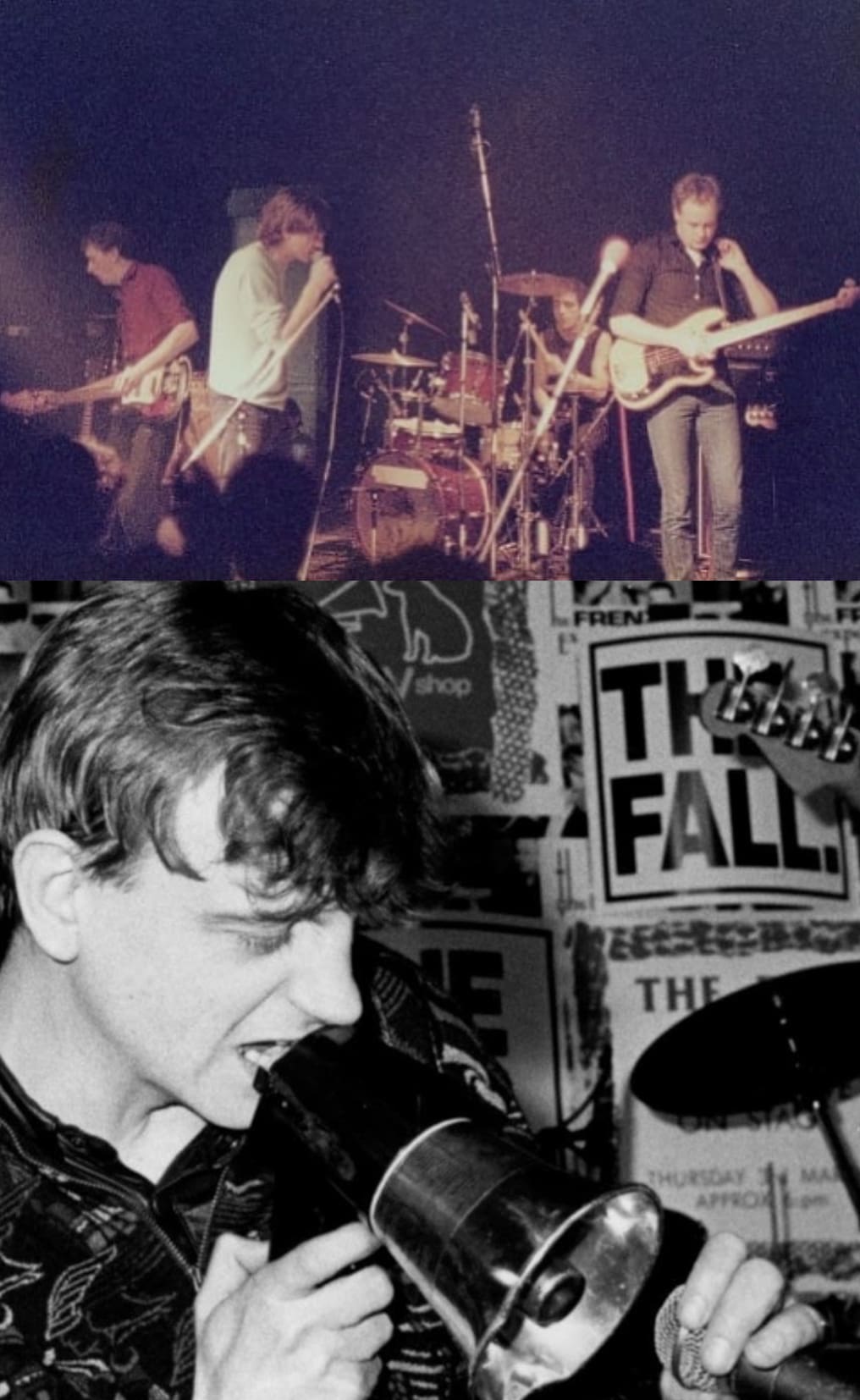
“All any of us were asking of Mark was to stand on that stage for an hour; he didn’t have to do the soundcheck if he didn’t want to, stand there for an hour, or sing the songs,” Hanley says. “At that time, sometimes he was singing the verse over the chorus and the chorus over the verse. That was all we asked of him, and he wouldn’t do it.”
To understand The Fall is to understand a central, brutal contradiction: it was both a vehicle for the singular genius of Mark E. Smith and a “factory,” as bassist Steve Hanley put it, “a factory of resentment.” While public controversies around the band often focused on on-stage violence and abrasive lyrics, the most damning and factual account of the group’s internal dynamics comes from Hanley’s 2015 memoir, The Big Midweek: Life Inside The Fall. Co-written with Olivia Piekarski, the book serves as a meticulous, first-hand chronicle of a two-decade tenure that charts a journey from wide-eyed fan to the band’s musical anchor and, finally, to a weary, exploited employee.
The Human Machinery of the “Fall Sound”
Hanley, who joined in 1979 and became the bedrock of the band’s iconic, grinding rhythm section until 1998, reframes the band’s legendary line-up changes not as creative reinvention, but as industrial-scale burnout. His memoir depicts The Fall not as a collaborative unit, but as a top-down enterprise where Smith was the foreman and the musicians were interchangeable, often uncredited, parts.
- The “You’re Not Wanted” Principle: Hanley details the casual cruelty of dismissals. He describes how members like guitarist Marc Riley, a key contributor, were sacked after minor disagreements, setting a precedent that no one’s job was secure. This created an atmosphere of perpetual anxiety, where artistic contribution was no protection against sudden unemployment.
- The Brix Smith Dynamic: Hanley provides a nuanced view of Brix Smith’s arrival. While acknowledging her positive impact on their commercial fortunes and songwriting, he also details the factionalism it created. The band split into “Mark’s people” and “Brix’s people,” with Hanley often caught in the middle, trying to keep the musical machinery operating amidst the personal schism.
The Physical and Financial Strain
The Big Midweek is forensic in its detailing of the band’s gruelling workload and financial precariousness, controversies far from the glamour of the stage.
- Relentless Touring and Recording: Hanley catalogues an endless cycle of tours and albums, often undertaken in squalid conditions with little regard for the musicians’ well-being. The controversy here was the sheer, grinding exploitation of the personnel required to realise Smith’s prolific vision.
- The Royalty Dispute: Hanley’s account provides factual, damning evidence of the band’s financial inequity. He reveals that after years of service, he discovered his royalty share was a paltry 2.5%, while Smith retained the vast majority. For the bassist whose iconic lines defined songs like “Hit the North” and “The Classical,” this was not a dispute over loose change, but a fundamental lack of recognition for his integral creative role. He frames it not as a rock star complaint, but as a worker’s grievance: “I was an employee, and not a particularly well-paid one at that.”
On-Stage Violence: From Performance to Assault
While public rumours of Smith’s on-stage behaviour were rife, Hanley provides an eyewitness perspective from the heart of the storm.
- The Descent into Real Violence: Hanley describes how Smith’s early, performative antagonism—kicking monitors, snarling at the audience—slowly curdled into genuine aggression directed at his own band. The memoir details specific incidents where Smith would violently shove amp stacks towards musicians, pull out their instrument leads, and swing microphones at their heads, all during performances.
- The 1998 Leeds Incident: Hanley offers a front-row account of the infamous Leeds show where Smith assaulted keyboardist Julia Nagle on stage. He describes the shock and humiliation felt by the band, confirming the public reports and framing it as the logical endpoint of an environment where control had completely dissolved.
The Final Act: Resignation, Not Sacking
Hanley’s departure, after nearly twenty years, is presented not as a dramatic sacking but as a resigned collapse. Exhausted, underpaid, and disillusioned, he describes simply reaching his limit. The ultimate controversy, as laid bare in The Big Midweek, is that The Fall’s most consistent and defining musician—the man who was the “Big Midweek”—was driven to leave by a toxic combination of financial exploitation, psychological warfare, and physical intimidation.
In conclusion, Steve Hanley’s The Big Midweek does not seek to demolish The Fall’s legacy but to correct the record. It shifts the focus from the myth of the tyrannical genius to the factual, grinding reality for the musicians who built the “Fall Sound.” The book stands as the definitive insider’s testimony, revealing that the greatest controversy was not the public outbursts but the private, systematic erosion of the very people who made the music possible. It is a vital document that chronicles not just life inside The Fall but the human cost of its art.







