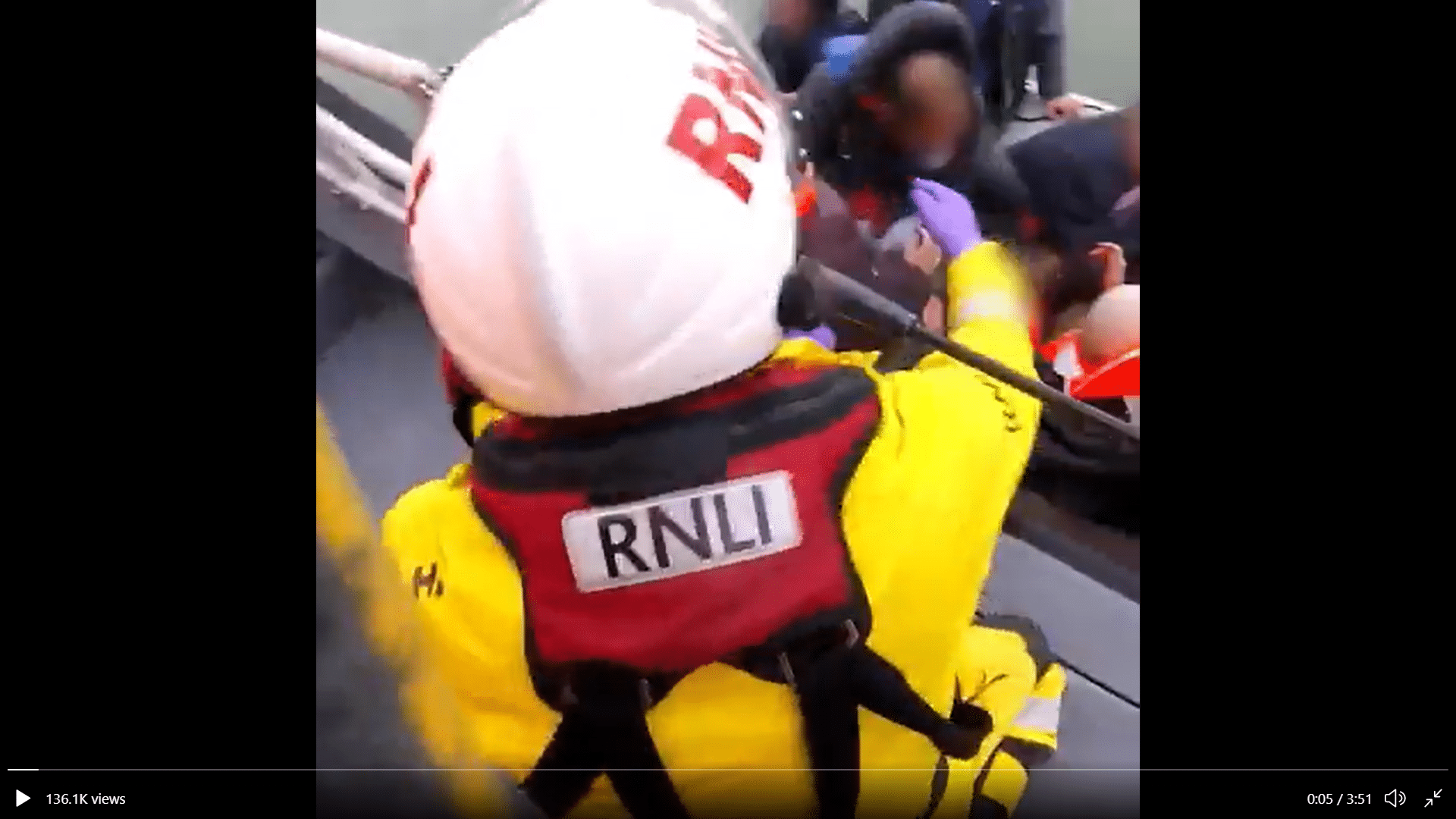
The RNLI saves lives. The far right has tried to turn that lifesaving mission into a political crime. But in Dorset, the public response appears to have been the exact opposite of what its critics wanted.
For more than 200 years, the Royal National Lifeboat Institution has operated according to one uncompromising principle: if someone is in danger at sea, you save them.
You don’t check their passport.
You don’t ask how they got into the water.
You don’t ask whether they are popular.
You save them.
That simple principle has increasingly placed the RNLI in the sights of the far right, particularly over the charity’s involvement in rescuing people attempting to cross the English Channel in small boats.
And in Dorset, the consequences have been very real.
Following the rescue of around 120 people from a small boat incident in the Channel in September, RNLI volunteers and staff became targets of abuse. Protesters gathered in Portsmouth and Poole, while the names and photographs of individual crew members were circulated online, with some branded “traitors”.
The RNLI has now been forced to consider additional security measures at its Lifeboat Support Centre on West Quay Road in Poole.
Planning documents reveal that unauthorised people have gained access to the building by following staff through swipe-card controlled doors. The proposed solution includes a new entrance lobby and three additional security gates.
Think about that for a moment.
A charity whose volunteers regularly put their own lives at risk to save strangers is having to strengthen the security of its buildings because some people are angry about who those volunteers rescue.
Poole Old Lifeboat Museum was also temporarily closed following reports of protesters verbally abusing volunteers.
RNLI chief executive Peter Sparkes has condemned the abuse as “wholly unacceptable”, warning that staff, volunteers and their families had been subjected to threats from people hiding behind “a balaclava or a keyboard”.
But there is a rather significant problem for those attempting to turn the RNLI into an enemy of the people.
The public isn’t playing along.
The financial evidence tells a very different story.
The RNLI’s 2025 accounts show donations of £75.3 million, compared with £71.1 million the previous year. That is an increase of £4.2 million, or almost 6%. Total income and endowments rose from £251.3 million to £286.7 million.
And Dorset provides some particularly striking examples of continuing public support.
In Lyme Regis, the local RNLI fundraising branch raised an impressive £144,000 during 2025 — £18,000 more than the previous year.
That’s a 14% increase.
Meanwhile, the Axe Yacht Club raised £4,590.50 for Lyme Regis RNLI through its events and activities during 2025, including an auction involving local businesses.
These aren’t abstract national statistics.
They are Dorset people putting their hands into their pockets to support the people who may one day be called upon to save them, their families or their friends.
And that is perhaps the most important point of all.
The RNLI has made its position abundantly clear. It is an apolitical charity. It does not determine immigration policy. It does not decide who crosses the Channel. Its lifeboats are tasked by the Coastguard.
In 2025, RNLI lifeboats launched 9,058 times. Only 109 of those launches — 1.2% — involved people in distress in the Channel. The charity says its crews are there to prevent people drowning, while those rescued are handed over to UK immigration authorities.
The far right has nevertheless attempted to transform an act of lifesaving into an act of betrayal.
That is not merely an attack on the RNLI.
It is an attack on the principle that compassion should not depend upon nationality.
And there is a deeply revealing irony here.
The more aggressively some activists have attempted to vilify the RNLI, the more the evidence suggests that communities are standing behind it.
Dorset’s response has not been to abandon its lifeboat crews.
It has been to raise money, organise events, volunteer, donate and show up.
The RNLI was founded in 1824. Its volunteers have continued going to sea in storms, darkness and freezing conditions because somebody needs help.
They don’t get to choose the people they rescue.
Nor should they.
The far right may have succeeded in creating fear, disruption and additional security costs. It may have subjected individual volunteers to appalling abuse.
But if the intention was to destroy public confidence in the RNLI, the evidence so far suggests a spectacular failure.
Because Dorset understands something that should never have needed explaining:
When someone is drowning, you don’t ask whether they deserve to live.
You save them.
And you thank the people brave enough to do it.