
I have a solution to stop all the small boat crossings. My solution is simple. We gun down every boat that tries to cross and let the people drown…. This will prevent others.
If you believe this is uncommon of the far-right supporters of Reform UK, let me introduce you to these lovely people:
or these following the tragic deaths of migrants in the Channel:
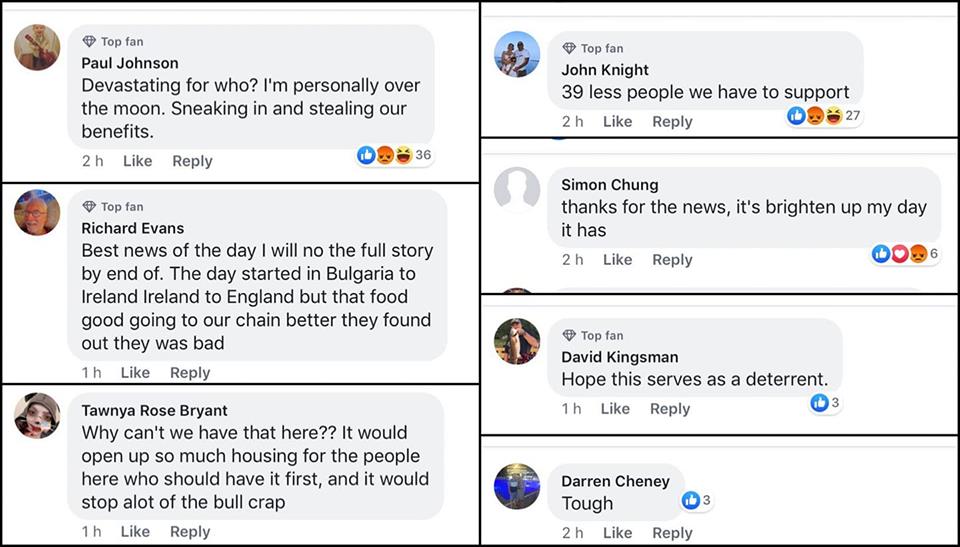
We are standing on the precipice of a moral abyss, and the voices from the dark are no longer whispering; they are dictating policy. An article cannot merely “expose” what is now hiding in plain sight: a significant and vocal faction within Reform UK’s support base does not just want to stop the boats; they are actively fantasising about murdering those who dare to cross the Channel.
The evidence is no longer in coded language but in the stark, psychopathic clarity of public forums and private conversations. Consider the “solution” proposed by one such individual, a manifesto of such chilling callousness it should shock the nation into action: “We gun down every boat that tries to cross and let the people drown.” This is not a fringe rant. It is the logical endpoint of a political project built on dehumanisation.
The proposer at the top of this article, with a utilitarian calmness devised in hell, argues that this single, monstrous act of mass killing would serve as a “deterrent,” saving more lives in the long run. It is the logic of the executioner who claims his axe prevents crime. It is the same moral arithmetic used to justify every atrocity in history: that we must sacrifice our humanity today for a promised, peaceful tomorrow. But that peace can never come, because its foundation would be a nation that has sanctioned state-sponsored mass murder at its border.
This is not a hypothetical. This is the base instinct that Reform UK, through its relentless rhetoric of “invasion” and its demonisation of the desperate, has deliberately cultivated. When their leaders speak of “taking back control,” this is the brutal, unvarnished form of “control” their most ardent supporters hear and crave. The party may distance itself from the most explicit calls for violence, but it pours the petrol of grievance and xenophobia onto the smoldering embers of public anxiety, then feigns surprise when the flames of genocidal fantasy erupt.
The terrifying truth is that for movements like Reform UK, the base instincts of the fringe do not remain there for long. They become the bargaining chips, the rallying cries, and the “common-sense” policies that are focus-grouped and sanitised just enough for the mainstream. First, you talk about “invasion.” Then, you propose off-shore processing in Rwanda. Then, you muse about leaving the European Convention on Human Rights. The trajectory is always, inevitably, towards greater cruelty. The “kill the boats” fantasy is simply the destination towards which this path leads—a Britain where the RNLI is replaced by a naval firing squad, and the White Cliffs of Dover become a monument to our national damnation.
The proposer even lets the mask slip entirely later on in their rant, revealing the true, cynical motivation: such an act would, they admit, “remove the greatest recruitment factor for Reform UK and other far-right-wing political groups.” There it is. The admission that the real problem is not the human tragedy in the Channel, but the political inconvenience it causes. It is also an admission that Reform UK has one siren only: that of demonising asylum seekers. The solution, therefore, is not to address root causes with compassion and competence, but to commit an atrocity so shocking it would win a culture war.
We must now choose what kind of country we wish to be. A nation that meets desperation with bullets and waves is a nation that has already lost its soul. It has traded its collective conscience for a false idol of security and, in doing so, has become the very monster it claims to be protecting itself from.
To regain our humanity, we must first name the beast. We must call this “killing solution” what it is: a call for mass murder. We must reject not only the act itself but the entire spectrum of rhetoric that makes it thinkable. We must demand solutions grounded in the rule of law, international cooperation, and a fundamental respect for human life—the hard, unglamorous work of governance, not the sadistic fantasies of internet trolls turned potential policy.
The siren song of brutality is loud, promising simple solutions to complex problems. But to heed that call is to shipwreck our nation’s soul. The damnation of our society will not arrive with a bang, but with a quiet, collective nod to the idea that some people are simply not worth saving. We must reject this. Our collective humanity, and the future of a civilised Britain, depends on it.
For those who are not persuaded by this call for empathy and understanding, can I suggest that if you still want to play this psychopathic game of killing, then you allow yourselves to be towed on a raft into the middle of the North Sea and you invite others to shoot at you, and then delight as your last bubble hits the surface? Perhaps then you may begin to comprehend what you desire for others.