

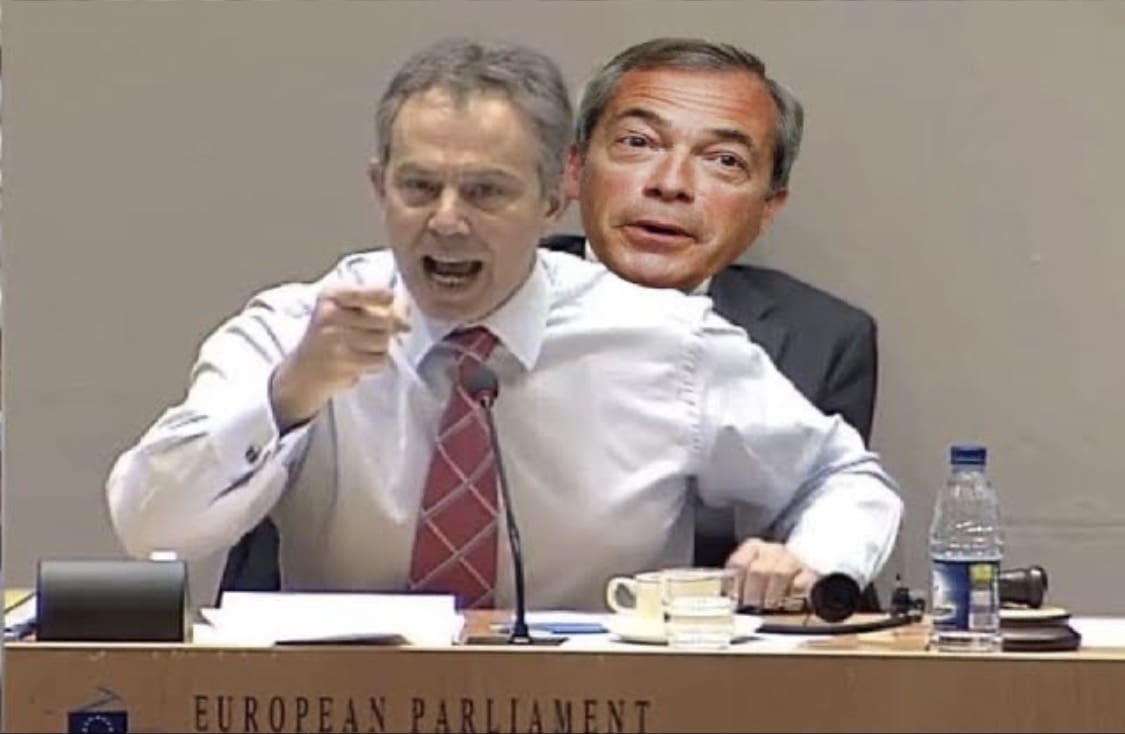
There is something profoundly disturbing about the sight of Britain’s most notorious cheerleaders for foreign wars once again clamouring for the United Kingdom to fall in line behind Washington. As tensions spiral following the American assault on Iran ordered by Donald Trump, two familiar voices have re-emerged to demand obedience: Nigel Farage and Tony Blair.
Both men have built careers on the rhetoric of patriotism and strength. Yet when it comes to war, their instinct is remarkably simple: follow America, ask questions later.
That instinct has already brought catastrophic consequences once before.
The shadow of the 2003 invasion of Iraq still hangs heavily over British politics. The decision by Blair to join forces with George W. Bush in launching that invasion remains one of the most controversial and damaging choices ever made by a British prime minister. It was justified on claims about weapons of mass destruction that never existed, justified through intelligence that was stretched beyond credibility, and justified with promises of stability that quickly dissolved into chaos.
Hundreds of thousands died. A region was destabilised. Extremism flourished in the vacuum left behind. Britain’s international credibility suffered a blow from which it has never fully recovered.
Yet here we are again.
Blair has now criticised the current government for refusing to immediately support American strikes on Iran, reportedly telling an audience that if the United States is “an indispensable cornerstone for your security… you had better show up.” It is a line that sounds eerily familiar. The same logic was deployed in 2003: loyalty to Washington must come first.
But loyalty without judgement is not diplomacy. It is submission.
If anyone should understand the dangers of blindly following American military adventures, it is Blair himself. The Chilcot Inquiry concluded that the UK joined the Iraq war before peaceful options had been exhausted and on the basis of flawed intelligence. The report also exposed how Britain’s political leadership had effectively committed itself to supporting the United States long before Parliament or the public had been properly informed.
In other words, Britain was led into war not by necessity but by political deference.
Blair’s return to the debate therefore carries a heavy irony. For many inside the Labour Party and far beyond it, he is the last person who should be urging Britain to once again “show up” when Washington calls.
Standing beside him in spirit, if not formally in government, is Nigel Farage.
The Reform UK leader has spent the weekend in Florida, reportedly meeting allies of Donald Trump at Mar-a-Lago while attacking the British government for refusing to support the initial American strikes. Farage has long cultivated his relationship with Trump, presenting himself as the British political figure most closely aligned with the former and possibly future American president.
Yet Farage’s enthusiasm for following the United States into conflict raises uncomfortable questions about the brand of sovereignty he so often champions.
For years he argued that Britain must “take back control” from Brussels. Yet when Washington demands military loyalty, that supposed independence suddenly disappears. The message becomes clear: sovereignty is important—unless America wants a war.
It is a contradiction that exposes the hollowness of much of Farage’s rhetoric.
Meanwhile, Trump himself has poured scorn on Britain for refusing to support the opening stages of the Iran attack. In one late-night outburst he dismissed the UK as “our once Great Ally” and sneered: “We will remember. We don’t need people that join wars after we’ve already won.”
The insult has shredded what remains of the carefully managed “special relationship” narrative. It also demonstrates a brutal truth about the politics of military alliances: loyalty rarely earns gratitude.
Trump’s anger appears to stem from the decision by Keir Starmer to refuse permission for American aircraft to use British bases during the initial strikes. That decision, controversial among some Conservatives and right-wing commentators, was based on a simple calculation: Britain should not become involved in another ‘Middle Eastern’ war without a clear legal basis or strategic plan.
It is a position that seems to reflect public opinion. Polling suggests only a small minority of British voters support joining air strikes against Iran. After the experiences of Iraq and Afghanistan, the public has grown deeply sceptical of wars launched with grand promises and little accountability.
For many Britons the lessons of the past two decades are painfully clear. Military interventions framed as quick and decisive rarely turn out that way. They drag on for years, drain national resources and leave devastated societies in their wake.
The Iraq War began with declarations of liberation and ended with sectarian violence, insurgency and the emergence of extremist groups that would destabilise the region for years.
Against that backdrop, the eagerness of figures like Blair and Farage to once again rally behind American military action feels less like leadership and more like historical amnesia.
There is also a deeper issue at stake: the independence of British foreign policy.
For decades politicians have spoken reverently about the “special relationship” between Britain and the United States. At its best, that relationship has produced cooperation on intelligence, defence and diplomacy that benefits both nations.
At its worst, it has created a political culture in which British leaders feel compelled to support American wars simply to demonstrate loyalty.
The result is a dangerous pattern. Washington acts. London follows.
Breaking that pattern requires political courage—the willingness to say no when the circumstances demand it.
That is precisely why the current debate matters so much. Whether one supports the government’s decision or not, refusing to automatically join a military conflict represents a significant shift from the reflexive Atlanticism that defined earlier eras.
For Farage and Blair, however, that shift is unacceptable. Their worldview still assumes that Britain must stand shoulder to shoulder with the United States in every confrontation, regardless of the risks or consequences.
But the world has changed since 2003.
The public remembers the false promises, the manipulated intelligence and the human cost of the Iraq war. They remember how political leaders assured them that intervention would bring stability and democracy.
Instead, it brought chaos.
If Britain has learned anything from the past two decades, it should be this: the loudest voices calling for war are often the least willing to confront its consequences.







