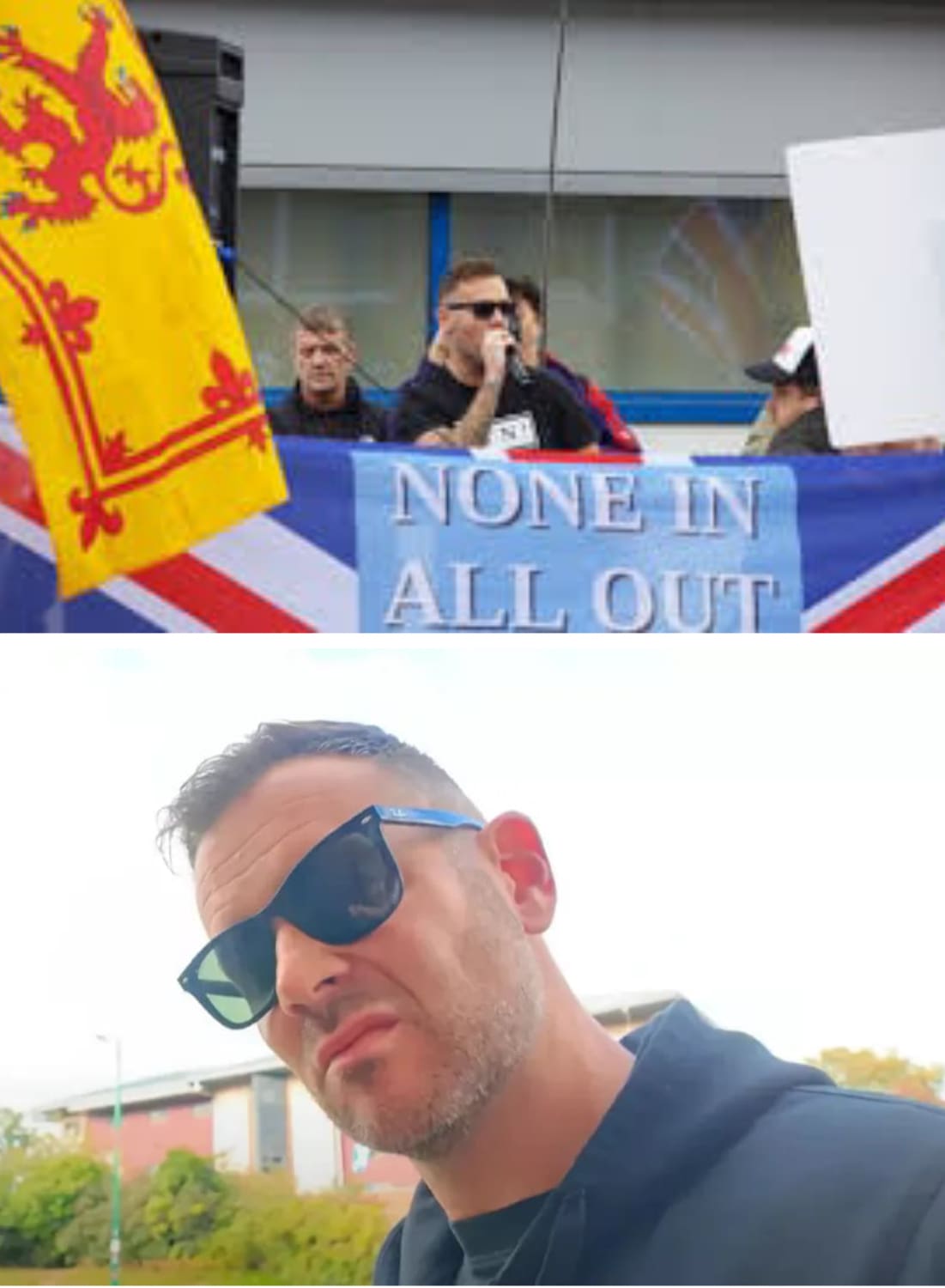
Don’t fall for it!
For years, a recurring theme in anti-immigrant activism has been the insistence that restricting migration is essential for protecting women and children. Campaigners often frame themselves as guardians of vulnerable people, warning of alleged dangers posed by asylum seekers and foreign nationals. Yet, as a growing body of evidence shows, some of the loudest voices in these movements have troubling histories of harming the very people they claim to defend.
The case of the anti-immigration activist John Watt is a stark example—and a reminder of how fear-based campaigns can mask the conduct and motivations of their leaders.
A Self-Styled Defender of Women
John Watt gained prominence during protests at asylum hotels earlier this year, using his podcast Bring the Noise to claim that women were unsafe because of the presence of male asylum seekers. His rhetoric, echoed by followers online, fuelled a climate of anger around accommodation sites in Falkirk and elsewhere.
But behind the public persona of a man supposedly standing up for women’s safety lay a very different story.
It later emerged that Watt had been convicted in 2018 of abusing two women over long periods. The BBC’s Disclosure programme, presented by reporter Mark Daly, aired testimony from one of those women—Watt’s former partner, Laura Shearer. Her account painted a picture of violence, intimidation and explosive temper. Shearer said: “He was a bully. He was a narcissist and his temper would go from one to 100 in a matter of seconds. How can he ask these women if they feel safe when he’s done what he’s done to women?”
His Daughter Speaks Out
Watt’s daughter, Katie, has now publicly condemned him, posting a video on TikTok in which she called him “a narcissist, a manipulator and an abuser.” She said she struggled to reconcile his public claims about protecting women with the man she knew at home. “It really confuses me when he talks about the immigration situation and he says women feel unsafe,” she said. “The person that is out protesting against all these men coming into the country is the one you should be scared of.”
Katie described witnessing his behaviour first-hand, rejecting her father’s assertions that her mother had “manipulated” her views. “I remember everything,” she said. “I’m so glad I do not have that narcissistic, manipulative person in my life.”
Her mother, commenting on the video, praised her daughter’s courage: “We know the truth, as we lived through it, and we have come out the other end.”
A Pattern Beyond One Man
Watt’s case is not an isolated anomaly—it highlights a broader dynamic. Across Europe and beyond, anti-immigrant figures frequently employ the language of safeguarding to justify hostility towards outsiders. They present immigration as a threat to women’s safety, often citing isolated incidents or unverified claims to stoke fear.
Yet research consistently shows that gender-based violence is overwhelmingly perpetrated by partners, ex-partners, family members or acquaintances—not by strangers, and certainly not uniquely by immigrants. Meanwhile, women’s rights organisations have long warned that far-right movements use “protection” of women as a political tool, despite having poor records on supporting survivors or addressing systemic violence.
The contradiction is especially stark when campaigners with histories of domestic or sexual abuse present themselves as moral authorities on women’s safety. In some cases, anti-immigrant activism provides a platform to launder reputations, deflect scrutiny and channel personal grievances into public rage.
Exploiting Fear Harms the Vulnerable
When people like Watt centre their activism on claims about defending women, they are often exploiting genuine concerns to advance an exclusionary political agenda. This does little to address real issues such as domestic abuse, coercive control, under-funded support services or the barriers survivors face in seeking help.
Instead, it diverts attention towards scapegoats—sometimes making migrant women themselves more vulnerable by fuelling hostility, harassment and social exclusion.
Katie put it bluntly when warning her father’s followers: “He comes along as such a lovely, genuine human being. But under all of that, he is a horrible person.”
Reclaiming the Conversation on Safety
The exposure of Watt’s abusive history has prompted reflection among some who previously supported his messaging. It also underscores the urgency of challenging narratives that portray immigration as the primary threat to women.
If safety is truly the priority, then it requires:
- Listening to survivors, not self-appointed “protectors”.
- Investing in services, including refuges, mental health support and legal aid.
- Addressing violence within communities, homes and relationships, where the vast majority of harm occurs.
- Rejecting political opportunism that weaponises women’s experiences to promote division.
As Watt’s own daughter observed, those loudly warning about outsiders can be the very individuals women and children should fear most. The more these voices dominate public debate, the harder it becomes to confront the realities of abuse—and the easier it is for real perpetrators to hide in plain sight.