
From this:
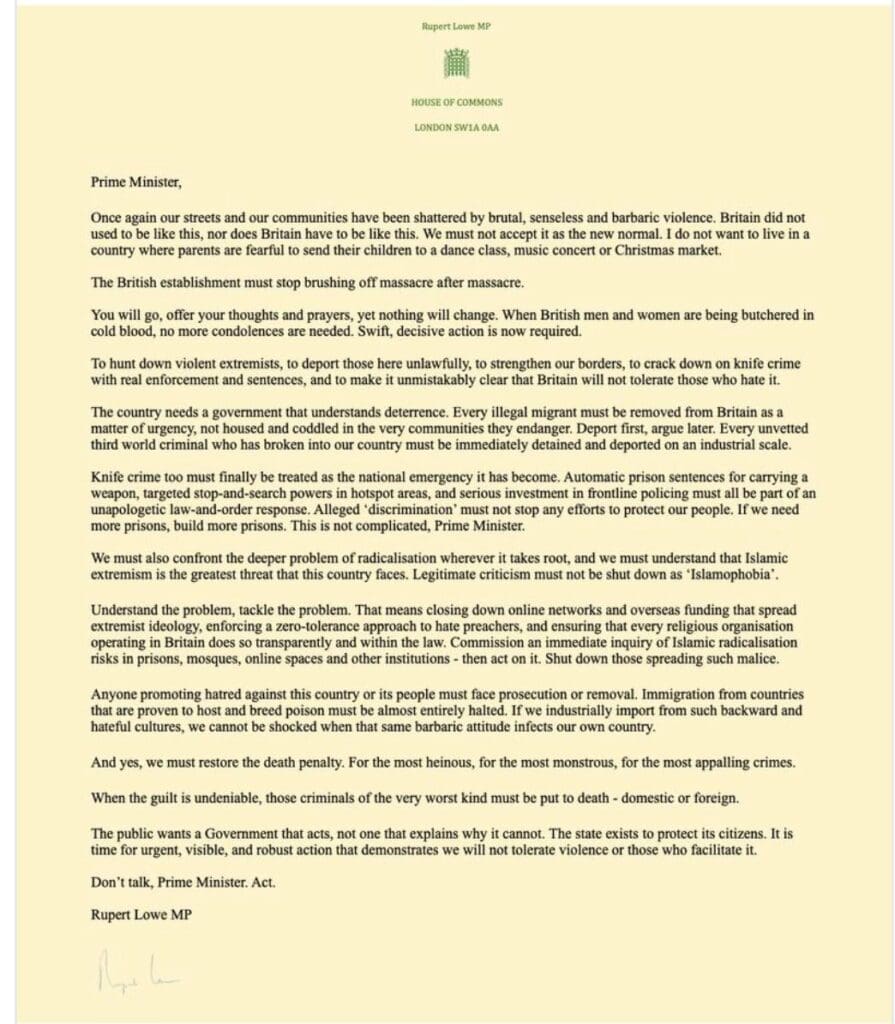
To this:
To fully understand who really hates Britain.
For your information, Rupert Lowe, and given that the knife attack in Huntingdon has not been classified as a terror incident, please find things that have happened to offer a response to ‘Britain did not used to be like this’. Perhaps you should have paid more attention to criminal history before spewing your nonsense.
- Cato Street Conspiracy (1820): A plot by radical Spencean Philanthropists to assassinate the entire British Cabinet. The ringleaders were arrested and five were executed for high treason.
- The Ratcliff Highway Murders (1811): Two separate, brutal attacks in London’s East End within twelve days, where two families were brutally bludgeoned to death. The crimes caused widespread panic.
- The Burke and Hare Murders (1828): In Edinburgh, William Burke and William Hare committed a series of 16 murders to sell the corpses to Dr. Robert Knox for anatomical dissection.
- The Red Barn Murder (1827): A notorious case where William Corder murdered his lover Maria Marten in Polstead, Suffolk. He was caught after Maria’s stepmother dreamt of the crime, leading to the discovery of the body.
- The Bermondsey Horror (1849): The serial killers Frederick and Maria Manning murdered Maria’s lover, Patrick O’Connor, and buried his body under their kitchen floor. They were both hanged.
- The Murder of Francis Saville Kent (1860): The infamous “Road Hill House Murder” of a young boy in Wiltshire. His half-sister, Constance Kent, was later convicted after confessing.
- The Maidenhead Railway Murder (1861): Franz Müller murdered Thomas Briggs on a North London Railway train, the first murder on a British train.
- The Murder of Harriet Staunton (1877): A notorious case of neglect and starvation. Harriet Staunton was starved to death by her husband and accomplices for her inheritance.
- Jack the Ripper Murders (1888): The most infamous serial killer in history, who murdered and mutilated at least five women in the Whitechapel district of London. The killer’s identity was never discovered.
- The Lambeth Poisonings (1891-1892): Serial killer Dr. Thomas Neill Cream poisoned at least four prostitutes in London with strychnine.
- The Siege of Sidney Street (1911): A gunfight in London between police and military and two Latvian anarchists, wanted for the murder of three police officers.
- Dr. Hawley Harvey Crippen (1910): Crippen poisoned his wife, Cora, buried her remains in his cellar, and fled with his mistress. He was arrested after a pioneering use of wireless telegraphy.
- The Brides in the Bath Murders (1915): Serial killer George Joseph Smith murdered three women he had bigamously married by drowning them in their baths.
- The Murder of Julia Martha Thomas (1879): Kate Webster murdered her employer in Richmond, dismembered the body, and boiled it down. She was the last woman to be hanged at Wandsworth Prison.
- The Rillington Place Murders (1940s-1950s): John Christie murdered at least eight women at his home in Notting Hill. His crimes led to the wrongful execution of Timothy Evans.
- The Acid Bath Murders (1940s): Serial killer John George Haigh murdered at least six people, dissolving their bodies in sulphuric acid to dispose of the evidence.
- The Moors Murders (1963-1965): Ian Brady and Myra Hindley tortured and murdered five children in the Manchester area, burying four on Saddleworth Moor.
- The Kray Twins (1950s-1960s): Notorious East London gangsters Ronnie and Reggie Kray were convicted for the murders of Jack “the Hat” McVitie and George Cornell.
- The Hungerford Massacre (1987): Michael Ryan went on a shooting rampage in Hungerford, Berkshire, killing 16 people (including his mother and himself) and injuring 15 others.
- The Dunblane Massacre (1996): Thomas Hamilton entered Dunblane Primary School in Scotland and shot dead 16 children and one teacher before killing himself.
- The Murder of James Bulger (1993): A two-year-old boy was abducted, tortured, and murdered by two ten-year-old boys, Robert Thompson and Jon Venables, in Merseyside.
- The Cumbria Shootings (2010): Derrick Bird, a taxi driver, went on a shooting rampage across Cumbria, killing 12 people and injuring 11 others before killing himself.
- The London Nail Bombings (1999): Neo-Nazi David Copeland planted three nail bombs targeting Black, Bangladeshi, and gay communities, killing three and injuring over 140.
- The Murder of Joanna Yeates (2010): The landscape architect was murdered by her neighbour, Vincent Tabak, in Bristol. The case received massive media attention.
- The Plymouth Shootings (2021): Jake Davison shot and killed five people, including his own mother and a three-year-old girl, in Keyham, Plymouth, before turning the gun on himself.
- The “Yorkshire Ripper” Murders (1975-1980): Serial killer Peter Sutcliffe murdered 13 women and attacked several others across Northern England.
- The “Babes in the Wood” Murders (1986): The bodies of two nine-year-old girls, Karen Hadaway and Nicola Fellows, were found in a woodland in Brighton after being sexually assaulted and murdered.
- The Murders of Dr. Harold Shipman (1975-1998): A GP who is considered one of the world’s most prolific serial killers; he was convicted of murdering 15 patients but a public inquiry found he was responsible for an estimated 250 deaths.
- The M40 Catseye Murders (1990s): Serial killer Michael Sams murdered at least two women, including a teenage girl whose body was found near a motorway. He was also known for kidnapping a estate agent.
- The Murder of Becky Godden (2003) and Sian O’Callaghan (2011): This case involved taxi driver Christopher Halliwell, who was convicted of murdering Sian O’Callaghan in 2011. During questioning, he led police to the buried remains of Becky Godden, whom he had killed in 2003. The investigation revealed Halliwell to be a suspected serial killer, with police linking him to several other unsolved murders of women. The case was notable for the “deeply flawed” police decision-making that initially delayed the discovery of Becky Godden’s body.
Any questions, Mr. Lowe, before you continue your campaign of hate and lies?
The tweet Rupert Lowe claims to be a fake:
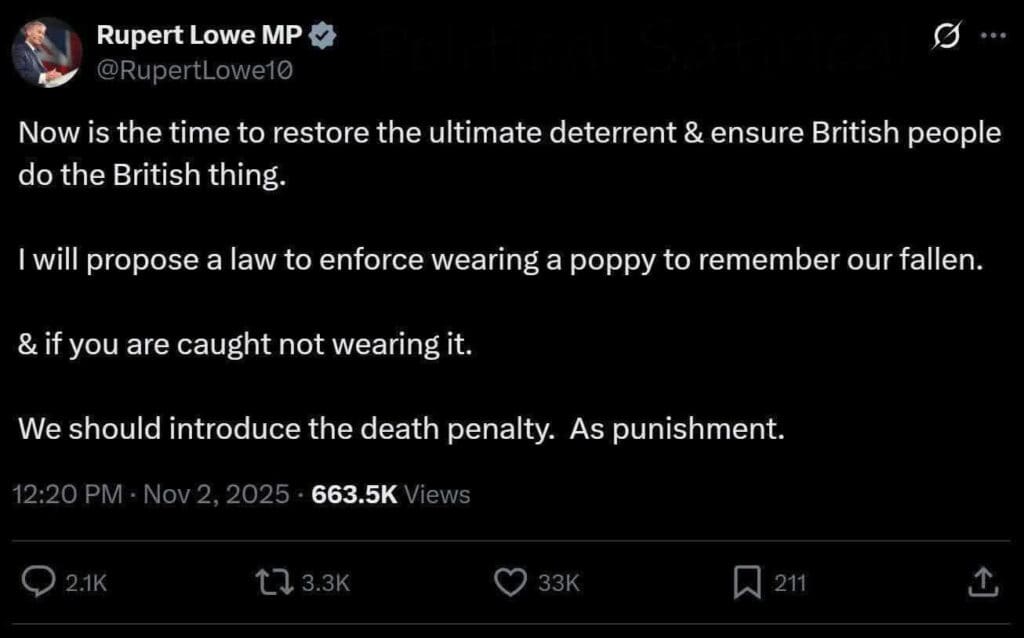
This tweet was merely taken from social media, having been shared by hundreds of thousands of people.
To report this post you need to login first.