

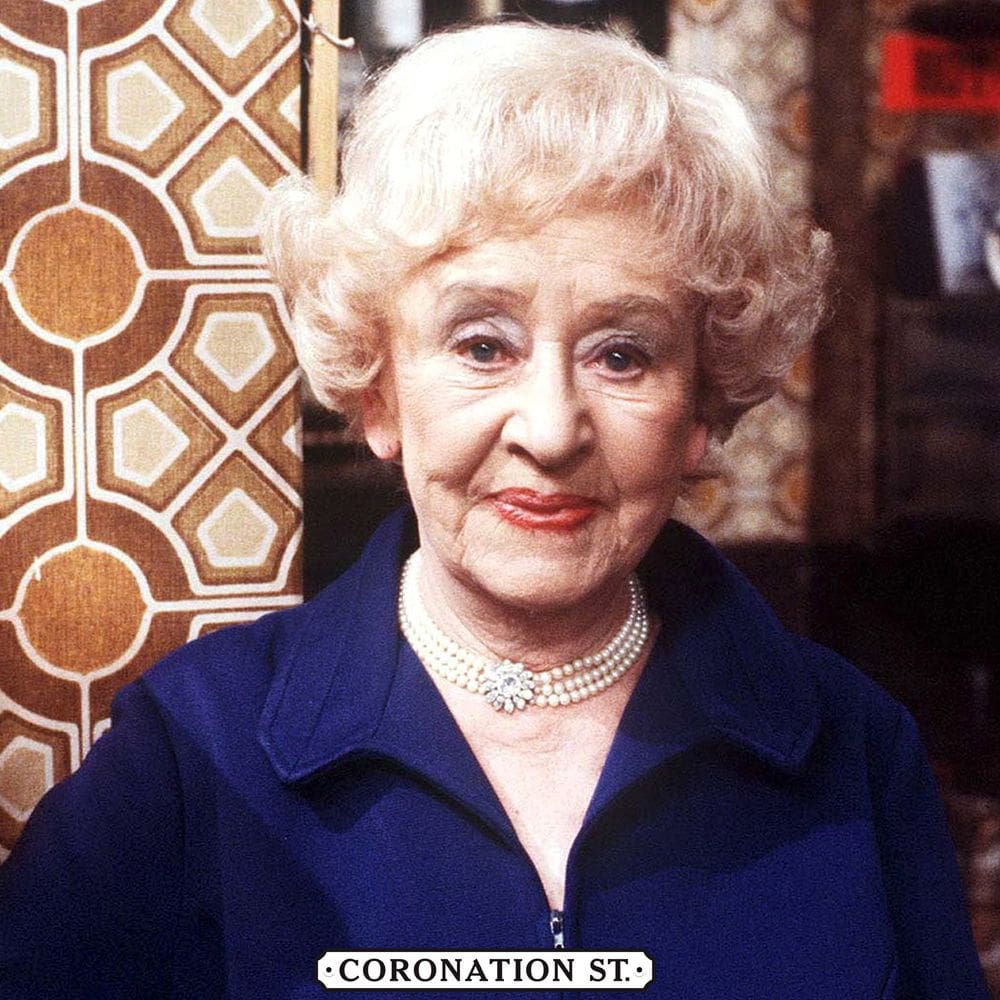
Few actors become so closely associated with a single role that the character and performer seem almost inseparable. For millions of viewers of Coronation Street, that was certainly true of Doris Speed, the formidable actress who brought pub landlady Annie Walker to life for more than two decades. Yet behind the stiff-backed dignity of the Rovers Return’s most fastidious licensee was a life shaped by theatre, hardship, intellect and, in its final moments, a quiet mystery.
Her story began on 3 February 1899 in Chorlton, Lancashire, now part of Manchester. Speed was born into the theatre. Her father George was a singer and her mother Ada Worsley Speed an actress, and their touring careers meant that the young Doris experienced an unusual childhood. She moved from school to school almost weekly as the family travelled the country performing in provincial theatres.
The stage arrived in her life almost before she could walk. At the age of three she toddled onto a stage wearing a nightdress to sing a comic song about a golliwog. Two years later she made her formal acting debut in the Victorian melodrama The Royal Divorce, playing the velvet-suited infant Prince of Rome. For Speed, the theatre was never a hobby—it was destiny. She would later say simply: “Acting was all I ever wanted to do.”
But dreams of acting had to coexist with reality. In 1915 she trained in shorthand and typing at a technical college and took a job with the brewery company Guinness in Manchester. The job was initially meant to support her parents’ stage work, yet Speed remained with the company for an astonishing 41 years, eventually rising to become personal assistant to the regional manager.
Even during those decades of office life, the theatre never left her. She was deeply involved with Manchester’s amateur dramatic scene, particularly a respected group known as The Unnamed Society. From the late 1930s she earned strong notices in the Manchester Guardian, including praise for her performance as Gertrude in a 1949 production of Hamlet. She also appeared in productions with Chorlton Rep and other companies, performing Shakespeare, classical drama and modern theatre. Among her roles were Mrs Sullen in The Beaux’ Stratagem, the mother in The Lady’s Not For Burning, and even the mythic beauty Leda in Amphitryon 38.
After the Second World War her career widened. Speed appeared in hundreds of radio plays and began to work in television during its early experimental years. She acted in the police drama Shadow Squad and its spin-off Skyport, both produced by Granada Television. She also appeared in the 1959 Manchester-set film Hell Is a City starring Stanley Baker.
Yet it was a young writer named Tony Warren who would change her life forever.
In 1960 Warren was developing a new ITV drama set in a working-class northern street. He had admired Speed’s acting since he was a boy and wrote the role of Annie Walker, the proud and status-conscious landlady of the Rovers Return—specifically for her. At the time Speed was performing in Bristol and twice refused to audition, thinking the journey to Manchester too inconvenient. By then, 57 other actresses had unsuccessfully tried for the part.
Eventually she relented.
Her first appearance came in the opening episode of Coronation Street in December 1960. What began as a three-week contract turned into a defining role lasting more than twenty years and 1,746 episodes. Annie Walker was a comic masterpiece of social aspiration, a woman who clung fiercely to the idea that the Rovers Return was a place of refinement rather than simply a pub.
Speed based the character partly on an aunt who ruled family Christmas charades with a famously withering glare. The result struck a chord with audiences. Annie Walker represented a certain strain of British respectability: proud, fastidious and determined to rise above the ordinary.
Ironically, Speed herself disliked pubs and regarded Annie as “a silly vain woman”. In real life she was considered intellectual and politically engaged—a staunch socialist who enjoyed bridge, theatre biographies and the notoriously difficult crossword in The Guardian. Her colleagues described her as witty but sharp-tongued. Actress Betty Driver later called her “a gentle lady” who nevertheless “didn’t suffer fools.”
Her politics sometimes produced lively disagreements with fellow cast members, notably Margot Bryant, who played Minnie Caldwell and held strong Conservative views. The two reportedly argued constantly, though with great affection.
The show’s success brought honours. Speed was appointed MBE in 1977 and later received a Pye Television Award for her contribution to television. She even found herself visiting 10 Downing Street alongside castmates Pat Phoenix and Arthur Leslie as guests of Prime Minister Harold Wilson and Chancellor James Callaghan.
But her later years on the programme were clouded by misfortune. In 1983 a tabloid story revealed that Speed had understated her age by fifteen years. Though the claim was widely known within the industry, its public exposure deeply upset her. Friends said it “broke her spirit”. Soon afterward, she collapsed during filming with stomach pains and never fully returned to regular work on the show.
Her last broadcast appearance as Annie Walker aired in October 1983. Declining health, worsening hearing and a burglary at her home led her eventually to move into a nursing home in Walshaw, Bury.
Yet the character she created never lost its hold on audiences. In 1990 she appeared on a programme marking thirty years of Coronation Street, helped onto the stage by host Cilla Black. The audience gave her a standing ovation. Frail but smiling, Speed seemed deeply touched.
Her final television interview came in 1993 with Ken Farrington, who had played her on-screen son Billy Walker.
Then came the strange ending to a long life.
On 16 November 1994, at the Highbank nursing home, Doris Speed prepared herself for the day in a way staff had rarely seen. She dressed in her best clothes and carefully applied make-up. Normally she did this only when expecting visitors. But none were scheduled.
Later that afternoon she settled into a chair with a book, To Sir, With Love by E. R. Braithwaite, and began to read.
At some point she drifted into sleep. When a staff member came to bring her afternoon tea, they found her peacefully gone. The book rested beside her, and a cigarette still smouldered in the ashtray.
She was 95 years old, the exact age her mother had been when she died.
The nursing home’s owner later remarked on the peculiar detail of that day: the careful dressing, the make-up, the sense of quiet preparation. “It is something she never did unless expecting a guest,” he said. “Nobody was due to see her. I wonder if she knew what was going to happen.”
Perhaps it was coincidence. Perhaps it was simply the instinct of an old actress who understood entrances and exits better than most.
Either way, Doris Speed left the stage of life much as she had lived it: composed, dignified and faintly theatrical.
And somewhere, one imagines, Annie Walker might have approved.







