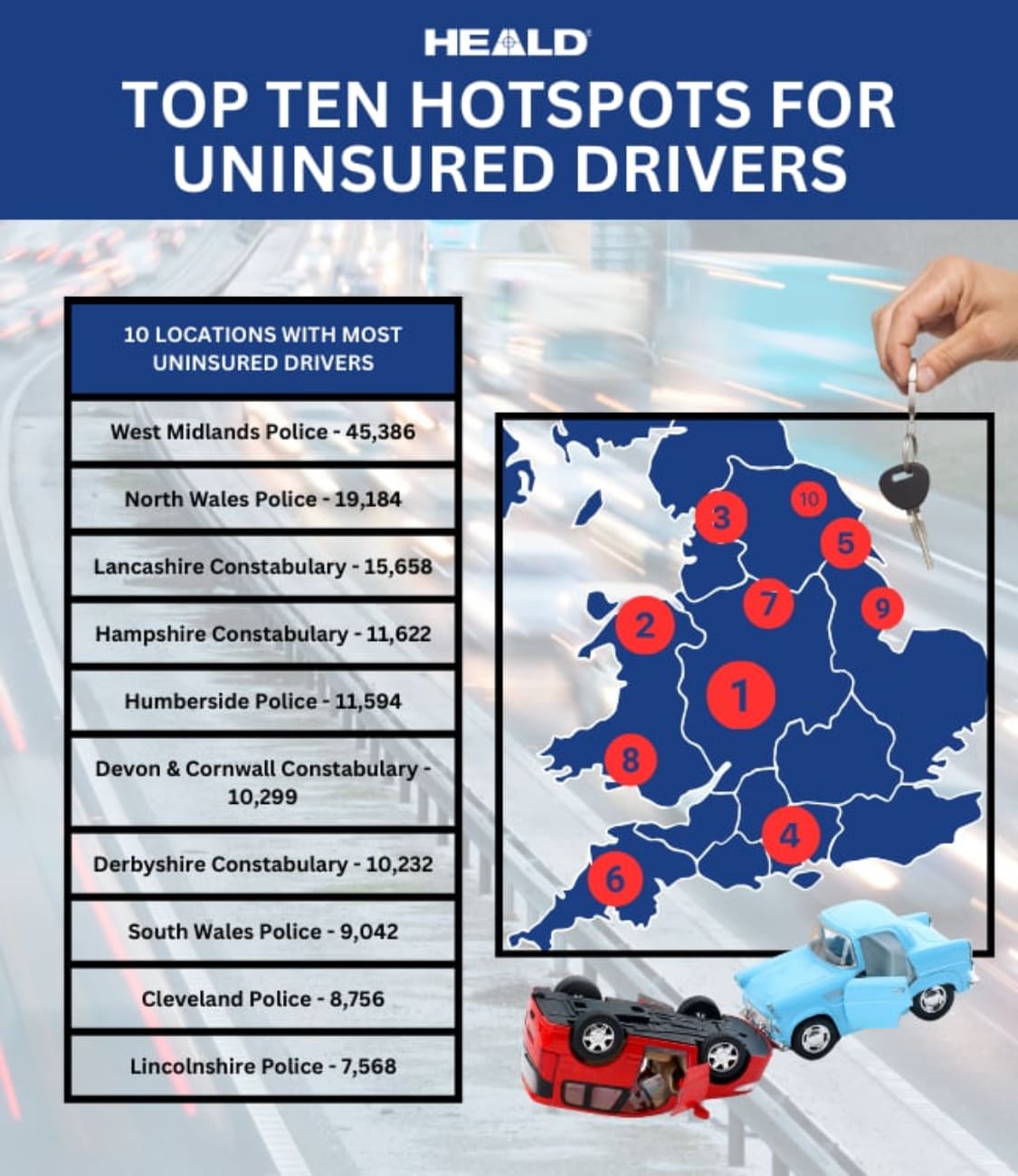
Every 20 minutes, someone in Britain is hit by an uninsured or hit-and-run driver. Every week, these collisions claim at least one life. Behind these stark statistics from the Motor Insurers’ Bureau (MIB) lies a deeply entrenched social problem: a powerful and disturbing correlation between uninsured driving and areas of the UK grappling with high levels of deprivation.
A recently released list of the 15 worst offending postal areas for uninsured driving reads less like a random assortment of locations and more like an index of economic vulnerability. Topping the list is Thurrock (RM19) in Essex, followed closely by four distinct postal districts in Birmingham (B25, B18, B21, B35). The list continues through Peterborough (PE1), Sandwell (B66), parts of Manchester (M18), Belfast (BT17, BT13), and Luton (LU1)—all areas consistently highlighted in indices of social and economic disadvantage.
This geographical overlap is not coincidental. The decision to drive uninsured is often framed as a simple matter of criminality, but in many of these communities, it is a symptom of a deeper financial crisis. With the cost of living soaring and insurance premiums at a record high, the annual cost of insuring a vehicle can represent an insurmountable barrier to mobility for those on low incomes. For some, the car is essential for getting to work or fulfilling caring responsibilities, creating a desperate dilemma that leads to the morally reprehensible, yet financially pragmatic, choice to drive without cover.
The human cost of this crisis is catastrophic, borne by victims like Cahal O’Reilly. The 55-year-old cyclist was five miles from a ferry port in Holyhead in 2021 when an uninsured driver, estimated to have been travelling at 70 mph, hit him from behind and fled the scene.
“I was left for dead, bleeding to death on the side of the road,” Mr O’Reilly stated. “Nobody knows how long I was on the floor for. When I came to my senses, I could taste my own blood and feel the road on my cheek.”
He suffered a broken back and neck, a shattered pelvis, and such severe damage to his leg that doctors warned him amputation was a real possibility. His recovery, described as “psychologically quite challenging,” has taken four years. His story is a brutal reminder that the £1 billion annual cost of uninsured driving—covering victim compensation, emergency services, and medical care—is not just a fiscal figure but a tally of human suffering.
This creates a vicious cycle. Uninsured drivers, often from economically depressed areas, cause collisions that inflict life-altering injuries on others. The resulting claims push up insurance premiums for all law-abiding motorists, making legitimate cover even less affordable in those very communities, thereby perpetuating the problem.
The MIB, a non-profit organisation that compensates victims of uninsured and untraced drivers, is attempting to break this cycle. Through targeted police enforcement—an uninsured vehicle is seized every four minutes—and public education campaigns, they aim to remove dangerous drivers from the road.
However, as Martin Saunders, MIB’s Head of Enforcement, notes, the solution requires more than just enforcement: “We are ramping up our support for motorists who want to drive legally, providing them with the knowledge they need to have the right cover in place.”
Ultimately, tackling the scourge of uninsured driving requires a dual approach. While robust policing is essential to protect the public, a long-term solution must also address the root cause: the profound economic inequality that makes insurance a luxury rather than a legal necessity for many. Until the link between poverty and peril on the roads is severed, communities across the UK, from Thurrock to Birmingham, will continue to pay the price, both in premiums and in shattered lives.