At a moment when much of Europe appears paralysed by the fear of provoking the White House, Spain has done something unfashionable: it has said no.
As US-Israeli strikes on Iran escalated tensions across the Middle East, the government of Pedro Sánchez refused to fall into line. Madrid questioned the legality of the operation, declined to allow US forces to use Spanish bases to facilitate military action, and publicly warned that the conflict risked catastrophic consequences.
Spain’s PM Pedro Sanchez has condemned the US-Israel war on Iran as a breach of international law, emerging as one of the sole Western leaders to denounce the attacks. pic.twitter.com/R6h2rn25YX
— Al Jazeera English (@AJEnglish) March 2, 2026
The response from Donald Trump was characteristically theatrical. He threatened to “cut off all trade with Spain” and declared that the United States wanted “nothing to do” with the country. It was a performance designed to intimidate, delivered, pointedly, beside a conspicuously restrained German chancellor.
Yet Spain did not blink.
Addressing the nation, Sánchez distilled his message into four words: “no to the war.” He was explicit that this was not an endorsement of Tehran’s leadership but a rejection of reckless escalation. He called on Iran, Israel and the US to step back before the spiral of violence became uncontrollable.
His warning drew on painful historical memory. Twenty-three years ago, another US administration led Europe into a disastrous Middle Eastern war. The invasion of Iraq destabilised a region, fuelled extremism and triggered a migration crisis that reshaped European politics. Sánchez described the current trajectory as “playing Russian roulette” with millions of lives, a striking phrase that captured both the unpredictability and the potential scale of devastation.
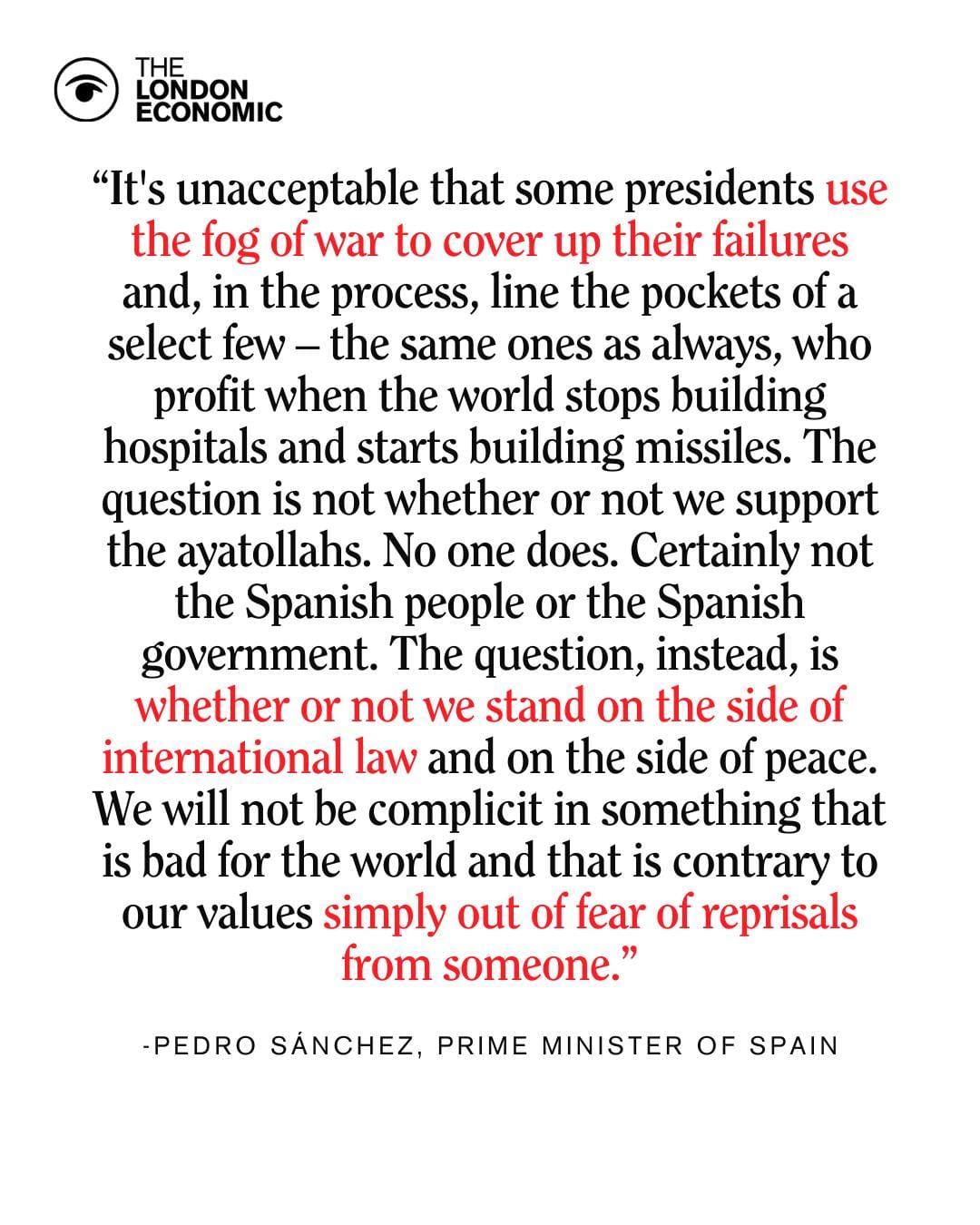
More stinging still was his broader rebuke: governments exist to improve lives and solve problems, not to “cover up their failure with the smoke of war.” In one sentence, he reframed militaristic bravado as political weakness, a diversionary tactic for leaders unable to deliver security, prosperity or cohesion at home.
That argument matters far beyond Spain.
Across Europe, leaders are walking a tightrope. Few want to publicly challenge Washington, particularly when trade, NATO commitments and geopolitical leverage are on the table. Emmanuel Macron has cautiously questioned the legality of the strikes, describing them as conducted “outside of international law,” but his tone was measured. Friedrich Merz opted for private diplomacy, saying he did not wish to escalate tensions publicly. Even as he reminded Trump that Spain cannot be singled out because it is an EU member, he avoided any visible confrontation.
The calculation is understandable. Public rows with Trump have a habit of spiralling. Leaders from Ukraine to Canada have learned that a televised rebuke can trigger days of retaliatory rhetoric. Yet there is a cost to silence. When Europe’s largest economies hesitate to defend one of their own against open threats, the message received in Madrid and beyond is that unity is conditional.
Spain’s foreign minister expressed surprise at Berlin’s restraint, invoking past German chancellors who, in his view, would have responded more forcefully. The implication was clear: European solidarity should not dissolve at the first sign of transatlantic pressure.
The deeper issue is not simply diplomatic etiquette. It is whether Europe can assert an independent voice when the United States pursues policies that risk regional conflagration. The EU has long presented itself as a project rooted in international law, multilateralism and conflict prevention. If those principles evaporate under pressure, they begin to look rhetorical rather than real.
Spain’s refusal to allow its bases to be used for strikes is not anti-Americanism. It is an assertion of sovereignty. NATO membership does not equate to automatic endorsement of every US military initiative. Nor does alliance oblige silence when the legality of an operation is disputed.
Critics will argue that such defiance weakens Western unity at a dangerous time. But unity built on acquiescence is brittle. A partnership in which one side dictates and the other complies breeds resentment, not strength. Mature alliances survive disagreement; they do not demand obedience.
There is also a domestic dimension that European leaders ignore at their peril. Public trust in political institutions has eroded over the past two decades, in part because of perceived complicity in ill-fated foreign interventions. The Iraq war cast a long shadow across the UK and the continent. Millions marched in protest; intelligence claims later unravelled; the promised stability never materialised. For many voters, scepticism about new military ventures is not radicalism, it is hard-earned caution.
When Sánchez evokes that history, he is speaking to a European electorate wary of being drawn once again into open-ended conflict. His rhetoric frames restraint not as weakness but as responsibility.
The UK, with its own complicated legacy in the Middle East, would do well to reflect on this moment. Too often, British leaders have balanced loyalty to Washington against domestic unease. The instinct to avoid confrontation with the US president is powerful. Yet unquestioning alignment carries its own risks, strategic, moral and political.
None of this requires embracing Tehran or ignoring security threats. It does require clarity about ends and means. If strikes are outside international law, they should be described as such. If escalation threatens civilian lives and economic stability, that should be said plainly. Diplomacy is not appeasement; it is the recognition that war, once unleashed, rarely conforms to its architects’ intentions.
Spain’s stand may ultimately provoke economic retaliation or political strain. Trump is unlikely to let public defiance pass without response. But the spectacle of a European leader calmly stating “no to the war” and refusing to be bullied into compliance has already altered the tone of the debate.
The question now is whether others will find similar resolve.
In times of rising tension, the easiest posture is silence. The harder path is to articulate a principled position and accept the consequences. If Europe believes in its own rhetoric about law, peace and cooperation, then it must be prepared to defend those values even when doing so invites confrontation.
Warmongering thrives on fear and division. It falters when confronted by leaders willing to say, simply and clearly, that escalating conflict is not leadership at all.