

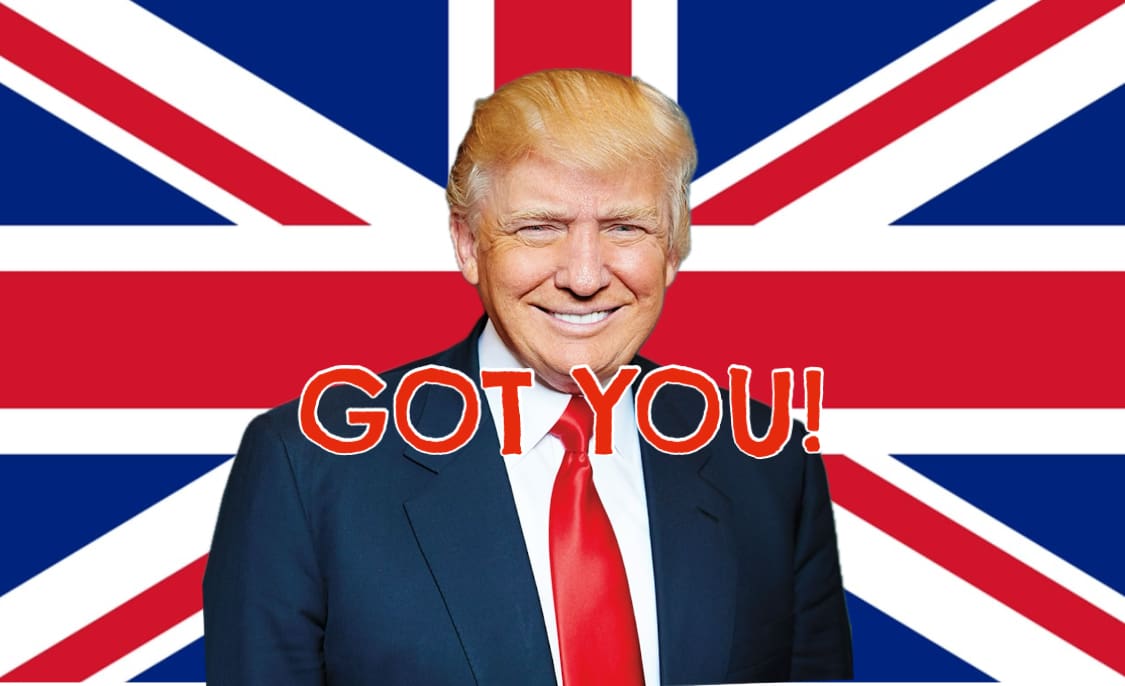
For generations, Britain has dined out on the myth of its own global importance. The country that once ran a quarter of the planet still likes to imagine itself a serious international power—calm, principled, steady, an elder statesperson guiding the world with quiet wisdom and a raised eyebrow. But the reality, exposed brutally during Donald Trump’s presidencies, is altogether more humiliating.
Today’s United Kingdom is no such thing. It is a diminished, isolated, economically weakened mid-size nation that has talked itself into believing it still matters. And because it refuses to recognise the extent of its own decline, it has ended up clinging desperately to the most powerful bully in the room: the United States, even when that United States is led by a man who treats allies like vassals and diplomacy like a reality-TV tantrum.
Britain did not cosy up to Trump out of admiration. It did so out of fear and because it has lost the ability to stand on its own feet. The UK put up with Trump’s America because, in the world it has made for itself, it simply has no other choice.
The Great British Pretence: Still a Power, Still Special, Still Relevant?
Every British government loves the phrase “the special relationship”. It suggests partnership, equality, an unbreakable bond forged in shared history and shared values. But in truth, the special relationship has, for decades, been built on Britain flattering America in the hope of being treated as its favourite sidekick.
Under Trump, that long-standing imbalance became impossible to deny. Trump saw alliances not as relationships but as leverage points. Loyalty to him personally was the price of continued cooperation. He insulted NATO allies, threatened to withdraw from commitments, praised dictators, and governed with the subtlety of a battering ram. Yet Britain kept smiling, nodding, and pretending that everything was fine.
Why? Because deep down, British leaders knew they had very little leverage left. After years of economic stagnation, shrinking defence capabilities, and diplomatic drift, the country had almost nothing to bargain with. Britain needs America far more than America needs Britain—and Trump knows it.
Brexit: The Self-Inflicted Wound That Broke Britain’s Backbone
To understand why Britain behaved with such cringe-inducing desperation, one must look squarely at Brexit. The decision to leave the European Union did not strengthen Britain’s hand in the world; it amputated it. By cutting itself off from its most important alliance, the UK traded influence for illusion.
The Brexiteers promised “Global Britain”—a swaggering, free-trading, sovereignty-wielding powerhouse liberated from Brussels. What Britain got instead was a geopolitical orphan, wandering the world in search of new friends while pretending it didn’t miss the old ones.
The immediate consequences were clear:
- Economic slowdown, making the UK increasingly reliant on foreign investment.
- Weakened diplomatic influence, both in Europe and beyond.
- Reduced bargaining power, leaving Britain at the mercy of larger powers.
- A desperate scramble for trade deals, any trade deals, even wildly lopsided ones.
Against this backdrop, Trump’s White House became not just a partner but a lifeline—one viewed through rose-tinted spectacles because the alternatives looked bleak.
Brexit didn’t give Britain freedom; it gave Britain dependency.
The Courtship of the Bully
Nothing illustrates Britain’s decline more starkly than the embarrassing eagerness with which it flatters Trump. British politicians queued up to praise him, even as he:
- mocks allies,
- emboldens autocrats,
- undermines democratic norms,
- and reduces foreign policy to a series of personal vendettas and photo ops.
The UK government pretends that Trump’s affections could be earned with the right level of decorum and deference. In truth, Trump respects only strength—and Britain had none to show.
Britain has been forced into the diplomatic equivalent of smiling at an abusive boss in order to keep its job. It’s not strategy; it’s survival.
From Moral Leader to Moral Bystander
Once upon a time, Britain liked to portray itself as the world’s conscience: a defender of human rights, democracy, and the rule of law. But weakness has a way of corroding principle.
Increasingly desperate for trade, investment and political favour, Britain has found itself rolling out red carpets for men it would once have condemned: Gulf autocrats, corrupt strongmen, and leaders with appalling human rights records.
This is not “pragmatic diplomacy”. It is a moral retreat. A country that cannot afford to stand up for its values will inevitably surrender them.
The UK is not leading. It is begging.
The Price of Powerlessness
There is a dangerous assumption at the heart of Britain’s current foreign policy: that appeasing powerful bullies will protect the nation.
History shows the opposite.
Bullies smell weakness. They exploit it. They push until they meet resistance. When Britain flatters strongmen or indulges authoritarian impulses abroad, it sends a clear message: We cannot afford to say no.
This is not strength. It is supplication. And it has consequences.
Britain is losing:
- credibility, because nobody respects a nation that bends too easily;
- influence, because nations without resources or alliances lose their voice;
- identity, because compromise becomes habit rather than exception.
The world no longer asks what Britain thinks. It barely remembers to ask what Britain wants.
Can Britain Reclaim Its Dignity?
Yes—but only by facing some uncomfortable truths.
First, Britain must accept that its power has declined. Pretending otherwise insults the intelligence of both citizens and allies. Second, it must rebuild alliances—especially with Europe—rather than indulging in nostalgia for vanished greatness. Third, it must develop a foreign policy rooted in principle, not panic.
Most importantly, Britain must stop behaving like a supplicant to whichever global strongman shouts loudest.
If it cannot find the courage to act with integrity, it will continue to drift into the orbit of tyrants and bullies—Trump included—nodding along, hoping not to be noticed, and pretending that humiliation is diplomacy.
A Country in Need of a Spine
The painful truth is this: Britain tolerates Trump’s America because it is weaker, more isolated, and more confused about its place in the world than at any time in modern history.
The UK has become a nation scared of being alone, terrified of irrelevance, and therefore willing to cosy up to anyone powerful enough to offer protection—even at the cost of its own dignity.
A strong Britain would challenge Trump.
A confident Britain would oppose his excesses.
A principled Britain would refuse to indulge his authoritarian instincts.
But today’s Britain is none of these things.
And until it finds the courage to rebuild its strength, it will keep smiling politely at bullies—not out of loyalty, not out of strategy, but because it has forgotten how to say no.







