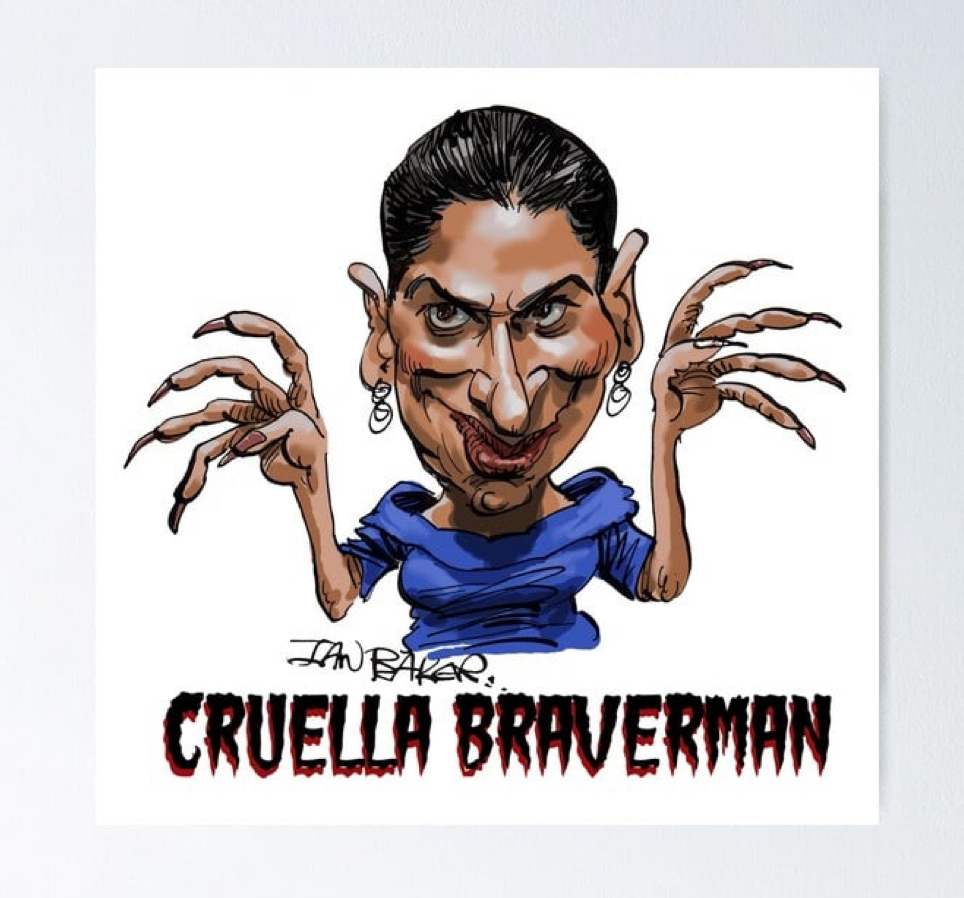
“Britain is broken,” declares Suella Braverman, as though she’s stumbled in from a parallel universe where she had nothing to do with the last fourteen years of government. It is a remarkable claim from a former Home Secretary who sat at the heart of power while public services frayed, trust in politics withered and the national mood curdled into grievance.
Having helped steer the country through that era, Braverman now appears alongside Nigel Farage, nodding gravely at the damage and offering herself as part of the cure. The pitch is familiar: blame migrants, scorn “elites”, cast institutions as enemies of the people and promise solutions that fit neatly on a protest placard. Same wreckage, new costume.
This is not diagnosis. It is alibi writing.
Britain’s problems are real enough. Waiting lists stretch on. Councils flirt with bankruptcy. The courts backlog cases. The small boats crisis dominates headlines. Wages have stagnated, taxes are high and the promise of post-Brexit renewal feels threadbare. But none of this arrived by meteor strike. It unfolded in slow motion, under governments in which Braverman was not a bystander but an active participant.
As Attorney General and later Home Secretary, she was a prominent voice in a project that treated governing as a permanent culture war. Immigration was framed not as a complex policy challenge but as a civilisational emergency. The language hardened. The rhetoric escalated. The asylum system, already creaking, became a theatre for performative toughness. Grand schemes were announced. Legal obstacles were denounced. The practical work of making systems function receded behind the politics of outrage.
To now declare the country broken without acknowledging the role she played in that breaking requires either extraordinary self-belief or extraordinary cynicism.
The move towards Reform is presented as a principled rupture, a refusal to tolerate drift and managerialism. Yet it looks less like rebellion and more like continuity. Reform’s offer is an intensified version of the politics that defined the later Conservative years: more hostility towards international law, more suspicion of the civil service, and more emphasis on sovereignty as spectacle rather than statecraft.
There is a curious sleight of hand at work. The argument runs like this: Britain is failing because liberal institutions, timid judges, obstructive officials and mass migration have thwarted the will of the people. Therefore, the answer is to double down on the very confrontational politics that have paralysed government for a decade.
But institutions do not decay in a vacuum. They are weakened by chronic underfunding, by constant ministerial churn, and by policy made for headlines rather than outcomes. The Home Office did not become dysfunctional overnight. It was run, repeatedly, by ministers who preferred symbolic battles to administrative reform. Braverman was among them.
None of this is to suggest she alone “broke Britain”. The story is broader and more systemic. Austerity hollowed out local government. Brexit consumed political bandwidth. Short-termism replaced long-term planning. Prime ministers came and went with dizzying speed. Yet to speak as though she observed this from the sidelines is implausible. She was part of the machinery.
There is also a deeper political problem. When senior figures recast themselves as insurgents against a system they helped design, accountability dissolves. Every failure becomes someone else’s fault: the courts, the blob, the migrants, the media. Responsibility is endlessly outsourced. Politics becomes theatre without memory.
Braverman’s rhetoric resonates with a genuine public frustration. Many voters do feel that Britain no longer works as it should. They sense decline in infrastructure, insecurity in communities and drift at the centre. That sentiment deserves serious engagement. It does not deserve to be instrumentalised.
The danger is that by reframing the crisis purely through the lens of migration and cultural grievance, the conversation narrows. The structural issues—productivity, regional inequality, housing supply, skills, the social care time bomb, fade from view. They are harder to fix, less amenable to applause lines and resistant to simple villains.
Standing beside Farage, Braverman presents herself as a truth-teller unafraid to confront taboos. Yet much of what she says has been governing orthodoxy on the right for years. The taboos have long since been shattered. What remains unaddressed is competence: the unglamorous business of making departments function, of building cross-party consensus where necessary, and of resisting the temptation to turn every policy dispute into an existential struggle.
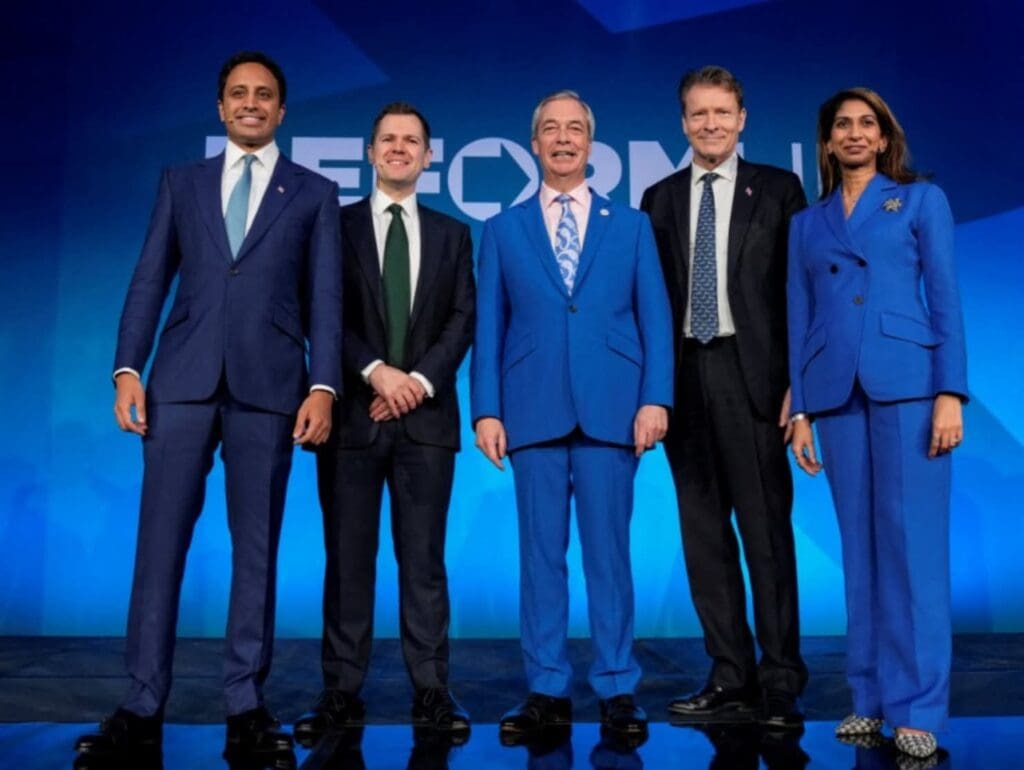
5 new cabinet members/ 5 old Tories.
Zia Yusef – former Tory party member.
Robert Jenrick – former Tory MP.
Nigel Farage – former Tory party member.
Richard Tice – former Tory party donor.
Suella Braverman – former Tory MP.
Reform offers clarity, not complexity. It offers anger, not administration. For politicians seeking reinvention, that can be attractive. For a country in need of patient repair, it is less obviously helpful.
“Britain is broken,” Braverman insists. Perhaps. But if so, the public is entitled to ask who held the tools when the cracks first appeared. Reinvention may be a time-honoured tradition in British politics. Redemption, however, usually begins with acknowledgement.
Without that, the declaration sounds less like a warning and more like an attempt to slip quietly away from the scene of the accident and to return later, high-vis jacket on, offering to direct the traffic.