From balconies overlooking the narrow valley of Wadi Qaddom in Silwan, residents stand silently as excavators tear into a four-storey building that had long been part of their daily view. The roads below are blocked by Israeli police. The sound of metal grinding through concrete echoes across the neighbourhood. By nightfall, a block of flats that once housed around 100 people is no more.
For the families forced out that morning, there was no warning that could soften the blow. Furniture, memories and lives were left behind as the demolition unfolded over 12 hours. For the onlookers — neighbours, relatives, friends — there was a familiar sense of dread. They know this could just as easily be their home next.
Nearby, an elderly woman sits at a bus stop close to the police checkpoint. She watches the dust rise, her cheeks flushed with anger. As she turns away, she raises her voice to the sky. “God is our only protection,” she says. Then she asks the question that so many Palestinians have asked before her: “Where are the Arab countries? Where is anyone to help us?”
Her question hangs in the air, unanswered.
A system designed to fail
The demolished building in Silwan was one of the largest residential demolitions in East Jerusalem this year. It was deemed illegal because it lacked a construction permit — a familiar justification used repeatedly by Israeli authorities. Yet the reality behind such claims tells a more troubling story.
Permits for Palestinians in East Jerusalem are notoriously difficult to obtain. According to Israeli planning experts and human rights organisations, only a tiny fraction of applications submitted by Palestinians are approved each year. Since October 7, that already limited approval rate has fallen even further. In neighbourhoods where land is overcrowded, zoning plans outdated or deliberately restrictive, families are left with little choice but to build without permits to accommodate growing households.
“This has always been discrimination,” says Sari Kornish, an architect and urban planner with the Israeli NGO Bimkom (Planners for Planning Rights), which supports Palestinian families attempting to legalise their homes. “It has always been not enough.”
The Silwan residents were challenging long-standing demolition orders and were in the process of applying for licences when the bulldozers arrived at dawn. While the Jerusalem Municipality maintains that the demolition was based on a 2014 court order and that residents were offered extensions, those working with the families dispute the fairness of the process.
“They were told the demolition order would be implemented and then they would have six months to continue planning,” Kornish explains. “Six months is not enough. These processes take years.”
In practice, the system operates as a trap: Palestinians are denied permits, forced to build illegally, then punished for doing so.
Political intent, openly stated
What was once framed as administrative enforcement has increasingly become a matter of explicit political ideology. Far-right figures within the Israeli government no longer conceal their enthusiasm for demolitions.
Itamar Ben-Gvir, Israel’s minister of national security, celebrated the Silwan demolition publicly, describing it as a source of pride. His language left little room for ambiguity. This was not about urban planning or legal compliance. It was about asserting control.
At the same time, Israel’s finance minister, Bezalel Smotrich, announced the approval of 19 new Jewish settlements in the occupied West Bank. These settlements are illegal under international law, as is Israel’s annexation of East Jerusalem. Yet such legal realities have done little to slow settlement expansion.
Today, around half a million Israeli settlers live in the West Bank, alongside more than 230,000 in East Jerusalem. In many cases, settlers do not merely build on confiscated land but take over existing Palestinian homes through court cases brought by settler organisations. The imbalance of power within the legal system makes it exceptionally difficult for Palestinian families to defend their claims.
At least 500 Palestinians have lost their homes to lack-of-permit demolitions in East Jerusalem alone. A further 1,000 people — including at least 460 children — are currently at risk of forced displacement through eviction cases making their way through Israeli courts.
Life among the ruins
In Batn al Hawa, another part of Silwan, the effects of these policies are impossible to miss. Former Palestinian homes are now marked with Israeli flags. Rooftops are being renovated by settlers. Families who once lived side by side have been scattered, some displaced only metres from where they grew up.
Zuhair al Rajabbi stands on his balcony, pointing to a house that once sheltered two families. “Five children and a grandmother in one room,” he says quietly. “Downstairs, seven children with their mother.”
As he speaks, a woman washes dirty water through a hole in a fence, letting it spill onto the roof of the neighbouring house — a home now occupied by settlers. The act is small, almost mundane, but its symbolism is painful.
“We used to live together,” Zuhair says. “Eating and drinking. It makes me sad when I see their home disappearing.”
This is not merely the loss of property. It is the dismantling of community, the erasure of social bonds, and the slow suffocation of Palestinian life in the city.
Gaza: destruction on a far greater scale
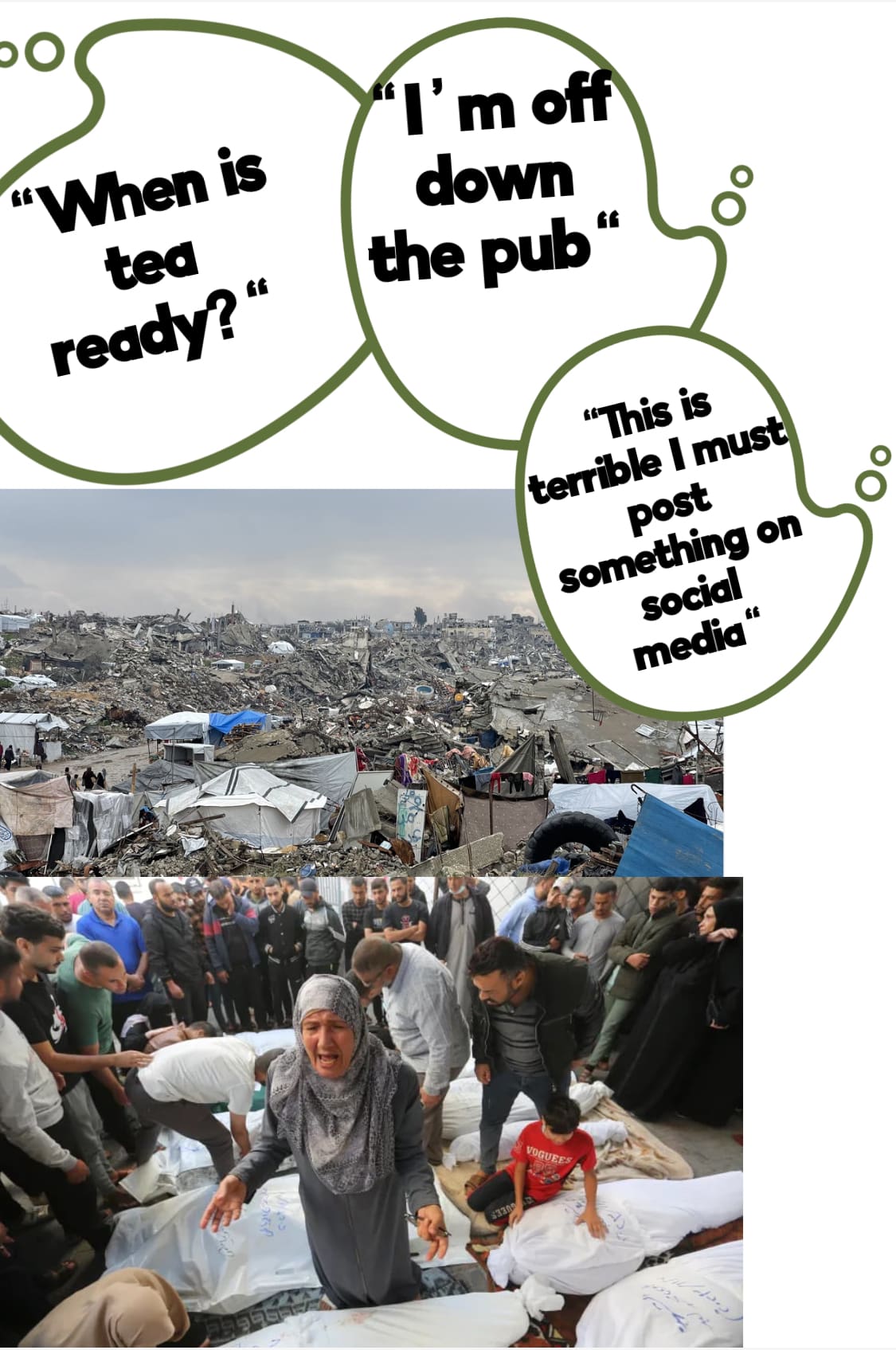
What is unfolding in East Jerusalem cannot be separated from what the world has witnessed in Gaza. Since October 7, Gaza has been subjected to an unprecedented military assault. Entire neighbourhoods have been flattened. Hospitals, schools and refugee camps have been struck. Tens of thousands of Palestinians have been killed, the majority of them civilians, including thousands of children.
More than a million people have been displaced, many forced to flee multiple times as designated “safe zones” are bombed or rendered uninhabitable. Essential infrastructure — water systems, electricity grids, medical facilities — has been systematically destroyed.
International humanitarian law is clear: civilians and civilian infrastructure must be protected, collective punishment is prohibited, and occupying powers have specific obligations towards the population under their control. Yet repeated warnings from the United Nations, human rights organisations and legal experts have been met largely with indifference.
The scale of destruction in Gaza is vast, but the underlying logic mirrors what Palestinians face elsewhere: displacement, dehumanisation and the normalisation of collective suffering.
A failure of the international community, including you and I
Perhaps the most striking aspect of this crisis is not only what has been done, but what has not been stopped. The international community has watched events unfold in real time, with unprecedented access to images, testimonies and documentation.
Western governments have issued statements expressing “concern” and urging “restraint”. Some have paused arms shipments temporarily or called for humanitarian pauses. Yet meaningful accountability has remained elusive. Diplomatic pressure has been weak, inconsistent and easily overridden by strategic interests.
Meanwhile, institutions designed to uphold international law struggle to act decisively. Investigations are launched, reports are written, resolutions are debated — but enforcement remains rare. For Palestinians facing demolition orders or airstrikes, these processes offer little immediate protection.
This inaction sends a powerful message: that some lives are more expendable than others, and that international law applies selectively.
The cost of silence
For Palestinians, the consequences are lived daily. Children grow up under the constant threat of displacement. Parents rebuild knowing their homes may be demolished again. Communities fracture as families are pushed out of their neighbourhoods.
For the wider world, the cost is moral as well as political. When violations of international law are tolerated, the entire legal framework is weakened. When human rights abuses are excused or ignored, they become easier to repeat elsewhere.
History has shown, time and again, that silence in the face of injustice is not neutrality. It is complicity.
An unanswered question
As the dust settles in Silwan, the elderly woman’s question remains unanswered. Where are the Arab countries? Where is the international community? Where is the protection promised by international law?
From Gaza’s ruins to East Jerusalem’s demolished homes, Palestinians are not asking for sympathy alone. They are asking for rights, for accountability, and for an end to policies that treat their existence as an obstacle to be removed.
The world has watched. It has documented. It has debated. Yet for the families now homeless in Silwan, for the children sleeping in tents in Gaza, and for those waiting anxiously for the next demolition order, watching is not enough.
What will define this moment is not what the world knew, but what it chose to do — or failed to do — when it mattered most.