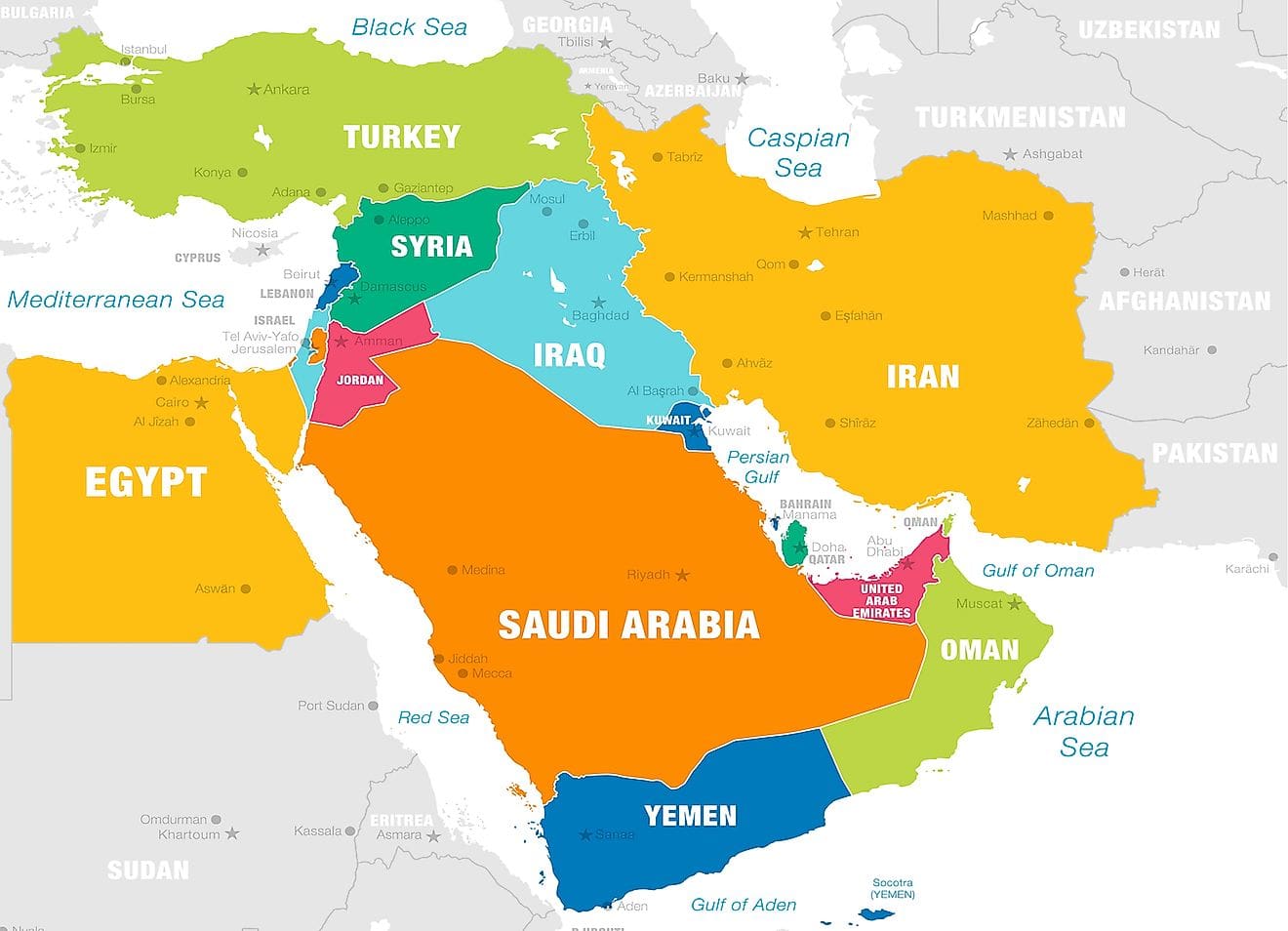
The term ‘Middle East’ is colonial language and relates only to the position of countries relative to Europe.
The term “Middle East” is widely used today, but its origins are rooted in colonial-era geopolitics rather than the perspectives of the people who live in the region. The phrase emerged in the late nineteenth and early twentieth centuries within the strategic vocabulary of the United Kingdom and other European powers. It was popularised by writers and officials such as Alfred Thayer Mahan, who used it in 1902 to describe the region between the Near East and the Far East from a European imperial viewpoint. In other words, the terminology defined the region not by its own geography or cultures, but by how far it lay from Europe.
This Eurocentric framing is why many scholars argue the phrase carries colonial assumptions. The terms “Near East,” “Middle East,” and “Far East” all position Europe as the central reference point, effectively mapping the world according to imperial trade routes and military strategy. From the perspective of cities like London or Paris, lands stretching from Egypt to Iran were categorized as a single strategic zone. This simplification ignored the enormous diversity of languages, religions, and political histories across the region, compressing dozens of distinct societies into a label that primarily served European administrative and strategic interests.
Critics also argue that the term helped reinforce colonial power structures during the era when European states exercised direct or indirect control over large parts of the region. Following the collapse of the Ottoman Empire after the First World War, colonial arrangements such as the Sykes–Picot Agreement divided territories under British and French influence. Within this geopolitical framework, “the Middle East” functioned as a convenient administrative and strategic concept rather than a historically rooted regional identity. Many historians therefore see the term as part of the linguistic infrastructure of imperial governance.
For these reasons, some academics and commentators advocate alternatives that better reflect regional realities. Terms such as “West Asia” or “Southwest Asia and North Africa” attempt to describe the geography without centering Europe as the point of reference. While “Middle East” remains deeply embedded in international politics, media, and diplomacy, its origins reveal how language can reflect historical power relations. The debate over the term is therefore not merely semantic; it highlights how colonial-era perspectives continue to shape the vocabulary used to describe entire regions of the world.