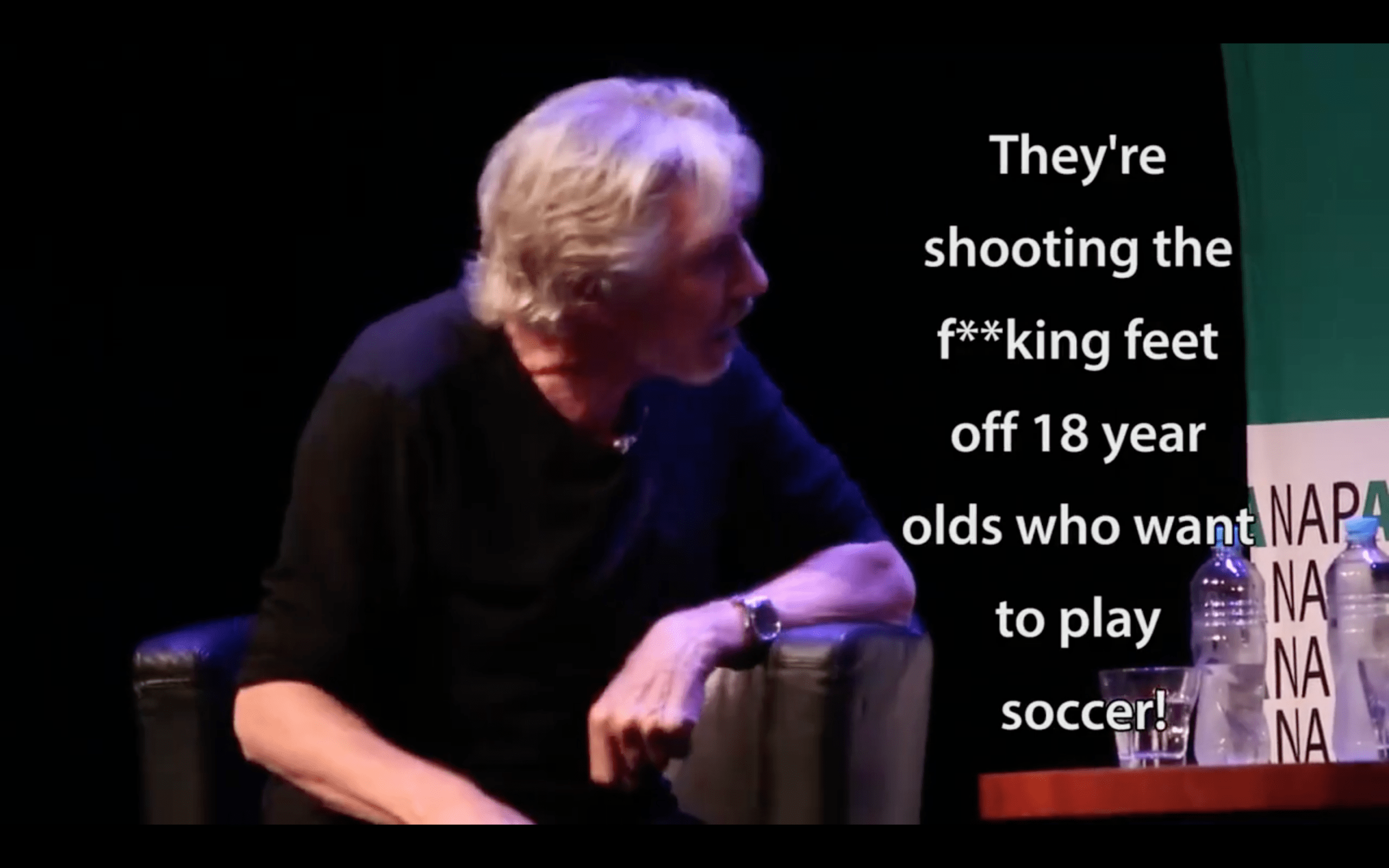
It is a line delivered with anger, frustration, and moral urgency by Roger Waters and it captures precisely why he remains such an incisive and essential public voice that should be listened to. Whether one agrees with him or not, dismissing Waters outright is to ignore a deeper challenge: his insistence that comfort must never override conscience.
Waters is not merely a rock star airing opinions. As a founding member of Pink Floyd, he helped shape one of the most politically charged catalogues in modern music history. Albums like The Wall and Animals were not just artistic triumphs, they were searing critiques of power, alienation, and institutional violence. His activism today is not a departure from that legacy; it is a continuation of it.
The quote in question, from almost a decade ago, arises from Waters’ outspoken criticism of Israeli policies towards Palestinians. He has repeatedly referenced allegations that security forces (the IDF) have used live ammunition against protesters, including young people, sometimes causing life-altering injuries. His phrasing is deliberately shocking, designed to cut through the fog of abstract debate and force attention onto human consequences. As he argues, it is absurd to centre discussions on Western anxieties about “free speech” while, in his view, far more immediate and brutal realities are unfolding elsewhere.
This is precisely why people should listen, not because Waters claims to be infallible, but because he refuses to sanitise injustice. In a media landscape saturated with euphemism, his language is jarring. It disrupts. It unsettles. And that discomfort is the point.
Critics often attempt to sideline Waters by portraying him as extreme or out of touch. Given the way Israel has raised Gaza to the ground recently, this accusation surely now holds no sway. Certainly, his rhetoric can be abrasive, and his positions, particularly his support for the Boycott, Divestment and Sanctions (BDS) movement, are fiercely contested. But dismissing him on tone alone avoids engaging with substance. The underlying question he raises is difficult but necessary: how should individuals respond when they believe human rights are being violated?
Waters’ argument is rooted in a long tradition of artists acting as moral witnesses. From anti-war protest songs during the Vietnam War to apartheid-era cultural boycotts in South Africa, musicians have often used their platforms to challenge power. In this context, Waters is not an anomaly; he is part of a lineage.
What distinguishes him is his refusal to separate art from responsibility. Many artists prefer to remain apolitical, or at least publicly neutral, arguing that their role is simply to entertain. A claim based upon their ignorance or the desire to merely chase the filthy lucre. Waters rejects this outright. His rebuke—“Don’t talk to me about your freedom of speech”—is aimed not at free expression itself, but at what he sees as its selective application. In his view, invoking free speech to justify performing in contested contexts, while ignoring alleged human rights abuses, represents a moral failure.
There is, of course, a counterargument. Some contend that cultural engagement fosters dialogue rather than division, and that boycotts can entrench positions rather than change them. Others argue that Waters’ framing oversimplifies a deeply complex conflict. These may be valid criticisms but only if one has not engaged with Waters directly as an interlocutor. Otherwise, one would simply not be able to ascertain this.
But even these critiques underline why listening matters. Waters forces the conversation into the open. He refuses to allow comfortable detachment. In doing so, he compels audiences to confront issues they might otherwise avoid.
Another reason to take him seriously is his consistency. Waters has not limited his criticism to one country or cause. He has spoken out against wars led by the United States and its allies, criticised authoritarianism in multiple contexts, and challenged corporate and political elites. This broader pattern suggests that his activism is driven by a coherent worldview underlain by an unambivalent morality.
Moreover, his willingness to endure backlash reinforces his credibility. Waters has faced professional and personal criticism, media hostility, and even attempts to cancel performances. Yet he continues to speak. In an era where public figures often calibrate every statement to avoid controversy, that persistence is notable.
Listening, importantly, does not mean agreeing. It means engaging. It means interrogating the claims, examining the evidence, and considering the ethical questions raised. Waters’ statement about young people being shot is not just an allegation; it is an invitation to investigate, to question, and to form an informed view.
In the end, the value of voices like Roger Waters lies in their capacity to disrupt complacency. He is not comfortable, and he, like every other human, is not always right. But he is engaged, informed, and unafraid to speak in stark moral terms. At a time when much public discourse is diluted by caution, echo chambers and calculation, that alone is worth paying attention to.
Because the alternative—ignoring such voices entirely—risks something far worse: a world in which difficult truths, however contested, are simply not heard at all. Then we really are in trouble.