
On the night of 16 September 1977, in Barnes, southwest London, a purple Mini Cooper left the road and struck a tree. Inside was Marc Bolan — the glittering heart of T. Rex, the man who helped invent glam rock, and the songwriter who turned teenage longing into anthems like Get It On and 20th Century Boy. He was 29 years old.
Marc died instantly.

Driving the car was Gloria Jones, his partner and the mother of his two-year-old son, Rolan. Gloria survived, but only just: a broken jaw, a broken leg, a broken foot, and serious internal injuries. Their son had stayed behind with his grandparents that night — a small, ordinary decision that saved his life.
But by morning, Rolan was fatherless.
What followed was not the kind of tragedy the headlines like to linger on. There were no dramatic courtroom battles, no public scandals. Just a quiet, devastating reality that almost nobody knew.
Marc Bolan was still legally married to his first wife, June Child. His will dated back to 1973, written before Rolan was even born. Although Marc had begun putting financial protections in place, the paperwork was unfinished. Under British law, Gloria and her young son were entitled to nothing.
“My mother went from a millionaire lifestyle to virtual poverty,” Rolan would later say. “We lived in Los Angeles and things got very tough.”
The funeral came swiftly. Among the mourners stood David Bowie — Marc’s friend, sometimes rival, and fellow pioneer of a sound and style that reshaped music. Just nine days earlier, the two men had appeared together on Marc’s television programme, laughing and performing as if the future stretched endlessly ahead.
The world moved on. David Bowie didn’t.

Bowie was Rolan’s godfather, and he treated the title as a responsibility rather than a sentiment. Without announcements, without press releases, without anyone knowing, he stepped in.
He paid for Rolan’s private education.
He covered expenses Gloria could no longer manage.
He phoned regularly — not once, not occasionally, but year after year.
“David’s generosity helped my mother and me to survive,” Rolan later shared. “It wasn’t just the financial help, but the time and kindness. He kept in regular touch by phone, and his first and last words every time were: ‘Don’t hesitate to tell me if there is anything I can do.’”
When Gloria tried to thank him, Bowie brushed it aside. “It’s the least I could do for the family of a good friend.”
This wasn’t a one-off gesture. It wasn’t a cheque written to ease a guilty conscience. It went on for seventeen years.
Seventeen years of quiet support.
Seventeen years without cameras.
Seventeen years without credit.
Only in 1994, when June Child passed away and Rolan finally received his rightful inheritance, did Bowie’s role gently come to an end. By then, the boy who might have slipped into hardship had grown up secure, educated, and supported.
Bowie never spoke publicly about what he did. He never used it to polish his image or add another layer to his legend. He simply saw a child who needed help — and helped.
Rolan Bolan grew up to become a musician and artist in his own right, carrying forward not only his father’s creative legacy, but the quieter influence of “Uncle David”, who protected his future when it mattered most.
Today, the tree in Barnes where Marc Bolan died is a permanent shrine. Fans still leave flowers, ribbons, and handwritten notes. It is a place of mourning and memory.
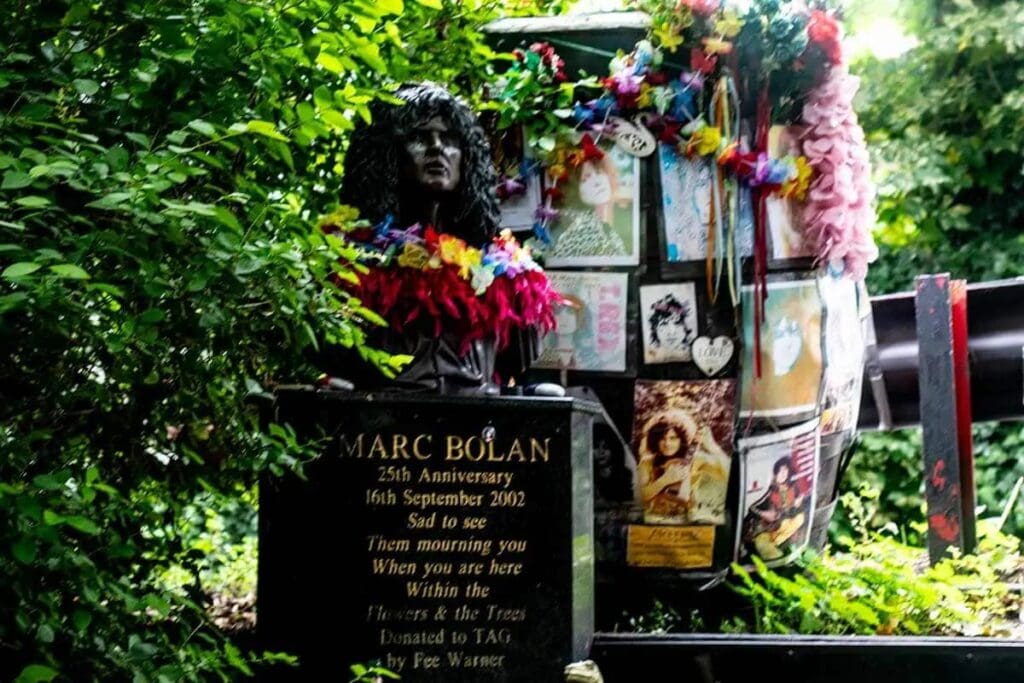
But perhaps the truest memorial isn’t carved in stone or tied to a trunk. It lives in a life that could have been derailed but wasn’t — because one friend understood that kindness doesn’t need witnesses.
David Bowie was Ziggy Stardust. The Thin White Duke. Major Tom. A man of masks, reinvention, and dazzling public personas.
Yet beneath the makeup and mythology was something rarer still: a human being who showed up when it counted, stayed when it was inconvenient, and gave without asking to be seen.
When Bowie died in 2016, Rolan Bolan wrote a simple tribute:
“Thank you for always being there through thick and thin. You were a true friend to my father and to me.”
Most people had no idea what “being there” really meant.
They didn’t know about the school fees.
They didn’t know about the phone calls.
They didn’t know about seventeen years of quiet care.
Because that’s how Bowie wanted it.
In a world of performative charity and public virtue, David Bowie simply took care of a friend’s child. No fanfare. No applause. No recognition.
Just kindness — when nobody was looking.
That is the man behind the fame.
That is the friend behind the legend.
And that is the legacy that matters most.