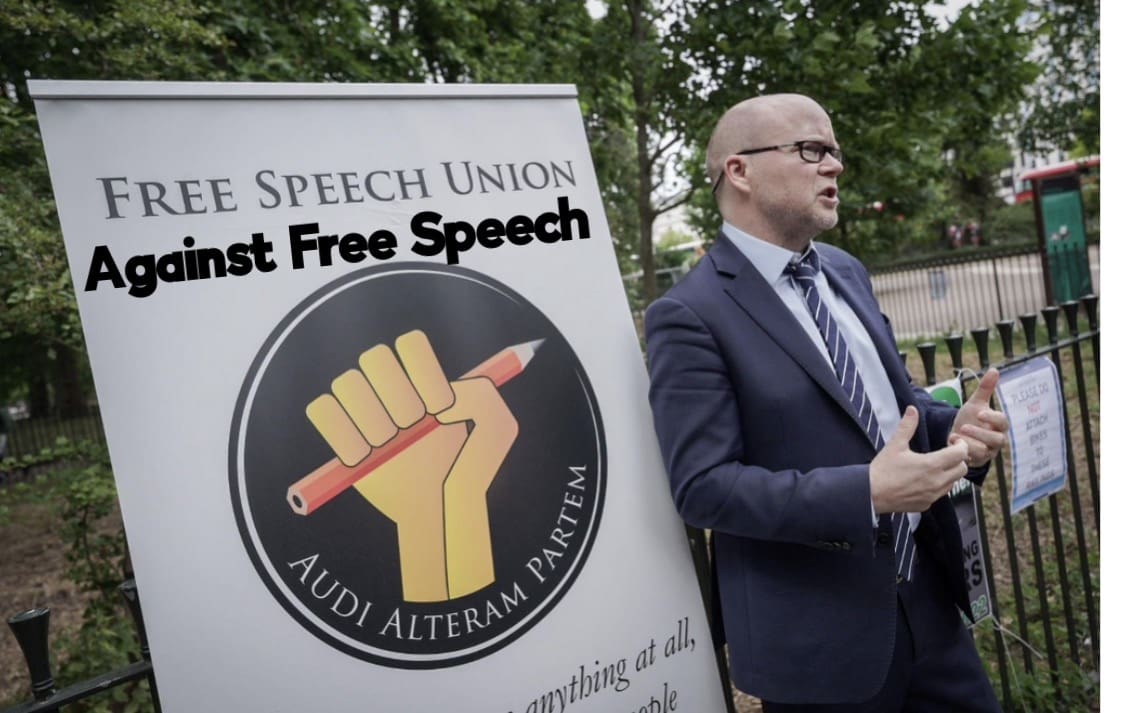
The Free Speech Union: Free Speech for Some, Silence for Others
Toby Young’s Free Speech Union (FSU) presents itself as a principled defender of open debate, freedom of expression and the right to dissent without fear of punishment. Its branding evokes a neutral civil-liberties organisation, standing above politics and ideology. Yet in practice, the FSU operates less as a universal defender of free expression and more as a selective advocacy group rooted in a narrow, culture-war worldview.
The problem with the Free Speech Union is not that it supports free speech — it is that it defines free speech in an unusually partisan way.
Selective outrage, selective defence
A genuinely pro-free-speech organisation would be expected to defend expression regardless of whether it aligns with the political preferences of its founders or members. In reality, the FSU’s interventions reveal a consistent pattern: it is vocal when conservative, right-leaning or “anti-woke” voices face criticism or consequences, and largely silent when suppression affects those on the left, trade unionists, pro-Palestinian activists, environmental campaigners or minority groups.
Academics disciplined for criticising government policy, workers sanctioned for organising or whistleblowing, and protesters facing sweeping restrictions under public order legislation rarely feature in the FSU’s campaigns. Nor has the organisation shown sustained concern about the chilling effect of new anti-protest laws, mass surveillance powers, or the use of counter-terrorism legislation against peaceful activists. These are among the most serious free-speech issues in modern Britain, yet they sit conspicuously outside the FSU’s focus.
Free speech, it seems, becomes urgent only when the speaker is politically sympathetic.
Free speech without power analysis
Another fundamental weakness in the FSU’s approach is its refusal to engage seriously with power. Free speech does not exist in a vacuum; it is shaped by who controls institutions, platforms, employment and the law. When a newspaper columnist with a national platform claims to be “silenced” after criticism on social media, the FSU often rushes to their defence. When marginalised groups face structural barriers to being heard at all, the organisation shows little interest.
This inversion of reality turns free speech on its head. The loudest voices in society are portrayed as persecuted, while those with the least access to power are ignored. The result is a rhetorical defence of “free speech” that protects status and influence rather than expression itself.
Confusing consequences with censorship
A recurring theme in FSU rhetoric is the conflation of censorship with criticism or professional consequences. Disagreement, protest, boycotts, or institutional decisions are frequently framed as attacks on free speech, even when no state suppression is involved.
This is a profound misunderstanding — or misrepresentation — of what free speech actually means. Freedom of expression does not guarantee freedom from challenge, reputational damage or social response. Treating accountability as censorship weakens genuine free-speech protections and turns the concept into a shield against scrutiny.
Ironically, this approach risks chilling speech rather than protecting it. When criticism is recast as repression, open debate becomes impossible.
Culture war first, principles second
The Free Speech Union’s campaigns are tightly aligned with a broader culture-war narrative: hostility to “wokeness”, scepticism of equality initiatives, and opposition to progressive social change. This framing is not incidental; it shapes which cases are highlighted, which are ignored, and how free speech is defined.
As a result, the FSU functions less like a civil liberties organisation and more like a lobbying group for a particular ideological constituency. Its version of free speech is not neutral or expansive, but narrow and defensive — a tool to resist cultural change rather than to protect democratic discourse.
Ignoring the state — the real threat to speech
Perhaps the most telling indictment of the Free Speech Union is its relative lack of concern for state power. Historically, the greatest threats to free expression come from governments: restrictive laws, policing, surveillance, prosecutions and bans. In contemporary Britain, these dangers are real and growing.
Yet the FSU has devoted far more energy to campus controversies and workplace disputes than to the erosion of protest rights, the criminalisation of dissent, or the expanding powers of the security state. Any organisation serious about free speech would place these issues at the centre of its mission.
The silence is revealing.
Free speech as branding, not belief
Free speech is a difficult principle. It demands consistency, discomfort and a willingness to defend expression one finds objectionable. It also requires recognising inequality, power and the difference between speech and dominance.
The Free Speech Union falls short on all counts. Its selective interventions, ideological framing and reluctance to confront state power suggest that “free speech” functions more as a brand than a belief — a slogan deployed in service of a political agenda rather than a universal right.
In the end, the Free Speech Union is not anything but about free speech. It is about whose speech matters, whose doesn’t, and who gets to decide.