

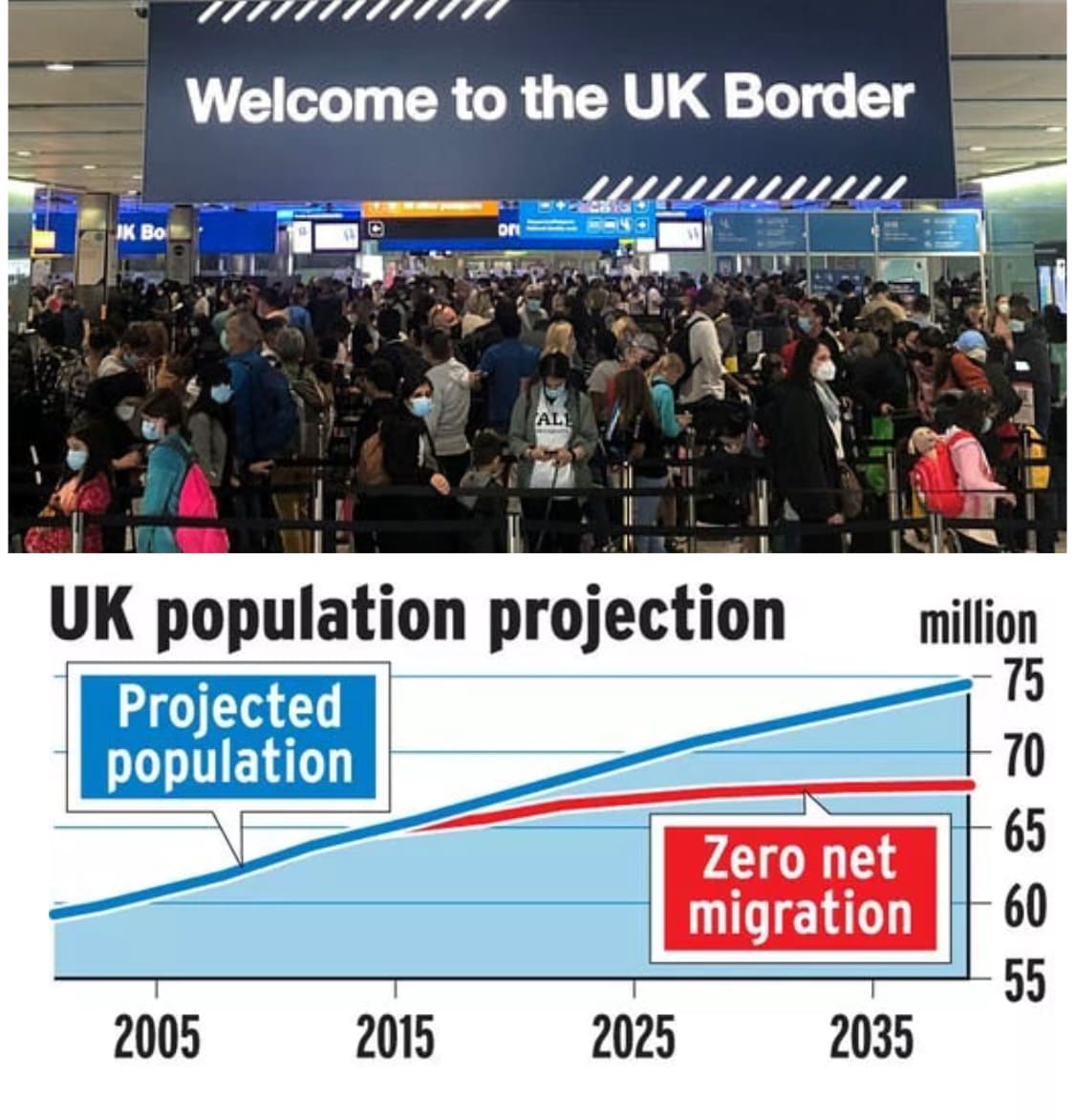
Tories Oversaw Second-Largest Population Surge in 75 Years – Driven by Migration, Brexit Failures, and the Blowback of Western Foreign Policy
England and Wales experienced the second-largest population increase in over 75 years during the year to June 2024, with the population growing by 706,881 to reach 61.8 million. The only larger annual increase on record occurred the previous year, when the population jumped by more than 820,000. Together, these back-to-back surges represent an unprecedented demographic shift and one that raises serious questions not only about domestic policy but also about the wider consequences of Britain’s role in the world.
The latest data from the Office for National Statistics (ONS) makes it unequivocally clear: nearly all of this growth — 98% — was driven by net international migration. In other words, the difference between people arriving in the UK and those leaving is now the overwhelming engine of population change. Natural change, the difference between births and deaths, is no longer a significant factor.
This influx is the product not only of UK immigration policy but also of a much wider set of geopolitical dynamics, many of which the UK and its Western allies have helped create.
The Brexit Contradiction
One of the most glaring contradictions lies in the legacy of Brexit. A central pillar of the 2016 Leave campaign was the promise to “take back control” of immigration. Yet since leaving the EU, migration has not fallen, it has skyrocketed. While EU immigration has declined sharply, it has been replaced by substantially higher arrivals from non-EU countries under new visa routes for work, study, and humanitarian purposes.
Rather than achieving control, the government has presided over a fragmented, reactive immigration system that has resulted in record numbers, with far less political clarity and cohesion. Brexit shifted the legal and political basis of immigration but failed to produce a workable long-term strategy. In doing so, it sowed disillusionment among both Leave and Remain voters and contributed to rising tensions in local communities that feel under-served and under-resourced.
The Global Consequences of Western Foreign Policy
Beyond Brexit, however, lies a deeper issue: the origins of many of today’s migration flows are closely tied to the legacy of war, destabilisation, and global inequality, often exacerbated, if not directly caused, by Western foreign policy.
The UK, alongside other NATO members, has been a major arms supplier to conflict zones around the world. British-made weapons have been sold to regimes with poor human rights records, including Saudi Arabia, whose ongoing intervention in Yemen has created one of the worst humanitarian crises of the 21st century. Similar patterns apply in other regions: arms and military support have flowed to governments involved in proxy conflicts or repression, while the long-term consequences—i.e., displacement, violence, and economic collapse, are felt by civilians who then seek refuge abroad.
In countries such as Syria, Libya, Iraq, and Afghanistan, the destabilisation that followed military interventions, airstrikes, and regime-change operations has directly contributed to mass displacement. The refugee flows from these countries have reshaped migration routes across Europe, including into the UK. In many cases, the UK has been both a participant in the wars and a destination for those fleeing them.
Meanwhile, Western economic policy, debt structures, and trade agreements continue to limit the capacity of many countries in Africa and Asia to build sustainable futures for their populations. Climate change, largely driven by emissions from wealthy industrialised nations, further intensifies these pressures, making regions increasingly uninhabitable and forcing millions to move.
In this context, the UK’s record migration figures are not an isolated domestic phenomenon. They are part of a global story of displacement, inequality, and the unintended, but foreseeable, consequences of decades of Western interventionism.
A System Unprepared and a Society Under Pressure
Despite this context, the British government has done little to prepare for the impact. Infrastructure, housing, schools, and healthcare have all failed to keep pace with the demographic changes. The absence of investment and long-term planning has made it easier for migration to be scapegoated in political discourse, while deeper systemic causes go unaddressed.
Critics argue that this amounts to a triple failure:
- A failure to deliver on Brexit’s promises regarding immigration.
- A failure to anticipate or responsibly manage migration flows resulting from foreign policy decisions.
- A failure to equip communities with the resources they need to adapt and thrive in the face of demographic change.
Historical Perspective
A long-term view puts this in stark relief:
| Year | Population Growth | Main Driver |
|---|---|---|
| 1947–48 | ~+1.5 million | Post-WWII return & baby boom |
| 1982 onwards | Gradual increase | Natural change, some migration |
| 2000–2010 | +200k–300k/year | Increasing net migration |
| 2022–2023 | +821,210 | Net migration (~96%) |
| 2023–2024 | +706,881 | Net migration (~98%) |
Over the past 75 years, only the post-war return of troops and a birth boom rival the pace of today’s population growth. But the causes are now fundamentally different and far more global.
In summary, what these numbers expose is more than a population trend; they reveal the deep fractures in Britain’s political, economic, and foreign policy strategies. A government that promised border control through Brexit has instead delivered record migration while ignoring the long-term effects of its role in global destabilisation.
The UK is not simply reacting to global pressures; it has helped create them. And until that reality is acknowledged and integrated into policy, attempts to “control” migration will remain superficial, inadequate, and politically volatile.
The conversation about immigration in the UK must now mature. It is no longer enough to talk about visas and quotas in isolation. We must confront the fact that our foreign policy, arms exports, and post-colonial relationships have global consequences and that the people who arrive on our shores are often escaping the very instability that Western powers have helped to unleash.







