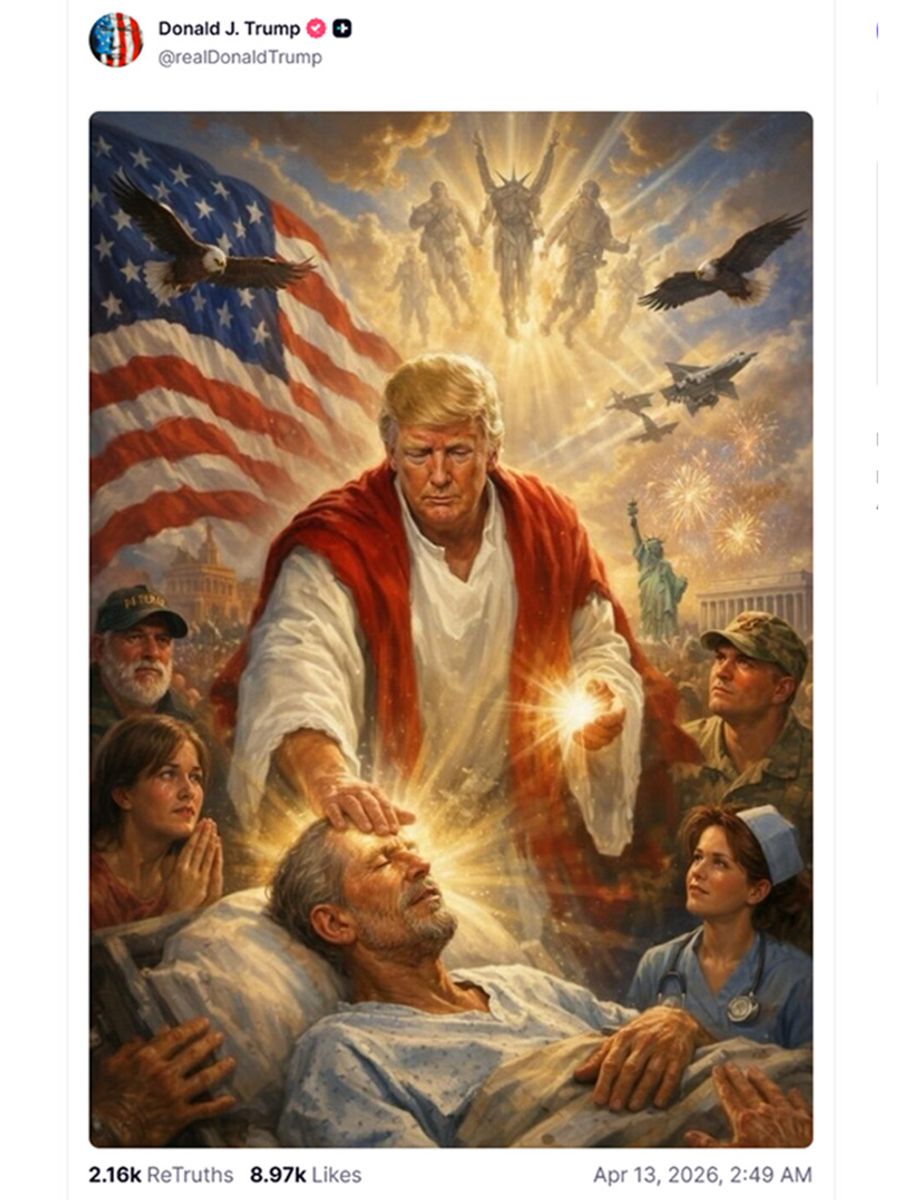
Donald Trump’s decision to share an AI-generated image of himself as Jesus Christ is not merely provocative politics, it is outright blasphemy. At a moment when he is publicly attacking Pope Leo for calling for peace in Iran, Trump has crossed from political theatre into the realm of sacrilege, elevating himself into the very image of the Son of God.
For millions of Christians, the image is deeply offensive. The Bible is unequivocal in its warning against false idols and the exaltation of man into the place of God. In Exodus 20:3-4, the first commandment declares: “Thou shalt have no other gods before me. Thou shalt not make unto thee any graven image.” By presenting himself in Christ-like robes, healing the sick in a staged miracle scene, Trump is not simply courting controversy, he is placing himself in the role reserved for Jesus alone.
Scripture also warns against those who elevate themselves through pride and vanity. Proverbs 16:18 states: “Pride goeth before destruction, and an haughty spirit before a fall.” Trump’s social media spectacle reeks of precisely that pride: a leader so consumed by self-image that he now casts himself as the saviour.
Even more damning is Matthew 24:5, where Christ warns: “For many shall come in my name, saying, I am Christ; and shall deceive many.” While Trump does not explicitly make that claim, the symbolism is unmistakable. This is a man who has built a personality cult around himself, and now visually places himself in the likeness of the central figure of Christianity.
The contrast with Pope Leo could not be more stark. While the pontiff speaks of peace, mercy, and the Gospel’s call to peacemaking, Trump responds with insults, false accusations, and imagery that many believers view as heretical.
This is not faith. This is ego masquerading as divinity.
For a politician who relies so heavily on Christian support, the post may prove to be a step too far. To many, this is not strength; it is idolatry. And in biblical terms, idolatry is among the gravest of sins.