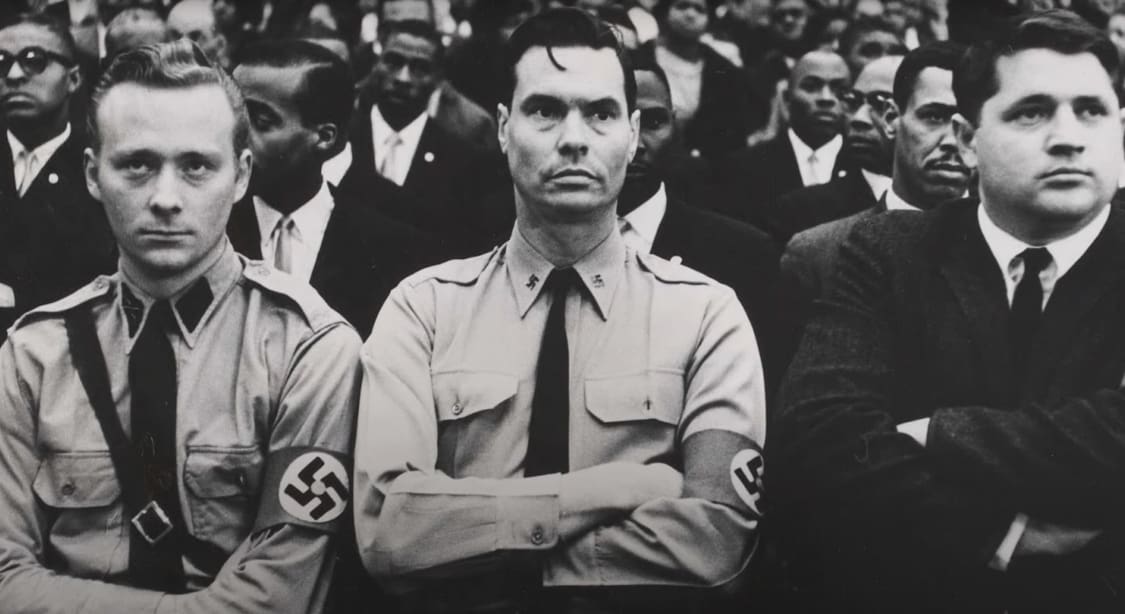
The Architect of American Nazism
To understand the assassination, one must first understand the man. George Lincoln Rockwell was a figure of grotesque paradox. A former U.S. Navy commander and a skilled graphic artist, he chose to devote his considerable talents to founding and leading the American Nazi Party (ANP) in 1959. With his uniformed “stormtroopers” and vitriolic protests targeting Jewish people, African Americans, and civil rights leaders, Rockwell became the most prominent white supremacist in post-war America. He was a master of media manipulation, using shock tactics to garner publicity most of his contemporaries found abhorrent.
His ideology, a venomous blend of Adolf Hitler’s doctrines and home-grown American racism, made him a pariah in the mainstream but a hero to a small, disaffected fringe. However, by 1967, his movement was crumbling. The ANP was riven with internal dissent, financial problems, and ideological schisms.
The Fatal Day: 25th August 1967
Rockwell had just left the Econ-O-Wash laundrette on Dominion Road, where he had been waiting for a load of laundry to be finished. He was sitting in his car—a 1958 Chevrolet—with two of his followers when another car pulled up alongside.
John Patler (born John Patsalos), a 25-year-old former high-ranking member of the ANP, stepped out. Patler had recently been expelled from the party by Rockwell for what he deemed insubordination and advocating for overly violent tactics. As Rockwell’s car idled, Patler raised a pistol and fired three shots through the open passenger window. One bullet struck Rockwell in the chest, piercing his heart and aorta. He was pronounced dead upon arrival at the nearby Arlington Hospital.
Patler fled the scene but was arrested hours later. The murder weapon was found in a storm drain near his home.
The Motive: A Vengeful Disciple
The trial revealed a story of bitter internal strife. Patler, once one of Rockwell’s most trusted lieutenants, had grown disillusioned. He represented a faction within the ANP that favoured a more aggressive, revolutionary approach, clashing with Rockwell’s focus on propaganda and political organising—however hateful it was.
His expulsion from the party was the final insult. For Patler, the man he once revered as the “American Fuehrer” had become a hindrance to the cause. The assassination was, in his warped view, a necessary act to save the movement from its own leader’s failing strategy.
In April 1968, a jury found John Patler guilty of first-degree murder. He was sentenced to 20 years in prison, though he would be paroled in 1975.
A Contested Legacy
Rockwell’s assassination did not, as he might have hoped, martyr him into a powerful symbol that galvanised a mass movement. Instead, it effectively decapitated the American Nazi Party, which splintered into various, less coherent factions. Without his charismatic and media-savvy leadership, the organised face of American Nazism faded from public view for a time.
However, to suggest his death erased his influence would be a mistake. Rockwell’s legacy is a dark and enduring one. He pioneered the use of shock value and spectacle to gain media attention for extremist views, a tactic now ubiquitous among modern hate groups. His writings and ideology became foundational texts for subsequent generations of white supremacists, neo-Nazis, and members of the Ku Klux Klan.
The murder of George Lincoln Rockwell remains a stark reminder of the violent, self-destructive nature of the ideology he preached. He was a man who traded his naval uniform for a Nazi one, who preached hatred until it consumed his own organisation, and who was ultimately killed not by an enemy, but by a product of the very bitterness he had sown.
What the USA has now is that legacy. It has Trump, and it had Charlie Kirk. It also has many others.
And it may well also have been someone who was more of a fascist extremist than either Trump or Kirk who pulled the trigger. That will all depend on whether Trump allows the corporate media and law enforcement to reveal reality.
It is possible not to rejoice at a Nazi’s death but not to mourn it either.