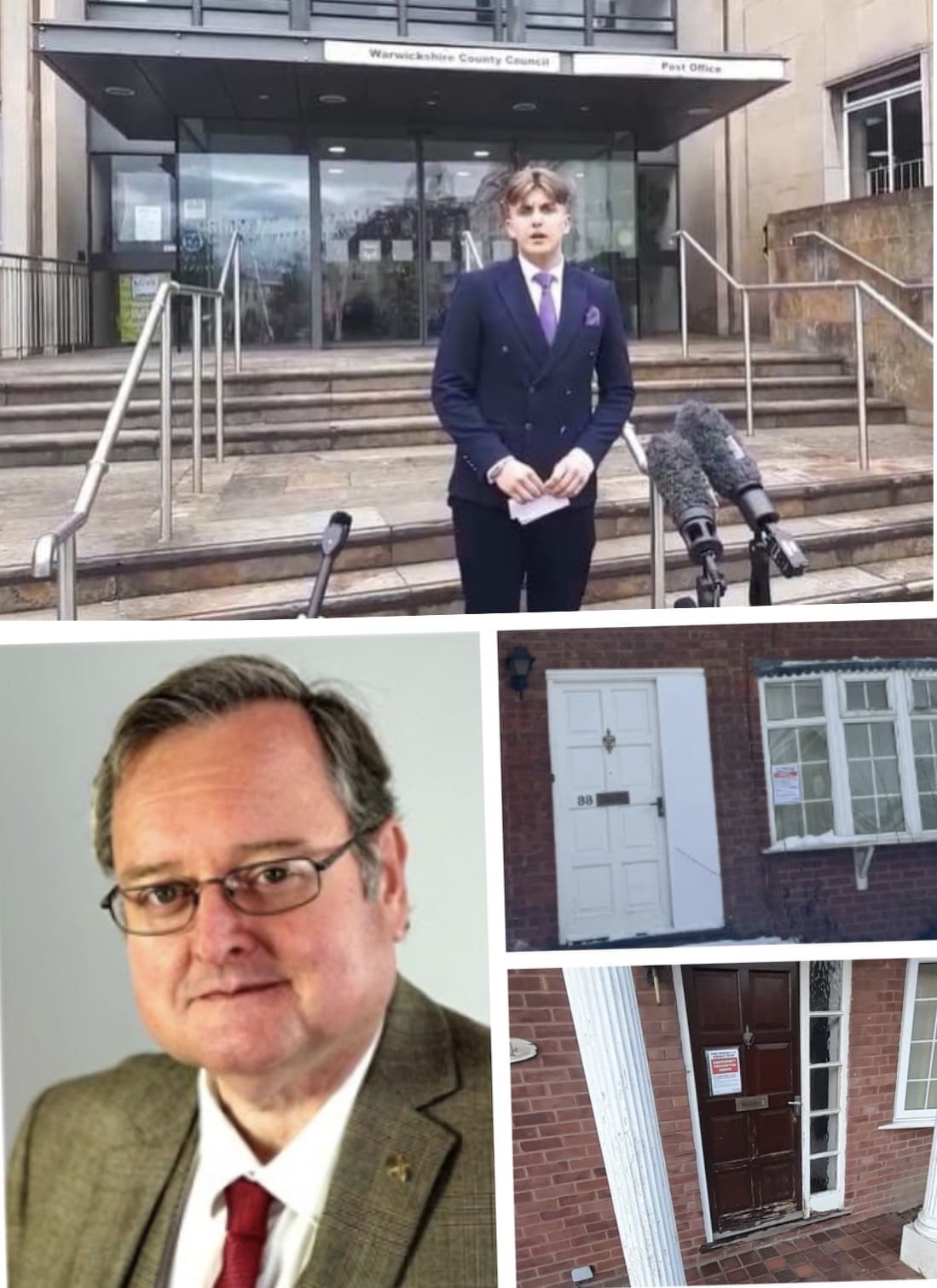
Rogue Landlords, Online Abuse and the Rot at the Top of Reform UK in Warwickshire
A Reform UK councillor branded a “rogue landlord” has resigned as chairman of a Warwickshire County Council body just a day after insisting he would stay on, the latest controversy to engulf the party’s representation at Shire Hall.
Councillor Ed Harris (Reform UK, Baddesley & Dordon) stepped down from his chair role after Tamworth Borough Council closed two six-bedroom houses of multiple occupation (HMOs) that he owns, citing “serious safety failures”.
The council said inspections uncovered significant deficiencies, including problems with central heating and hot water, inadequate fire and smoke detection, unsafe cooking facilities and issues around access, shortcomings that posed clear risks to tenants. The authority publicly described Harris as a “rogue landlord”, a label that quickly became politically toxic.
Speaking to the Local Democracy Reporting Service on Wednesday, 28 January, Harris said he was “contrite” but disputed elements of the council’s findings, arguing they required “much more context”. Asked directly whether he should resign from Warwickshire County Council or step aside as chair, he replied: “I don’t think there is any need to.”
That position changed within 24 hours, with Harris resigning as chairman the following day. He remains a county councillor, though the episode has raised serious questions about judgement, accountability and credibility, particularly for a party that regularly frames itself as tough on standards and responsibility.
A second controversy at the top
Harris’s case is not an isolated incident. Reform UK’s leadership at Warwickshire County Council is also under scrutiny, with council leader Councillor George Finch (Reform UK, Bedworth Central) now facing a third code of conduct complaint.
The latest complaint relates to a series of social media posts shared on Facebook and X, including a video in which Finch referred to the then leader of Nuneaton & Bedworth Borough Council, Chris Watkins, as a “squatter” if he were to remain in post beyond May’s elections. Other posts included images mocking fellow councillors, one depicting Rugby borough councillors dressed as clowns, and another showing county councillor Jan Matecki (Con, Budbrooke & Bishop’s Tachbrook) dressed as a burglar.
The complaints come on top of an earlier decision by the council to appoint an external solicitor to investigate Finch’s public comments about an ongoing criminal case. Councillor Matecki has also formally complained about how he was portrayed online.
Concerns have been raised across party lines. Liberal Democrat councillor Sarah Boad (Leamington North), the second longest-serving member of the council, said she had never submitted a code of conduct complaint in her 31 years at Shire Hall until now.
She described Finch’s conduct as “very rude and very personal”, adding that his recent social media output had become “much more aggressive” in tone, body language and delivery.
“As leader, he is bringing the council into disrepute,” she said. “He isn’t treating his fellow councillors with respect and he isn’t communicating respectfully with people outside of the council. There is a line between being a Reform UK campaigner and being the leader of the council.”
Boad also questioned whether Finch was personally producing the content or whether others were involved, noting what she saw as a marked escalation in recent months. She said her concerns were shared by Conservative and other political groups and confirmed the matter is now with the council’s monitoring officer.
Defiance, not reflection
Finch has rejected the criticism, describing himself as “disappointed” and defending his language and approach. He dismissed one of the disputed images as a “joke” and said it had been removed simply because it had “reached its potential”. He stood by his description of Chris Watkins as a “squatter”, arguing he had been “absolutely right” and refusing to withdraw his remarks.
While Finch acknowledged that “every leader of a council has things to learn”, he made clear that he does not intend to soften his style, insisting that his personal and political opinions would not “fade away” because of the office he holds.
A pattern emerging
Taken together, the Harris and Finch cases point to a broader issue for Reform UK in Warwickshire: a gap between the party’s rhetoric on standards, accountability, and respect and the conduct of those representing it in positions of power.
In one case, a senior councillor oversaw rental properties found to be unsafe for tenants, only stepping aside after public pressure intensified. In the other, the council leader faces repeated complaints over personal attacks, aggressive rhetoric and conduct that colleagues across parties say is lowering the tone of local democracy.
For a party that claims to offer voters a cleaner, tougher alternative to established politics, Warwickshire is increasingly becoming an uncomfortable test case.