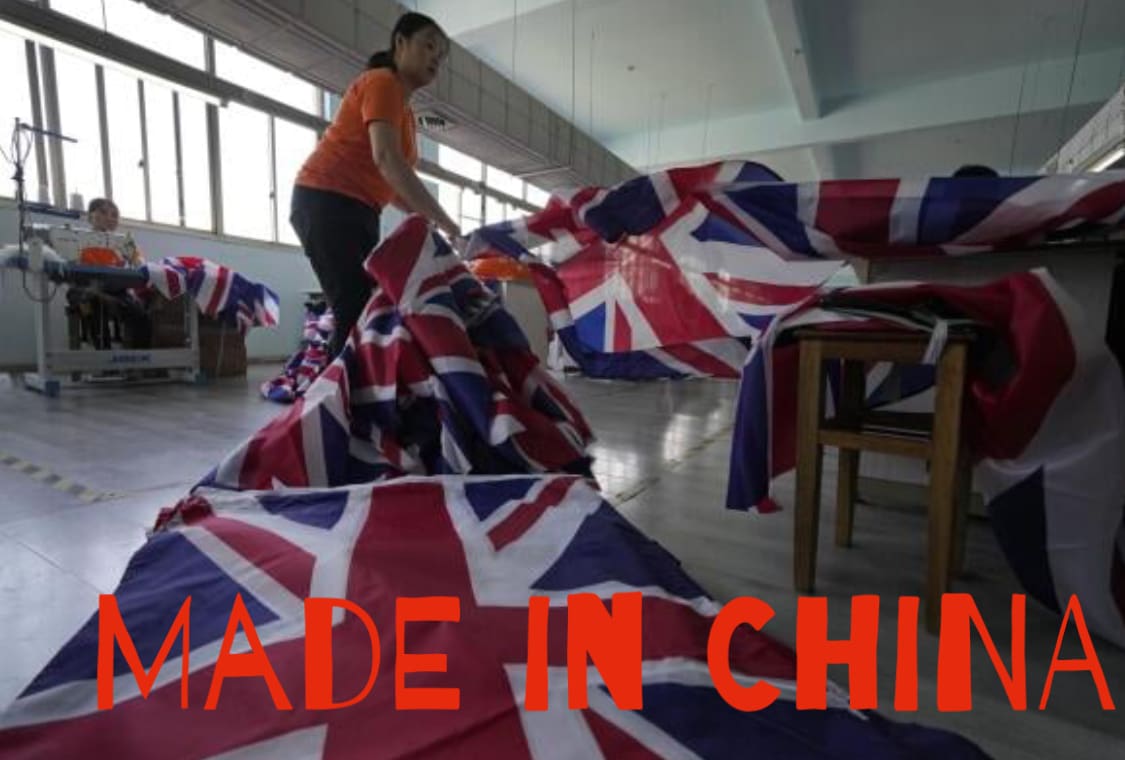
A majority of people responding to a Dorset Echo survey have rejected the attempt to fill Weymouth’s streets with Union flags (made in China) erected by a controversial nationalist campaign, raising awkward questions for those presenting the displays as an expression of popular patriotism.
The poll found that 56.9 per cent of respondents did not want the flags put up, compared with 43.1 per cent who supported them.
‘The ones near ferry bridge are already tatty. Cheap Chinese shit and will look awful in another couple of weeks.’
It is a significant result because the campaign behind the Weymouth displays has attempted to portray the mass erection of flags on lampposts as a spontaneous expression of national pride.
The figures suggest something rather different.
A majority of respondents did not want them.
And that matters.
The flags have been associated with Flagman UK and the wider Raise the Colours movement, a campaign that has spread the unauthorised erection of Union Jacks and St George’s flags across England.
The movement has attracted increasingly intense scrutiny because of the individuals involved, its links to anti-migrant activism and the confrontational circumstances surrounding some of its activities.
Most significantly, Ryan Bridge, a co-founder of Raise the Colours, was charged this month with 14 offences following a police investigation into incidents in Oxfordshire.
The charges include seven counts of using threatening words or behaviour, three counts involving threatening, abusive or insulting words or behaviour with intent to cause fear of or provoke unlawful violence, two racially aggravated harassment charges, a racially aggravated fear-of-violence charge and common assault.
Bridge denies wrongdoing.
The circumstances surrounding the movement’s other leading figures have also become deeply uncomfortable.
Billy Allison, a member of Raise the Colours, has pleaded not guilty to murder following the death of Matthew O’Gara after an incident outside a bar in Lichfield. He also denies a charge of causing grievous bodily harm with intent. His trial is due to begin in October.
Another figure associated with the movement, Ben Cullen, faces charges relating to indecent images of children. Those allegations remain allegations and Cullen has not been convicted.
These facts do not make the Union Jack itself responsible for the alleged conduct of individuals.
Nor does flying the Union flag automatically make somebody far-right.
Millions of perfectly ordinary British people display the Union Jack without any connection whatsoever to nationalist politics.
‘Stop using them as a symbol of hate, and maybe people will agree.’
The issue in Weymouth is rather more specific: who is putting these particular flags on public infrastructure, what campaign do they belong to, and what political activity surrounds that campaign?
That distinction is crucial.
Because Raise the Colours is not simply a community group organising a village fête.
The campaign has been at the centre of a national dispute over the unauthorised attachment of flags to public property.
In Oxfordshire, the local authority obtained a High Court injunction preventing members of the group from putting flags on council property. The court action followed concerns about safety, obstruction, harassment and confrontations surrounding the removal of flags.
The controversy has subsequently spread to other parts of England.
And now Weymouth is being used as another stage.
That should concern anyone who believes that public space belongs to the public rather than to whichever organised political faction is prepared to climb a lamppost first.
There is nothing remotely anti-British about saying that.
Indeed, the opposite is true.
The right to fly a flag does not include the automatic right to attach it to somebody else’s property.
Nor does loudly proclaiming patriotism provide an exemption from planning, highways, safety or other laws.
Dorset Council has previously made its position clear: permission had not been granted for items to be attached to highway infrastructure, and unauthorised attachments would be removed regardless of their content or symbolism.
That is an important principle.
It means the council does not have to decide whether a Union Jack is politically acceptable before enforcing the rules.
The same rules should apply whether someone attaches a Union Jack, a St George’s Cross, a Palestinian flag, a political party banner, a campaign poster or any other symbol to public infrastructure.
Otherwise the message is simple: if you are sufficiently determined, organised and willing to ignore the rules, you can claim public space for yourself.
That is not patriotism.
It is a challenge to public authority.
And the Weymouth survey makes clear that a substantial section of the local public does not want that challenge accepted.
The controversy is also occurring against a much wider political background.
Raise the Colours has been repeatedly criticised by anti-racism campaigners for using national flags alongside an anti-immigration political message.
Lynne Hubbard of Stand Up To Racism Dorset previously warned that the campaign could create an environment in which some people feel “uneasy and threatened”.
That criticism cannot simply be dismissed as opposition to the Union Jack.
The flag belongs to everyone.
What is being contested is the political meaning attached to its deliberate mass deployment in particular places, by particular organisations, at particular times.
And there is another uncomfortable question.
If the campaign genuinely believes that the flags represent the wishes of local communities, why is it necessary to install them without permission on public infrastructure?
Why not ask residents?
Why not hold properly organised community events?
Why not persuade councils to approve displays?
Why not allow local people to decide whether they want their streets decorated in this way?
The Dorset Echo survey has effectively provided part of that answer.
When asked directly, 56.9 percent said no.
That is not evidence that Weymouth is hostile to Britain.
It is evidence that patriotism cannot simply be imposed on a town and then presented as though everybody agrees.
There is also a democratic danger in allowing a vocal minority to confuse visibility with consent.
A dozen people on ladders can make a street appear to support something that a majority of local respondents may not support at all.
A forest of flags can create the illusion of overwhelming public enthusiasm.
The poll punctures that illusion.
And the controversy surrounding the people and organisations behind the campaign makes it even more important that residents are told the full story.
Nobody should be condemned because of an allegation against somebody else.
But neither should the public be expected to ignore documented links, criminal charges, court proceedings, political associations and repeated disputes over the legality of flag installations.
The Union Jack is not the problem.
The attempt to use Britain’s national symbols as a vehicle for a particular political campaign – while bypassing the consent of the communities in which the symbols are being imposed – is the issue.
Weymouth residents have now had their say in one local survey.
The result was not overwhelming.
But it was unmistakable.
More people said they did not want the flags than wanted them.
That should be impossible for anyone claiming to speak for Weymouth to ignore.