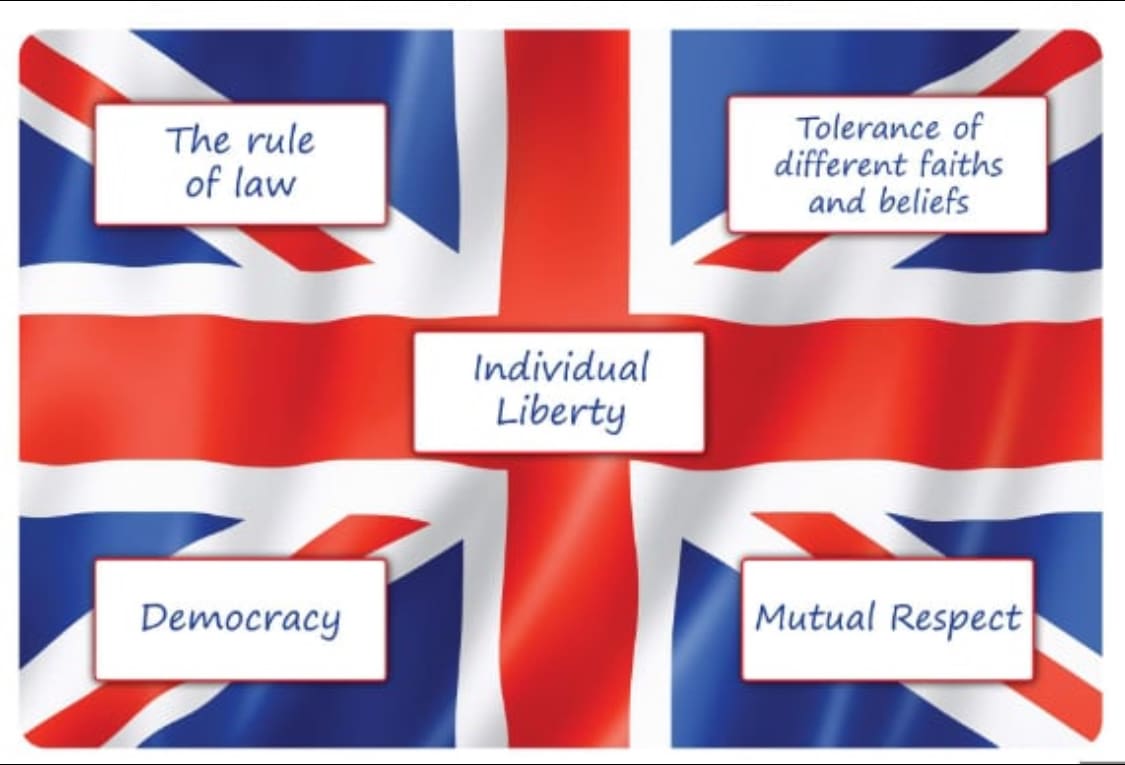
The phrase “British values” is often invoked in schools, in politics, and in public debate. It usually refers to five core principles: democracy, the rule of law, individual liberty, mutual respect, and tolerance of those with different faiths and beliefs. Some would add fairness and equality to the list. These values are not empty slogans. They have been shaped through centuries of struggle, from Magna Carta to the suffragettes, from the post-war settlement to human rights legislation. They are lived out daily when citizens cast their votes, criticise government without fear of reprisal, practise their faiths freely, and expect justice to be impartial.
| Official British Values (government/education) | Traditional & Cultural Values (popularly associated) |
|---|---|
| Democracy – free and fair elections, public voice | Fair play – sense of justice, doing things properly |
| Rule of law – everyone equal before the law | “Stiff upper lip” – resilience, calm in adversity |
| Individual liberty – freedom of choice, expression | Politeness & good manners – saying “please,” “thank you,” queueing |
| Mutual respect – treating others with courtesy | Respect for tradition – monarchy, Parliament, ceremonies |
| Tolerance of different faiths & beliefs – recognition of diversity | Community spirit – helping neighbours, pulling together |
| Tolerance & understatement – modesty, avoiding fuss | |
| Self-deprecating humour – poking fun at oneself | |
| Love of tea (and pubs) – light-hearted national quirks |
Yet in Britain today, some of the loudest voices claiming to defend “Britishness” belong to those most intent on undermining these very values. The far right, in its various guises, proclaims itself the guardian of the nation. In practice, however, its leaders and movements betray Britain’s democratic traditions, corrode respect and tolerance, and endanger the fairness that holds society together.
Democracy and the Rule of Law
At the heart of British values lies the principle of democracy: the idea that power is vested in the people and that governments are accountable to them. This is underpinned by the rule of law, which insists that everyone — from ordinary citizens to ministers and monarchs — is bound by the same legal standards. As Baroness Hale, former president of the Supreme Court, once said: “The rule of law is what keeps us safe from arbitrary power.”
Far-right figures frequently undermine both. Tommy Robinson, born Stephen Yaxley-Lennon, has built a career on attacking judges, vilifying the press, and framing courts as enemies of the people. Convicted of contempt of court and other offences, he has cast himself as a martyr to free speech while disregarding the law he claims to uphold. By eroding trust in democratic institutions and peddling conspiracy theories, he weakens the framework that guarantees liberty for all.
Similarly, activists around Mark Collett, leader of the extremist group Patriotic Alternative, encourage sympathisers to infiltrate mainstream politics in order to steer it towards white nationalist agendas. A BBC investigation in 2024 reported how his supporters sought to influence parties such as Reform UK. Such manoeuvres, grounded in deception and exclusion, are antithetical to open democracy.
| Name / Movement | Ways They Are Said to Betray British Values |
|---|---|
| Tommy Robinson (Stephen Yaxley-Lennon) | Widely regarded as a leading far-right Islamophobic influencer. He has amplified anti-Muslim rhetoric, spread misinformation, been convicted for contempt of court, and used provocative language that many say undermines democratic discourse and mutual respect. |
| Mark Collett | Leader of Patriotic Alternative, which promotes a “pro-white” anti-immigration agenda. He has been associated with efforts to shift broader right-wing currents in the UK toward more extremist and exclusionary views. |
| Anne Marie Waters | Founder of the anti-Islam party For Britain, former activist in UKIP, and involved in launching UK branches of Pegida. Criticised for targeting Muslim communities, promoting intolerance, and undermining social cohesion. |
| Jim Dowson | Christian nationalist activist, one of the financial backers / organisers in far-right groups such as Britain First and Knights Templar International. He uses religious identity in a politicised way, often to polarise issues of immigration or multiculturalism. |
Liberty and Respect
Individual liberty is central to Britain’s political tradition. It is the right to speak, to worship, to assemble, to protest, and to make choices about one’s life, provided those choices do not infringe upon the rights of others. Liberty in a healthy society is balanced by respect for the dignity of all. John Stuart Mill, in On Liberty, argued that freedom ends where harm begins.
But far-right politics is built on contempt rather than respect. Anne Marie Waters, founder of the party For Britain and formerly linked to anti-Islam groups such as Pegida UK, has dedicated much of her career to portraying Muslims as a problem population. This rhetoric narrows liberty rather than expanding it: by turning a community into a target, it denies individuals the freedom to live without harassment or fear.
Likewise, campaigns led or supported by Britain First and activists like Jim Dowson use intimidation, protest stunts, and inflammatory propaganda to silence others. They do not broaden the marketplace of ideas; they attempt to dominate it with hostility.
Tolerance and Diversity
Another cornerstone of British values is tolerance — not passive acceptance, but an active commitment to respecting difference. Britain’s story has always been plural: Huguenot refugees in the seventeenth century, Jewish communities fleeing pogroms, Windrush arrivals staffing hospitals and public transport, and more recent waves of migration from South Asia, Africa and Eastern Europe. Census data confirms that around 15 per cent of residents today were born overseas. Far from diminishing the nation, research from the British Academy has shown that diversity enriches our economy, our culture and our civic life.
The far right, however, frames diversity as a threat. Mark Collett’s Patriotic Alternative openly advocates for a Britain defined by whiteness. Waters and Robinson regularly characterise immigration and multiculturalism as dangers to national identity. In so doing, they reject the lived reality of modern Britain. Tolerance is not undermined by diversity; it is realised through it.
Fairness and Equality
British values also rest on fairness — the belief that institutions should treat people equitably, that opportunity should not be limited by background, and that rights belong to all. Far-right movements consistently betray this principle. By scapegoating immigrants for housing shortages, health service pressures or crime, they divert attention from systemic issues while fuelling resentment. Their vision of Britain is not one of equality but of hierarchy, where some are considered more deserving of rights and protection than others.
The Real Consequences
This betrayal has real-world consequences. Far-right rhetoric fuels polarisation, emboldens hate crimes, and has been linked to acts of violence. It chips away at the authority of democratic institutions by casting judges, journalists and politicians as traitors. It damages social cohesion by telling minorities they do not belong. And it harms Britain’s reputation abroad, diminishing its ability to stand credibly for human rights and democratic values.
The True Defence of British Values
British values have never been static. They have evolved through the struggles of ordinary people — suffragettes demanding the vote, trade unionists demanding fair wages, campaigners standing against fascists at Cable Street in 1936. To defend these values is not to wrap oneself in a flag while stoking division. It is to practise democracy, respect liberty, champion fairness, and embrace pluralism.
By that standard, the far right are not defenders of Britain’s values. They are their greatest contradiction. In their rhetoric and their actions, figures such as Tommy Robinson, Nigel Farage, Mark Collett, Anne Marie Waters, and Jim Dowson reveal themselves as betrayers of the very principles they claim to protect. The true task lies with those who believe in democracy, fairness, liberty and tolerance to uphold them in everyday life, resisting those who would undermine them for short-term gain.