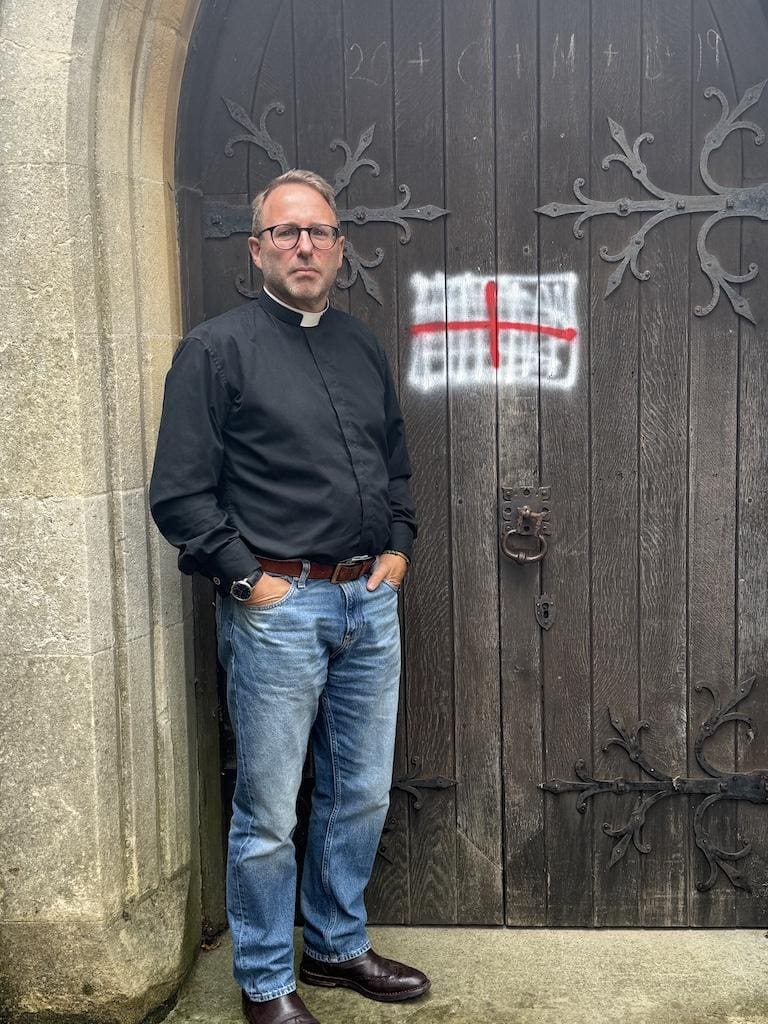
New investigation exposes the hypocrisy at the heart of Christian nationalism, revealing that many who invoke Christianity to attack migrants and Muslims rarely practise the faith they claim to defend.
The far right’s increasingly public display of crosses, chants of “Christ is King” and claims to be defending Britain’s Christian heritage are supposed to demonstrate a religious revival. But new research suggests something rather different: some of the loudest voices claiming to defend Christianity are far more interested in national identity, hostility towards immigration and opposition to Islam than in practising the religion they invoke.
A report by the thinktank Theos, based on a survey of 1,765 adults conducted in April 2026, has exposed a striking contradiction at the heart of British Christian nationalism. The research identified five groups according to their attitudes towards Christianity and Britishness, with the group most closely resembling Christian nationalists accounting for just 11% of respondents.
The findings raise an uncomfortable question for those marching under crosses and presenting themselves as defenders of the Christian faith: are they defending Christianity, or using it as a political weapon?
Christianity as a political identity
Theos researchers called the group most closely aligned with Christian nationalism “identity integrationists”. Although 81% identified as Christian, only 13% attended church weekly. Just 31% prayed weekly, while fewer than half expressed an interest in the Bible.
Their defining characteristic was not regular religious observance, but the belief that Christianity should be central to British national identity.
A remarkable 90% believed defending Britain’s Christian culture and heritage was important to being Christian. Yet only 19% agreed that Christian values required welcoming and supporting asylum seekers, while just 30% supported the equal treatment of religions in public life.
The group was also strongly hostile to immigration and Islam.
These figures expose the central contradiction in Christian nationalism: a movement that claims to defend Christian values appears far more concerned with deciding who belongs in Britain than with the religious practices and ethical responsibilities associated with Christianity.
This is particularly relevant as far-right demonstrations have featured people carrying wooden crosses and crowds chanting “Christ is King”. Such displays can create the impression of a growing religious movement. But the research suggests that, for many involved, Christianity functions primarily as a badge of national identity rather than a regularly practised faith.
Practising Christians tell a different story
The contrast with another group in the research is revealing.
Theos identified a group called “belief integrationists”, who also reported high levels of Christian affiliation but demonstrated considerably greater religious observance and more inclusive attitudes.
Among this group, 31% attended church weekly, 46% prayed weekly and 62% expressed an interest in the Bible.
Nearly half, 48%, agreed that Christian values required welcoming and supporting asylum seekers. Meanwhile, 63% supported the equal treatment of religions in public life.
Only 18% believed defending Britain’s Christian culture and heritage was important to being Christian.
In other words, the group displaying the strongest commitment to practising Christianity was much less likely to insist that Christianity should serve as a test of national belonging.
The research also found that practising Christians were the most ethnically diverse group surveyed, with 20% identifying as non-white. The Christian nationalist group was among the least ethnically diverse.
These findings undermine the simplistic claim that defending Christianity necessarily means defending a particular ethnic or national identity.
Christianity is a global religion, practised by people of every ethnicity and nationality. The idea that it belongs exclusively to white Britons is not merely politically divisive; it ignores the reality of Christianity itself.
The disturbing spread of conspiracy theories
The research also uncovered worrying evidence of anti-Muslim prejudice and conspiratorial thinking.
More than half of respondents, 55%, said they would be unhappy if their local church closed and became a mosque. Some 37% said they would be very unhappy.
Even more troubling, 37% agreed with the so-called “great replacement” conspiracy theory, which claims that Europe’s white population is being deliberately replaced by migrants from Muslim countries.
This is not an ordinary debate about immigration policy. The great replacement theory has become a central narrative within sections of the international far right, portraying demographic change as a deliberate plot against white populations.
When such ideas become intertwined with claims of defending Christianity, religion risks being transformed from a source of spiritual reflection into a vehicle for fear, resentment and exclusion.
The figures do not mean that everyone who identifies as Christian nationalist subscribes to every far-right conspiracy theory. Nor does the research establish that all participants in anti-immigration demonstrations hold identical beliefs. But it does reveal a disturbing overlap between Christian national identity, hostility towards religious diversity and conspiratorial views about immigration.
What would Jesus make of it?
Arun Arora, the Church of England bishop of Kirkstall in Leeds, identified the distinction between displaying a cross and living according to Christian teachings.
He argued that nationalists appeared eager to carry crosses at demonstrations but showed less interest in the demands of self-denial and following Jesus.
That observation goes to the heart of the issue. Christianity is not simply a cultural inheritance or a symbol to be displayed at a political rally. Its teachings include loving one’s neighbour, caring for the vulnerable and extending compassion beyond familiar communities.
The Rev Dr Helen Paynter, a theologian who has researched the far right’s use of Christianity, likewise warned against equating the Church with any particular nationality or ethnicity. She highlighted the global reality of a faith whose followers include millions of poor, female and Black Christians.
Her argument challenges those who attempt to present Christianity as the exclusive property of a particular national or racial group.
It also raises an obvious question: how can a movement claim to defend Christian values while treating refugees, migrants and Muslims as threats simply because of their origins or beliefs?
Political disagreements about immigration are legitimate. But wrapping hostility towards outsiders in religious symbolism does not automatically make that hostility Christian.
A warning about the weaponisation of faith
Theos’s findings do not suggest that every Christian nationalist is irreligious, or that every person attending an anti-immigration rally is motivated by religious prejudice. They do, however, challenge the claim that the growing visibility of Christian symbolism on Britain’s streets represents a revival of Christian faith.
The evidence points towards something more complicated: Christianity being used by some people as a marker of national identity at a time of anxiety about immigration, Islam and cultural change.
That distinction matters. A cross can be a symbol of faith, sacrifice and love. It can also be deployed as a political emblem intended to draw a boundary between those deemed to belong and those portrayed as outsiders.
The danger is that the second use becomes confused with the first.
If Christian nationalism is less about attending church, prayer or engaging with scripture, and more about opposing migrants and defending an imagined version of a white Christian Britain, then its political appeal deserves serious scrutiny.
The question is not whether Britain has a Christian heritage. It plainly does. The question is whether that heritage should be used to justify exclusion, suspicion and hostility towards people of other faiths or nationalities.
The findings suggest that many practising Christians understand the distinction.
Those who claim to defend Christianity would do well to remember that displaying a cross is considerably easier than living by the values it represents.