

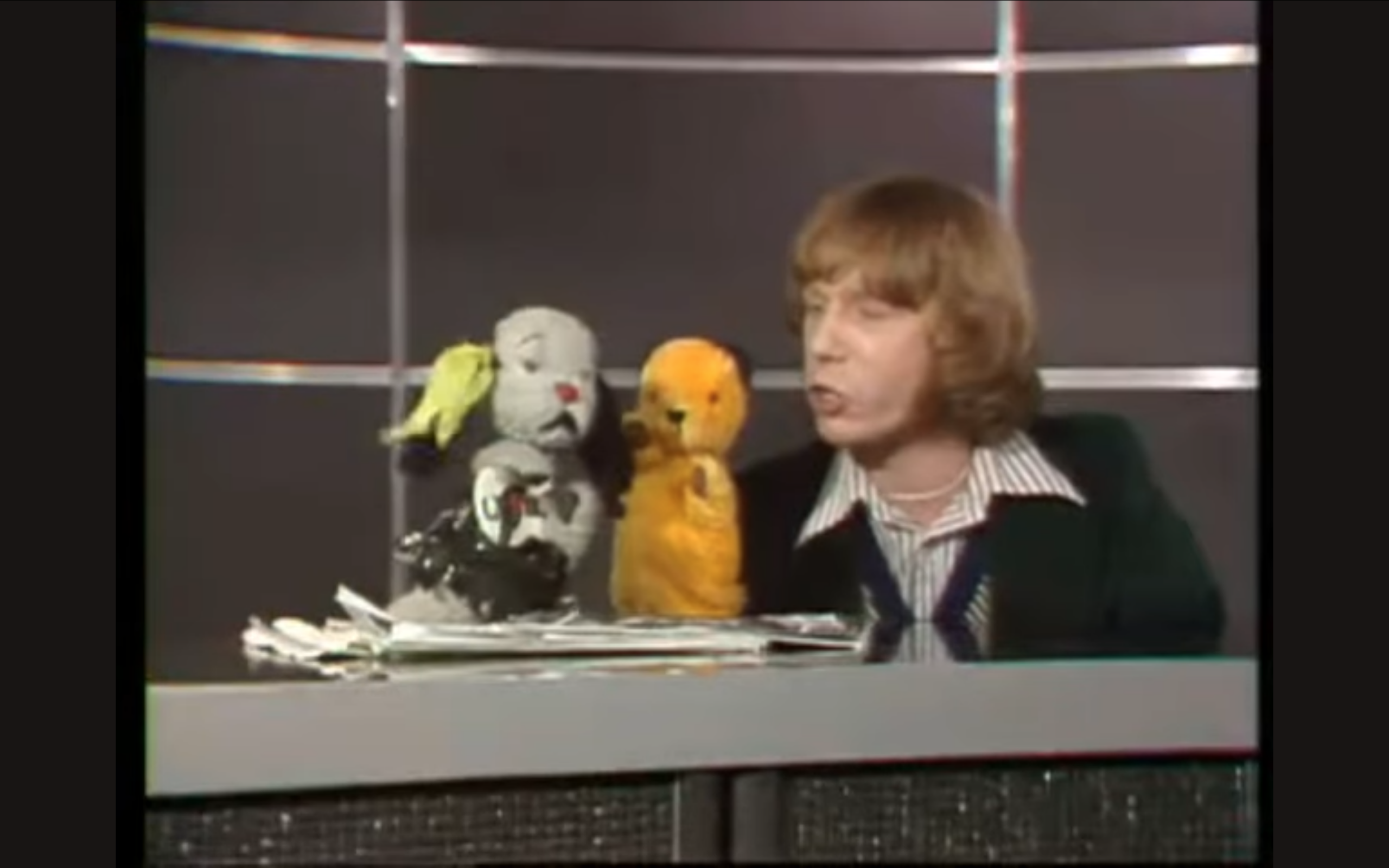
For more than seven decades, two small glove puppets have occupied a strange and beloved corner of British culture. On the surface they belong firmly in the nursery: simple jokes, slapstick chaos, jam tarts and magic wands. Yet the unlikely double act of Sooty and Sweep has repeatedly wandered into the adult world, sometimes in ways nobody quite expected. One of the most surreal examples came in 1977, when they appeared alongside the famously cerebral television presenter Tony Wilson on the late-night music programme So It Goes, a moment when children’s television collided with punk rock culture.
A Bear, a Dog, and British Television
The story begins in 1948 when puppeteer and magician Harry Corbett bought a small yellow glove puppet from a joke shop on Blackpool’s North Pier. Originally called Teddy, the puppet soon acquired distinctive black ears and a new name: Sooty. Corbett used him in magic shows, with Sooty communicating only through whispers into his handler’s ear.
The character’s appeal was immediate. Children loved the silent bear’s mischievous personality, which was clever, cheeky, and forever ready to cause chaos. Television followed quickly. By the mid-1950s, Sooty had his own programme, and a British institution was born.
But every great act needs a foil. Enter Sweep, the grey dog with the squeaky voice.
Where Sooty was quietly cunning, Sweep was exuberant and slightly dim. His entire vocabulary consisted of a rubber-squeaker noise that somehow conveyed excitement, indignation, confusion and delight. Viewers simply learned to understand him. Together they became a perfect comic pairing: the mastermind and the enthusiastic accomplice.
Over time the cast expanded, most notably with Soo, the calm and sensible panda who often tried (usually unsuccessfully) to impose order. Yet it was always the anarchic partnership of Sooty and Sweep that carried the show.
A Family Dynasty
When Harry Corbett retired in 1976, the show passed to his son Matthew Corbett. It was a rare example of a television property genuinely inherited by the next generation, not rebooted or reinvented.
Matthew Corbett preserved the original magic while gently modernising the format. The sets became brighter, the sketches more elaborate, and the comedy leaned further into absurdity.
Under his stewardship the programme flourished throughout the 1970s and 1980s. Millions of children grew up with Sooty waving his magic wand and declaring the immortal phrase: “Izzy wizzy, let’s get busy.”
Yet for all their reputation as children’s entertainers, Sooty and Sweep occasionally wandered into stranger territory.
When Sweep Went Punk
One of the oddest moments in British broadcasting history occurred in December 1977.
At the time, Tony Wilson was presenting So It Goes, a Granada Television programme that championed the emerging punk and new wave music scenes. The show is famous for introducing acts like the Sex Pistols to television audiences and for capturing the raw energy of late-1970s British music.
Wilson’s programme was clever, chaotic, and often deliberately pretentious — a long way from jam tarts and squeaky dogs.
Yet in one episode Wilson invited Matthew Corbett and his puppet companions to co-present the show.
The result was television surrealism at its finest.
Imagine the scene: amid performances by cutting-edge bands and earnest discussions about music culture, Sooty and Sweep appeared alongside Tony Wilson. A silent yellow bear and a squeaking dog suddenly hosting a programme associated with punk rebellion.
It was a perfect Wilson moment, high culture colliding with low, irony mixed with innocence.
Sweep squeaked enthusiastically. Sooty, as ever, plotted silent mischief. Wilson played along with the absurdity.
The episode has since become one of the most delightfully strange footnotes in British television history.
Why the Characters Endure
The remarkable thing about Sooty and Sweep is their longevity.
Television has changed dramatically since the 1950s. Children’s programmes now feature sophisticated animation, computer graphics and complex storytelling. Yet the appeal of a silent bear and a squeaking dog somehow survives.
Part of the secret lies in their simplicity.
Sooty rarely speaks. Sweep doesn’t speak at all. The comedy is visual, physical and universal: custard pies, exploding magic tricks, and ridiculous misunderstandings.
Children understand it instantly.
Adults, meanwhile, recognise the gentle nostalgia. For many parents and grandparents, watching Sooty with their children is a return to their own childhoods.
The characters have even survived multiple custodians. After Matthew Corbett retired in the 1990s, the show passed to magician and presenter Richard Cadell, who continues to perform with the puppets today.
The Strange Cultural Journey of a Puppet
What makes Sooty and Sweep fascinating is the strange path they have travelled through British culture.
They began as seaside entertainment in a Blackpool magic act. They became icons of children’s television. They appeared in theatre shows, royal galas, and even, briefly, the edgy world of punk-era television.
Not many children’s characters can claim such a journey.
Yet perhaps that is exactly why they endure.
Sooty and Sweep are simple enough to belong anywhere. In a living room with toddlers. On a theatre stage. Or, for one unforgettable evening in 1977, on a late-night music programme alongside Tony Wilson.
In the end, the magic wand still works. The jokes are still silly. Sweep still squeaks.
And somewhere in the background, Sooty is still whispering his plans into someone’s ear, probably involving a jam tart and a small explosion.
Which, when you think about it, might not be so different from punk rock after all.







