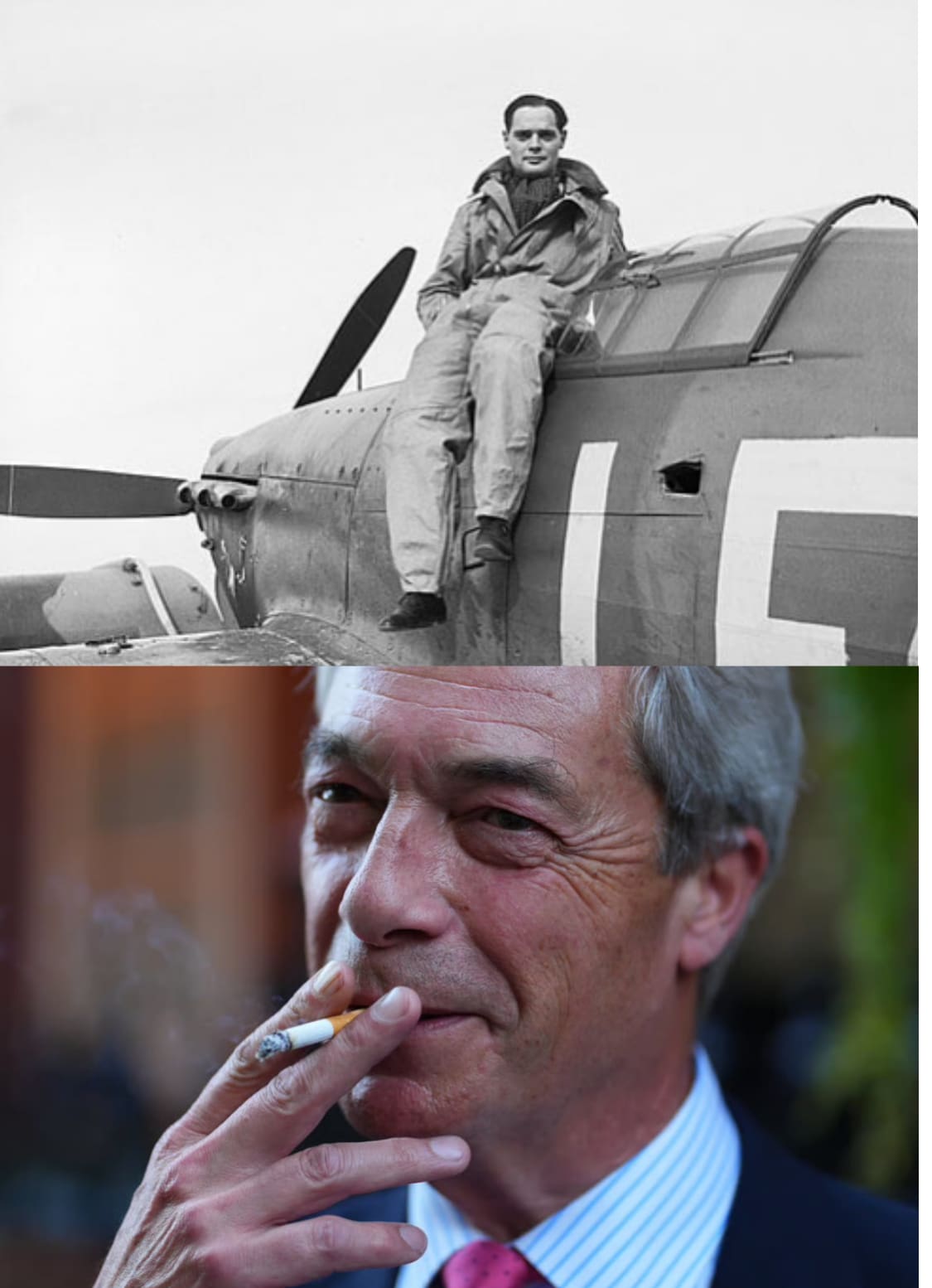
Douglas Bader: The Legless Ace Who Defied the Odds
In the annals of British history, few figures embody the spirit of “the Few” as remarkably as Group Captain Sir Douglas Bader. His story is not merely one of aerial combat prowess during the Battle of Britain but an extraordinary tale of resilience, defiance, and an indomitable will that triumphed over profound physical adversity.
The family of Douglas Bader makes it clear to Nigel Farage that they want nothing to do with his politics.

A True Hero
Born in London in 1910, Douglas Robert Steuart Bader was a gifted and fiercely competitive sportsman from a young age. He won a scholarship to St Edward’s School in Oxford and later, captivated by flight, joined the Royal Air Force in 1928. A natural and audacious pilot, he excelled at Cranwell, the RAF’s elite academy, graduating with a reputation for superb skill and a rebellious streak.
Tragedy struck in December 1931. While performing low-level aerobatics at Woodley airfield in a Bristol Bulldog, Bader’s aircraft crashed. The injuries were catastrophic: both of his legs had to be amputated—one above the knee and one below. For most, this would have meant the end of an RAF career. The medical board agreed and invalided him out of the service.
Refusing to be defined by his disability, Bader undertook a gruelling rehabilitation. He learned to walk on artificial legs with a distinctive, rolling gait, drove a car, and even played golf. His determination to return to the cockpit was absolute. He badgered the RAF for a flying assessment and, in November 1939, shortly after the outbreak of the Second World War, he was miraculously passed fit for flying duties.
The RAF, desperately short of experienced pilots, had allowed a legend to return. Bader quickly proved that his disability was no impediment. He discovered that his artificial legs actually allowed him to withstand higher G-forces than able-bodied pilots, as they prevented blood from pooling in his feet during violent manoeuvres.
Bader’s second act in the RAF was nothing short of brilliant. Posted to 19 Squadron and then to command 242 Squadron, a Canadian unit demoralised after the Dunkirk evacuation, he whipped his pilots into a formidable fighting force. His aggressive, hands-on leadership and his unshakable confidence were infectious.
He is most famous for his role in the Battle of Britain. A passionate advocate of the “Big Wing” formation—massing three to five squadrons to meet incoming German bombers as a single, devastating force—he often clashed with Air Vice-Marshal Keith Park at 11 Group. While the tactical efficacy of the Big Wing remains debated by historians, its psychological impact on the Luftwaffe was significant.
Bader’s score of 22 aerial victories (and numerous shared and damaged) cemented his status as a fighter ace. His personal aircraft, a Hawker Hurricane and later a Supermarine Spitfire, were instantly recognisable by the letters “D-B” on the side.
Bader’s incredible war came to an end on 9 August 1941. Over Northern France, his Spitfire collided with a German Messerschmitt Bf 109. Forced to bale out, one of his artificial legs became trapped in the cockpit. He escaped only when the leg tore free, leaving the prosthetic behind.
Captured and taken to a hospital near St Omer, his first request to the Germans was not for medical aid, but for them to radio the RAF and request a replacement leg. In a remarkable display of chivalry, the RAF agreed, and a new leg was dropped by parachute during a bombing raid. This act of respect between enemies is one of the war’s most famous anecdotes.
True to form, Bader was a notoriously difficult prisoner of war. He made multiple escape attempts from various camps, including Colditz Castle, so exasperating his captors that they eventually resorted to confiscating his legs at night.
After the war, Bader left the RAF in 1946 and embarked on a successful career in the aviation industry. He was knighted in 1976 for his services to disabled people, tirelessly campaigning and raising funds. He became a living symbol of courage, meeting with countless amputees to offer them hope and practical advice.
Douglas Bader died on 5 September 1982, aged 72, following a heart attack after a dinner honouring the Marshal of the RAF, Sir Arthur “Bomber” Harris. His legacy is immortal. He was a brilliant, if sometimes controversial, leader whose sheer force of personality and refusal to accept limits inspired a nation at its darkest hour and continues to inspire today. He remains the ultimate testament to the idea that the spirit, not the body, defines a person’s capabilities.
A vote for Reform UK is a vote for phony patriotism.