The UK has a first-past-the-post voting system. The following data reveals everything that is wrong about it.
Can you spot the PROBLEM?
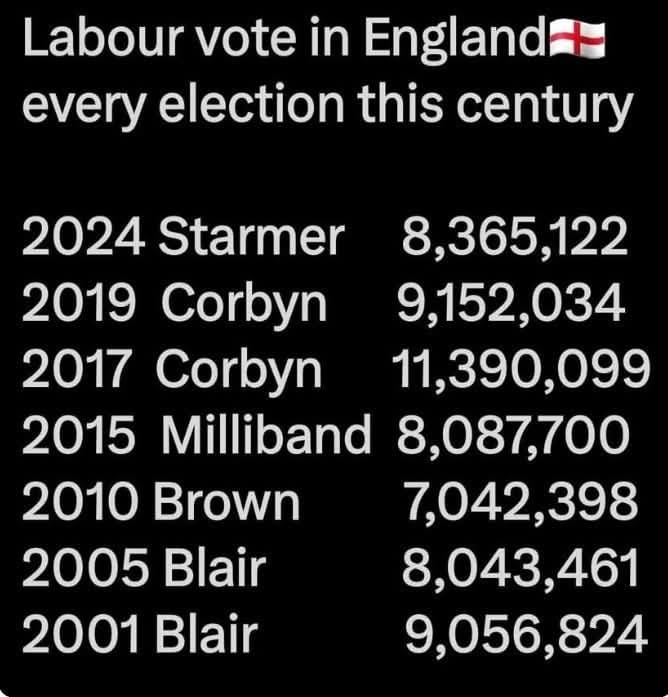
Hopefully it did not take long. However, for those not good with numbers, the issue is that the two largest numbers were somehow reported as a disaster. And one of the lowest was a landslide.
And they tell us we live in a democracy.
Does that make you laugh or cry?
Why First Past the Post Elections Are a Long Way from Being Democratic
In theory, democracy is about fair representation, equal voice, and government by the people. But in practice, at least in countries like the United Kingdom and the United States, our democratic ideals are consistently undermined by a voting system that fails to reflect the will of the people: First Past the Post (FPTP).
Despite being one of the oldest voting systems in the world, FPTP is increasingly viewed as archaic, unjust, and unfit for modern democracy. Here’s why.
1. Minority Rule: Most Votes Don’t Win
Under FPTP, the candidate with the most votes in a constituency wins, even if they haven’t secured more than 50% of the vote. This means that a candidate can be elected even when the majority of voters actively voted against them. In many UK constituencies, MPs are elected with as little as 30% of the vote, leaving the other 70% effectively unheard.
This isn’t representation, it’s a numbers game that rewards fragmented opposition and voter apathy.
2. Safe Seats and Voter Inequality
FPTP creates “safe seats” where one party is almost guaranteed to win every time. These areas often receive less attention during campaigns and can lead to complacency among elected officials. Meanwhile, swing seats, the handful of constituencies that could change hands, attract all the focus.
This breeds a two-tier system: voters in marginal constituencies are courted and valued, while those in safe seats are essentially ignored. That’s not equality, that’s a postcode lottery.
3. Tactical Voting Distorts True Intent
Because of the winner-takes-all nature of FPTP, many voters feel compelled to vote tactically, choosing the “least bad” candidate most likely to defeat their least preferred option, rather than voting for the party or person they truly support.
This distorts the true political landscape, suppresses emerging voices, and reinforces the dominance of major parties at the expense of new ideas.
4. Disproportionate Outcomes
Perhaps the most damning feature of FPTP is how it translates votes into seats. In the 2019 UK general election, the Conservative Party won 43.6% of the vote but gained 56.2% of the seats. Meanwhile, the Liberal Democrats won 11.5% of the vote but secured just 1.7% of the seats.
Such results aren’t just unfair, they actively undermine the idea that every vote should count equally.
5. Barriers to Pluralism
FPTP entrenches a two-party system and discourages diversity in representation. Smaller parties and independents are systematically locked out, not because they lack support, but because the system isn’t designed to accommodate pluralistic politics.
In a world that increasingly values nuance, cooperation, and diversity, FPTP forces us into binary choices and polarised politics.
A Democratic Illusion
The First Past the Post system might be simple to understand, but it fails at its most fundamental purpose: to fairly represent the will of the people. It’s a system that wastes millions of votes, creates perverse incentives, and delivers governments that often lack genuine majority support.
Democracy is more than putting an ‘X’ in a box; it’s about ensuring that all voices are heard and fairly represented. Until we move towards a more proportional system, like Single Transferable Vote or Mixed-Member Proportional representation, our elections will remain a long way from truly democratic.