The world becomes more of a shitshow as each day passes. But how did we get into this mess? Why did those who survived two world wars in the 20th century have their legacy destroyed by what came after? The following tries to make sense of each generation since the 1920’s and their role in enabling some very dangerous people to turn the 21st century into potentially something even worse.
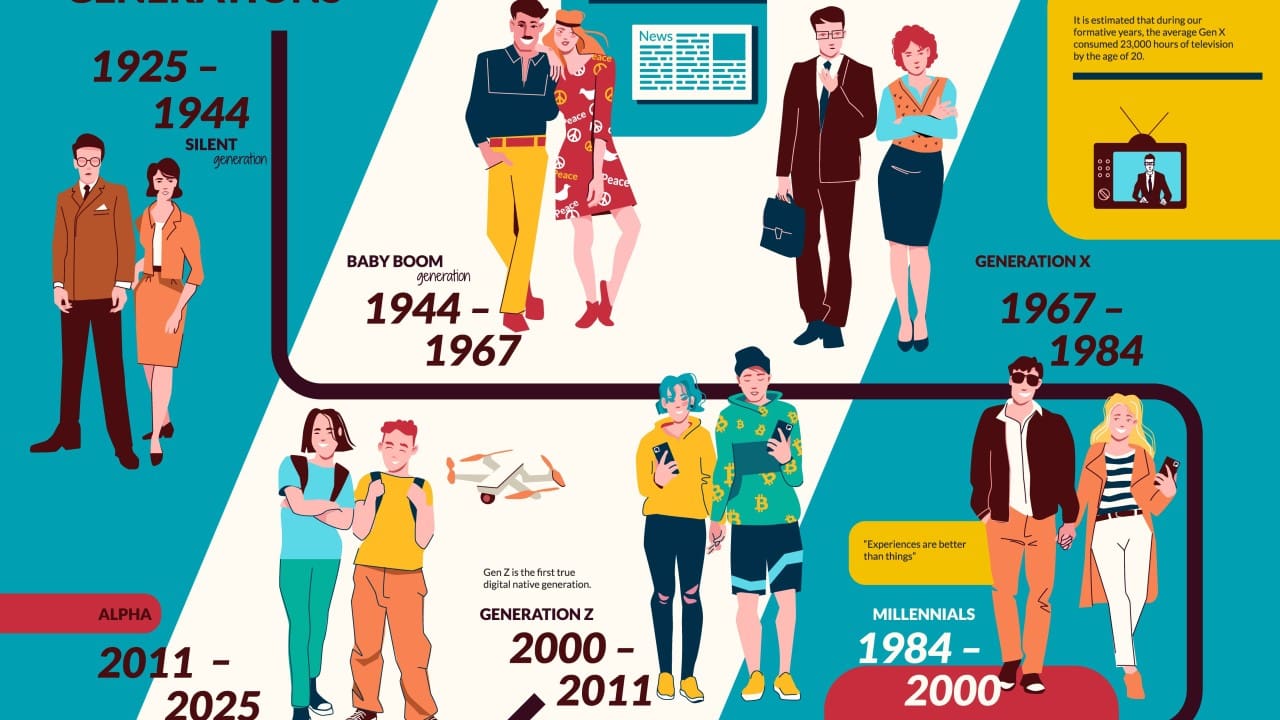
Every generation likes to believe it is uniquely shaped by history and, to some extent, it is. Wars, economic booms and busts, technological ‘revolutions’ and cultural shifts leave distinct fingerprints on the people who live through them. A widely shared generational breakdown offers a blunt, sometimes uncomfortable, summary of how different age groups have been moulded by their times. While inevitably simplified, it captures something recognisable about how society has evolved and why generations often talk past one another.
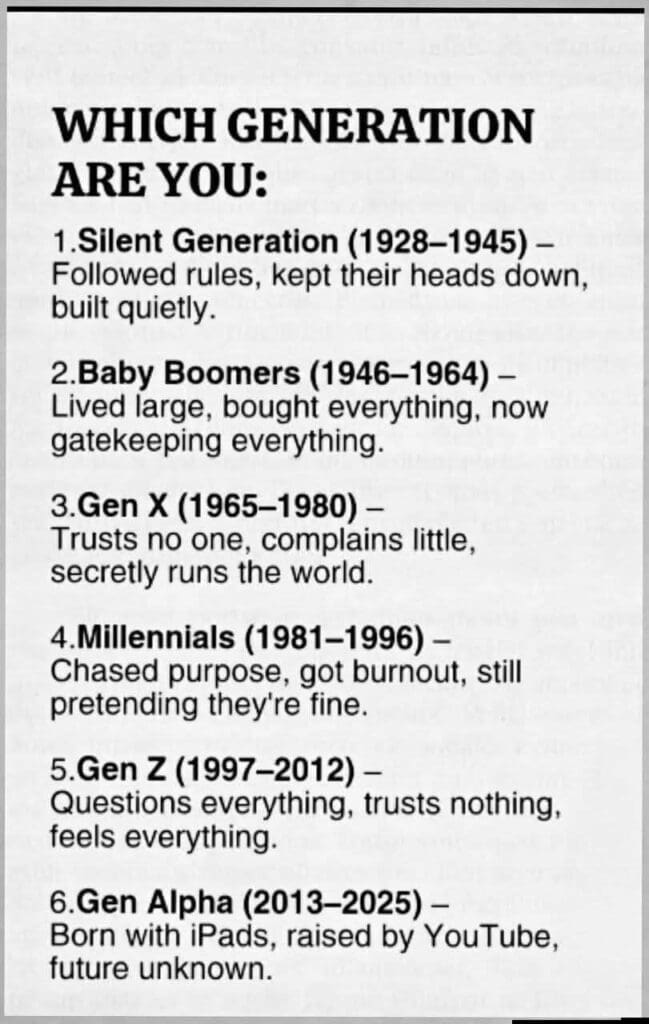
The Silent Generation (1928–1945): Builders Without Applause
The Silent Generation grew up in the shadow of the economic depression and the Second World War. They were taught not to complain, not to expect much, and not to stand out. Security mattered more than self-expression. Many followed rules because rules were what kept societies functioning during chaos.
They rebuilt quietly: homes, industries, and public services, often without expecting credit. Their values of duty, thrift and restraint laid much of the groundwork for the post-war state, even if they rarely shouted about it.
Baby Boomers (1946–1964): Opportunity and Ownership
Born into post-war optimism, Baby Boomers benefited from expanding education, plentiful jobs and affordable housing. Many lived large by historical standards, accumulating property, pensions and political influence.
Critics argue that this generation pulled up the ladder behind them, gatekeeping opportunities that were once widely available. Whether entirely fair or not, it is undeniable that Boomers came of age during a period of growth that later generations have not enjoyed and the choices made during those years still shape economic and political life today.
Generation X (1965–1980): Quiet Sceptics
Often overlooked, Generation X learned early not to trust institutions. They grew up amid industrial decline, rising divorce rates and the erosion of job-for-life security. As a result, they tend to be self-reliant, cynical and understated.
They complain less publicly than younger generations, yet disproportionately occupy leadership roles across business, media and government. If the world seems to run on a mixture of pragmatism and quiet compromise, Gen X is often behind the curtain.
Millennials (1981–1996): Purpose, Pressure and Burnout
Millennials were told they could be anything and then discovered the bill. Raised to value purpose, fulfilment and self-expression, many entered adulthood just as financial crises, soaring housing costs and insecure work took hold.
They chased meaning, burned out, and were then told to be grateful. Mental health conversations became unavoidable not because Millennials are weaker, but because the gap between promise and reality became impossible to ignore. Many continue to perform resilience while privately running on empty.
Generation Z (1997–2012): Hyper-Aware and Emotionally Fluent
Gen Z has never known a world without smartphones, social media or permanent connectivity. They question everything because they have seen too much too early: political failure, climate crisis, online misinformation and economic precarity.
They trust institutions least of all, yet feel deeply about identity, justice and the future. Often caricatured as fragile, they are arguably the most clear-eyed generation yet about how broken many systems have become.
Generation Alpha (2013–2025): The Unknown Future
Generation Alpha is growing up swiping before speaking, raised by algorithms as much as adults. iPads, YouTube and AI are not tools to them; they are the environment.
What this will mean remains unclear. They may become the most adaptable generation in history or the most overwhelmed. Their future will depend less on their own choices and more on whether older generations act responsibly now.
More Than Labels
Generational labels are blunt instruments. Not everyone fits their stereotype, and blaming entire age groups rarely leads to solutions. But these summaries do reveal something important: each generation is shaped by circumstances largely beyond its control.
Understanding that may be the first step towards less resentment and more responsibility, especially from those who still hold the power to shape what comes next.
And what does come next?
More greed and concentration of wealth or more humanity and solidarity?
And what will future generations make of the conflict and destruction we continually impose upon ourselves? Will they even be around to judge?