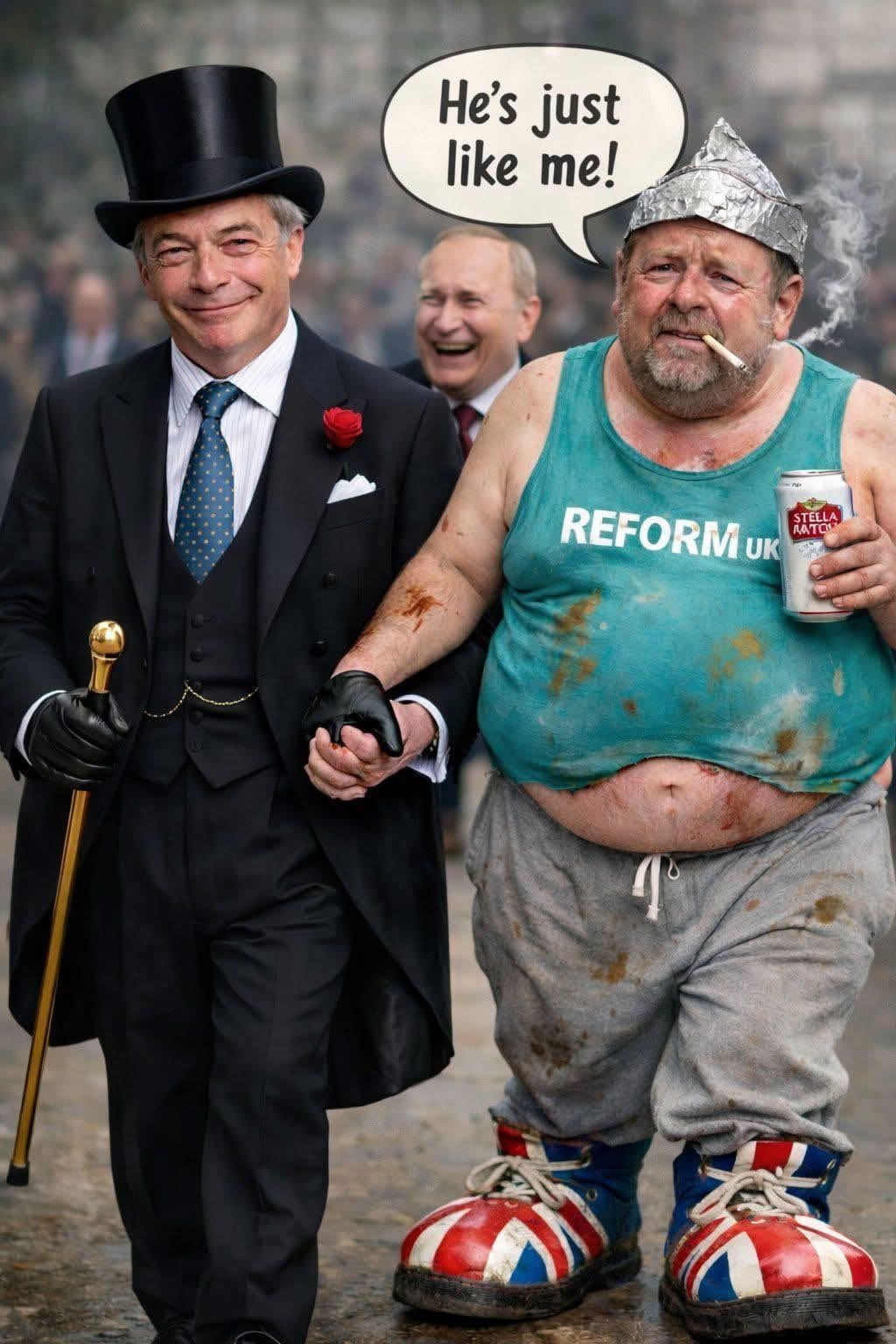
When public figures speak, facts are supposed to matter. Yet in Britain’s increasingly febrile political climate, numbers are tossed around like confetti at a rally, useful not because they’re true, but because they feel true to an already primed audience.
Take Jim Ratcliffe, billionaire industrialist and co-owner of Manchester United. Ratcliffe recently claimed that the UK population had surged from 58 million in 2020 to 70 million today. It’s a dramatic figure, startling enough to provoke anxiety and perfectly calibrated to suggest chaos. It is also wrong. Official data show the population rose from 66.7 million to 69.4 million over that period, an increase of 2.7 million, largely driven by net migration. That is a significant rise, yes, but not the 12-million explosion implied.
In the echo chamber of culture-war politics, however, precision is optional. The point is not accuracy; it is impact.
Standing shoulder to shoulder with Ratcliffe was Nigel Farage, who claimed that one million people in Britain do not speak English and that entire areas have been “completely changed.” Again, it’s a claim designed to conjure alienation and loss. Yet the 2021 Census recorded around 161,000 people in England and Wales who could not speak English at all, a fraction of the number cited. The overwhelming majority of non-native speakers reported speaking English well or very well.
That distinction matters. One million people not speaking English suggests parallel societies and systemic breakdown. 161,000 people—many of whom are elderly or recently arrived—suggests something far more mundane: a complex, multilingual country that remains overwhelmingly English-speaking.
Critics, including Prime Minister Keir Starmer, have labelled such rhetoric divisive and racist. Farage, for his part, insists he is voicing legitimate concerns about integration and demographic change. He points to years of high net migration and argues that rapid shifts place pressure on housing, services, and social cohesion. These are debates worth having in a mature democracy.
But mature debates require adult numeracy.
The problem is not that immigration is discussed. It is that the discussion is so often fuelled by exaggeration. Inflate the baseline population downward, inflate the current population upward, and round up English-language difficulties by a factor of six and you produce a crisis on paper that bears only partial resemblance to reality.
And here lies the deeper issue. When influential figures repeatedly present distorted numbers without consequence, it sends a message: the audience either will not check or will not care. If supporters are already convinced that Britain is on the brink, the exact figures become irrelevant. The narrative does the work. Correcting the statistics feels pedantic, even suspect—“establishment spin” against “common sense.”
This dynamic corrodes public discourse. Democracy depends on shared facts, even when interpretations differ. One can argue for stricter immigration controls based on a 2.7 million increase. One can question integration policy based on census data. But if debate begins with fictional baselines, policy conclusions drift further from evidence.
The tragedy is that real challenges do exist. Net migration has fluctuated sharply in recent years. Housing shortages are real. Public services are stretched. Integration policy deserves scrutiny. None of that requires conjuring an imaginary 12-million population surge or multiplying language barriers sixfold.
Yet exaggeration is seductive. It is emotionally potent. It travels faster than corrections. And for politicians and public figures chasing headlines or votes, the temptation to trade precision for punchlines can prove irresistible.
In the end, this is less about Ratcliffe or Farage individually and more about the ecosystem that rewards sensationalism. If audiences demand accuracy, public figures will provide it. If audiences applaud whatever confirms their fears, then the line between error and invention blurs.
Facts are stubborn things. They may be inconvenient, but they do not bend to applause. The question is whether Britain’s political culture still values them—or whether, given the right speech and the right crowd, even the most implausible claims would be swallowed whole.