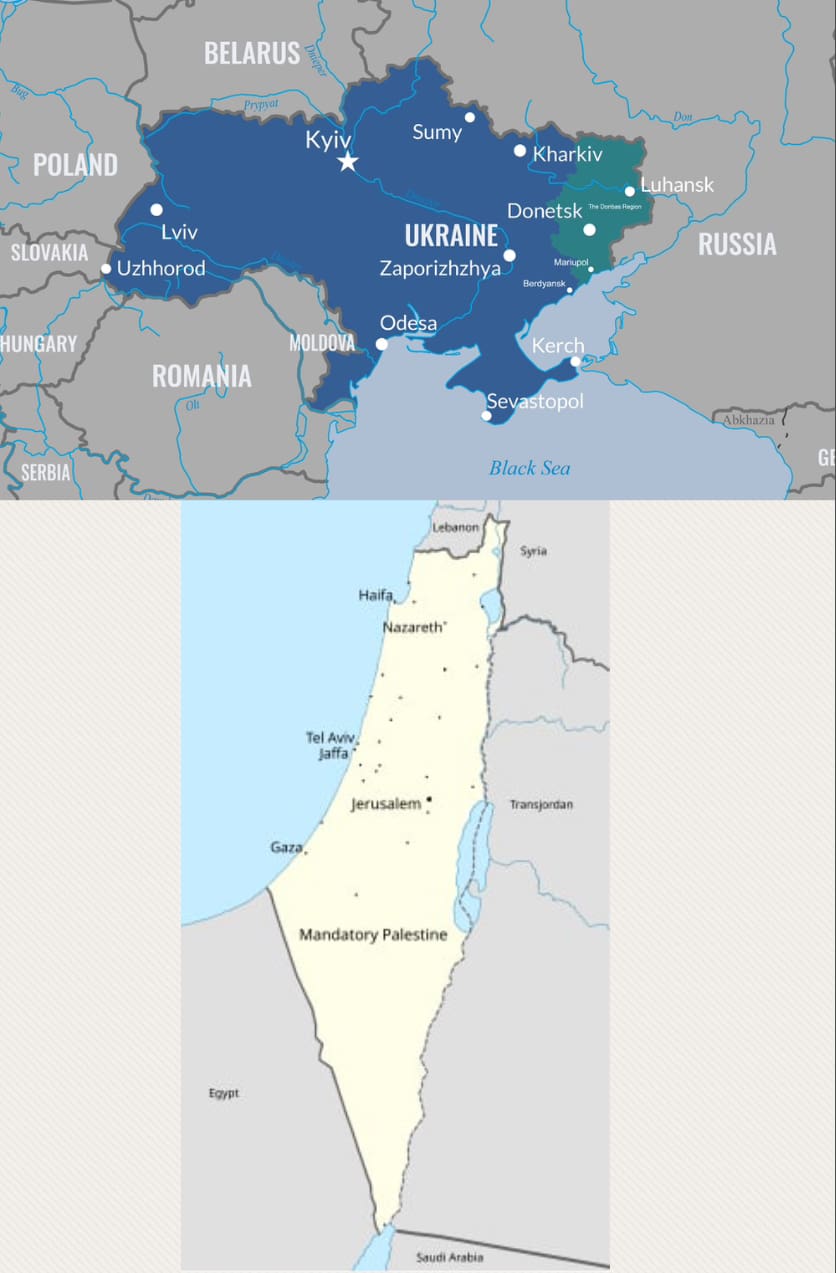
When Russia invaded Ukraine in February 2022, Western leaders rallied around a clear legal and moral principle: no state may acquire territory by force. This idea is not merely political rhetoric; it is embedded in the bedrock of modern international law.
Article 2(4) of the UN Charter prohibits the acquisition of territory through aggression. The Fourth Geneva Convention forbids the transfer of an occupier’s population into occupied land. The UN General Assembly reaffirmed—again—that Ukraine’s territorial integrity within its 1991 borders is inviolable.
In short, the West insists that Ukraine must not—cannot—be pressured into relinquishing land seized by Russia.
Yet, when the conversation shifts to Palestine, the tone changes. Palestinians living under a decades-long occupation have been repeatedly told, implicitly and sometimes explicitly, that they must accept the permanence of territorial loss. Land taken in 1967, despite being recognised by the UN as occupied, is frequently treated in Western discourse as a “final status” bargaining chip rather than territory to be restored.
The contrast exposes a moral fissure:
Why is territorial integrity sacrosanct in Ukraine but negotiable in Palestine?
The Legal Standards Are Clear—In Theory
International law is remarkably consistent on the issue of occupation.
- UN Security Council Resolution 242 (1967) emphasises “the inadmissibility of the acquisition of territory by war”.
- UN Security Council Resolution 338 (1973) calls for the implementation of Resolution 242 and a negotiated end to occupation.
- The International Court of Justice (ICJ) advisory opinion (2004) on the separation barrier in the West Bank affirmed that the territories are occupied and that Israeli settlements violate the Fourth Geneva Convention.
- The legal principle of self-determination, enshrined in Article 1 of both the ICCPR and ICESCR, applies equally to Palestinians as to Ukrainians.
By these standards, the expectation should be clear:
occupied land should be returned, not negotiated away under duress.
And yet, this is not how the West treats the two situations.
From Principle to Pragmatism: A Tale of Two Occupations
1. Ukraine: Law as a Shield
Western leaders refuse to entertain the idea that Ukraine should cede Crimea or the Donbas to secure peace.
To do so, they argue, would reward aggression and fatally weaken the international legal order.
The logic is sound. If Russia can take Ukrainian land by force and suffer no consequences, the prohibition on territorial conquest becomes meaningless. The principle must hold absolutely—or it holds nowhere.
2. Palestine: Law as an Inconvenience
When the subject turns to Israel and Palestine, however, Western rhetoric shifts from principle to pragmatism.
Rather than calling unequivocally for the end of occupation—as international law does—many Western governments frame Palestinian territorial claims as negotiable. Settlement blocs, despite being deemed illegal by the UN Security Council in Resolution 2334 (2016), are often described as “facts on the ground” that must be accommodated in future agreements.
The Palestinians are told to be “realistic”.
The Ukrainians are told to be “resolute”.
One people is urged to preserve every square inch of internationally recognised territory.
Another is asked to accept that historic injustices must simply be lived with.
The Consequences of Double Standards
This inconsistency is not lost on the world.
Across Africa, Latin America and the Middle East, diplomats openly question why the West invokes international law vigorously in Eastern Europe while applying it half-heartedly in the Middle East. The message received—fairly or not—is that legality is enforced most strongly when Western interests or allies are involved.
This has consequences:
- Erosion of Western credibility: selective enforcement undermines claims to moral leadership.
- Weakening of the rules-based order: if international law is conditional, it ceases to be law at all.
- Diplomatic fragmentation: states in the Global South increasingly turn to alternative alliances, frustrated by perceived hypocrisy.
- Empowerment of aggressors: inconsistent principles provide a script for future violations.
The defence of Ukraine’s territorial integrity is noble and justified—but it is weakened, not strengthened, when the same commitment is not shown elsewhere.
Is Realpolitik the Real Explanation?
Western officials argue that the two conflicts are incomparable. Ukraine is a sovereign state; Palestine’s statehood, though recognised by much of the world, remains partially contested. Russia threatens European security; Israel is a close ally. The contexts differ, the security environments differ, and the political narratives differ.
But international law does not differentiate between occupations on the basis of political convenience. The prohibition on territorial acquisition by force applies universally, or it applies not at all.
If the international system is to function, if the UN Charter is to mean anything, then legality cannot depend on who the occupier is or how close a friendship they hold with Washington or Brussels.
A Necessary Moral Reckoning
The question—Why shouldn’t Ukraine give up land? The Palestinians had to—is not an argument that either people should surrender territory. Rather, it is a mirror held up to Western policy, reflecting back a contradiction that many would prefer not to see.
Both Ukrainians and Palestinians possess the right to territorial integrity under international law.
Both are protected by the same UN Charter.
Both are entitled to self-determination free from coercion.
If the West wishes to defend a rules-based international order, it must do so consistently.
Not selectively.
Not strategically.
Not only when convenient.
Until then, accusations of hypocrisy will remain uncomfortably justified.