Richard Shrubb is a Transport & Energy Analyst | Writer on EVs, Charging Infrastructure & Supply Chain Decarbonisation | Research & Thought Leadership for B2B Audiences
Weymouth and its neighbouring Isle of Portland once benefitted from the Royal Navy’s presence in Portland Port, with up to 6,500 well-paid jobs in the area. When the Navy left the area, its economy went into sharp decline. Could wind energy revive the area’s fortunes?
Forgotten Towns
Weymouth’s last day in the sun was when the Olympic sailing events came here in 2012. Until then it had become an ‘end of the line’ seasonal tourist economy with high poverty rates and associated social issues such as drug abuse, poor housing and high unemployment.
In 2022 Prof. Philip Marfleet et al. published a report called Forgotten Towns that briefly touched on the economy’s history. Prior to the Royal Navy leaving, the report stated in the 1990s, “combined defence employment (direct and indirect) accounted for 41 percent of jobs in Weymouth & Portland. In the Travel To Work Area (primarily Weymouth, Portland and Dorchester), 6,465 employees relied directly or indirectly on the Ministry of Defence and its contractors.”
These jobs weren’t menial. Marfleet et al. stated, “There was a high level of trade union organisation in workplaces, with the result that rates of pay and conditions of employment were comparable to those in establishments across the UK.”
After the RN left, the report continued “By the end of the decade all but a handful of defence-related jobs had gone – a change that exceeded in scale and speed the closure of many major industrial complexes in the UK, such as coalfields, steelworks, and manufacturing plants. The change was abrupt and had profound consequences. Between 2007 and 2017, the economy in Weymouth & Portland contracted by 13 percent (measured by Gross Value Added) – an extraordinarily rapid rate of decline”.
What does this mean in practice? A personal viewpoint
I live in Wyke Regis, the village you drive through to join the causeway that links Portland to the mainland. I’ve long had an interest in social affairs and am now married into a working-class family that’s lived here for at least five generations.
What does an economy look like that has had its heart ripped out 31 years later?
While there are traces of the military-industrial complex left here, it is a shadow of what it was. The majority of the best jobs locally are the manual trades – electricians, plumbers, gas fitters and brickies, to name a few. Pop into The Smugglers pub on Portland Road – the only pub for a mile in any direction – and you will find that the majority of the regular drinkers are tradesmen and women. They’re on good money by and large and form the beating heart of the local economy.
The Smugglers used to be one of four pubs, but including The Old Castle, it is now one of two within a comfortable walking distance in Wyke. The other two struggled on for a while but just didn’t have the punters to keep going. The Ferrybridge has been demolished and in its place a block of apartments priced well beyond what locals can afford is being built on Portland Beach Road overlooking the harbour.
You can’t eat the view, they say. Not everyone in Wyke and Portland has enough money to spend £100+ in the pub on a Friday or Saturday night. I’m aware of uncomfortable rates of:
- Drug and alcohol abuse
- Child neglect and abuse
- Unemployment and welfare dependence
- Poor housing
- Acquisitive crime
- Poor education attainment levels
- Homelessness
Weymouth’s shopping centre has almost as many empty shops as it has ones in operation. Large numbers of retired people and second homeowners pump up house prices beyond what locals can afford. Consequently, in a moribund economy largely dependent on tourism, those who remain cannot afford decent housing. Bright kids who can get an education tend to leave, with those remaining left to look for the seasonal tourism economy and low-paid service sector jobs.
Winds of change?
Portland Port hasn’t always been popular among local residents. The infamous waste incinerator project will bring a smokestack belching pollution into Weymouth Bay and create congestion as large lorries drive through central Weymouth with their loads of waste, creating relatively few jobs. Most residents don’t want it. But what if the port could revive the local economy for a similar reason it once did with the Royal Navy?
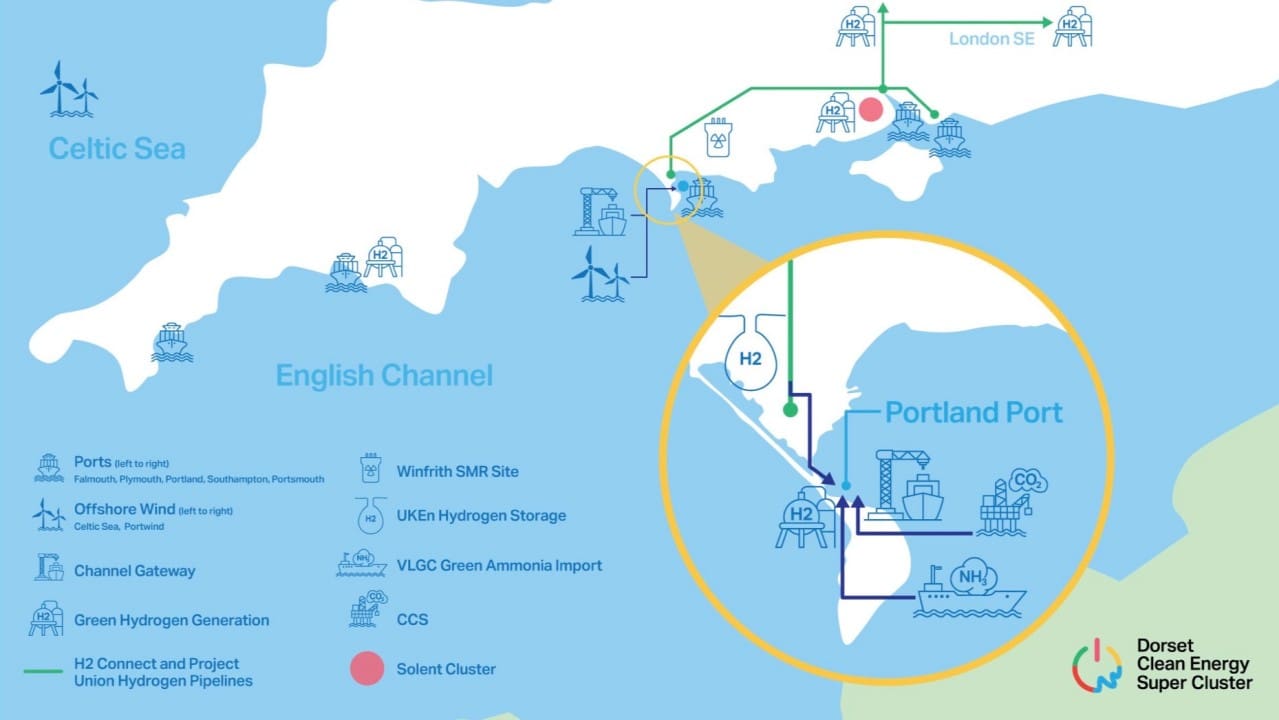
Morwind and Portland Port have been funded by Dorset Council and the Crown Estate to look into a wind farm dock on Portland. The Dorset Clean Energy Super Cluster stated, “The proposed Channel Gateway facility is designed to service the offshore wind energy sector, including the manufacturing of components such as concrete substructures, the integration and assembly of large-scale components, marshalling and staging areas for deployment, and operations and maintenance support”.
According to Dorset Council, the Channel Gateway has the potential to:
- Transform Dorset into a centre for wind construction & manufacturing
- Create 1,500-2,000 direct jobs and as many again in the wider supply chain
- Unlock long-term clean energy opportunities in offshore wind,
- Attract billions in private investment and deliver a significant boost to regional productivity
Cllr Nick Ireland, Leader of Dorset Council said: “Funding for the Channel Gateway Project is a major opportunity for the UK and will bring investment and energy to Dorset. We’re working with our unitary neighbours at Somerset, Wiltshire and BCP councils through the Wessex Partnership to boost regional growth, and with The Crown Estate, we plan to support offshore wind supply chains, creating jobs, social value and economic growth for local communities.”
What would this mean? Dare to dream…
Up to 2,000 direct jobs remain, just a third of that of the Royal Navy in the 1980s. But these jobs will be well-paid and generally high-skilled. The indirect jobs are important too – another 2,000 that will service those working there. This could mean:
- More opportunities for the young in the form of apprenticeships and prospects
- Less economic dependence on the tourism trade
- More hope, leading to reductions in drug and alcohol dependence
- Less welfare dependence
- Reduction in poverty-associated crime
- More thriving pubs!
One thing that seems to come with economic success is more success. More skilled employees requires better educational establishments, and the presence of more skilled people will attract more businesses beyond Portland Port. Though not in itself as big a presence as the Royal Navy, the Channel Gateway could prime the pump for the local economy to breathe again.
Earth conscience – a footnote
Discussing with locals on Portland, there is some worry that important marine habitats could be destroyed around the east of the island to create the new dock and facility. Though less likely with the expensive flats being built where the causeway touches the mainland, there could be impetus to call for a new bypass around Wyke, destroying the wetlands of the Fleet Lagoon.
The economy is important, but checks and balances need to be maintained so money doesn’t come before the environment. Though you can’t eat the view, the view is home to wildlife that still needs protecting at all costs. As such, while hopeful for the potential of this project, it should be done with locals’ consent and not (as with the incinerator) without it. Not all value is in money, and that needs to be remembered.