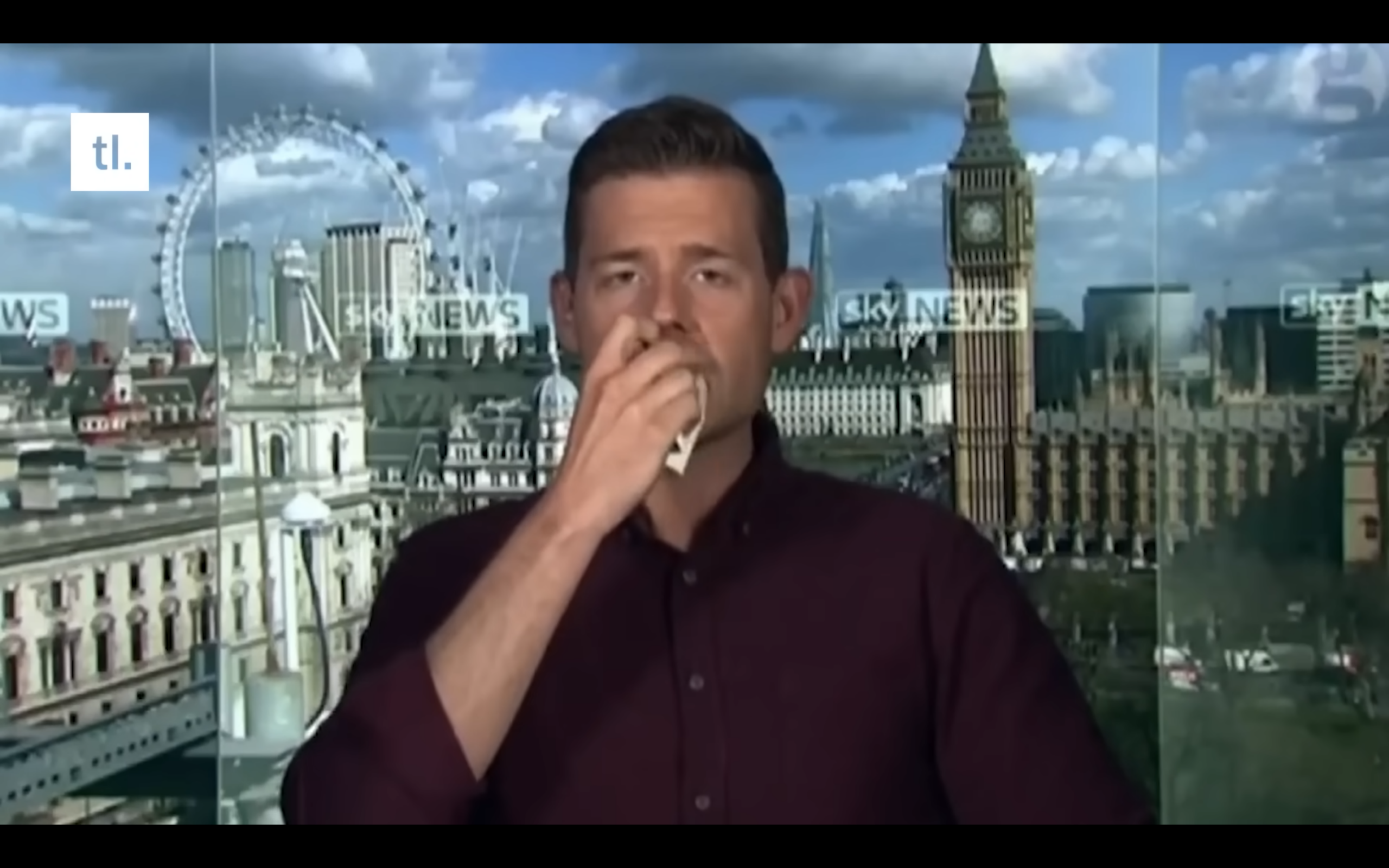
First check out the detail exposed in the following video. Goodwin does not even try to hide the fact he used ChatGPT. He is supposed to be an academic; instead, he behaves like a deranged charlatan.
But let’s not rest on ad hominem as much as the desperate-looking weasel deserves it.
No, let’s break this down so that even the most simple and gullible people can get it.
Matthew Goodwin’s Suicide of a Nation is presented as a work of urgent national diagnosis. In truth, it reads less like serious political analysis and more like a sustained exercise in distortion, one that dresses ideology up as evidence, substitutes fear for fact, and relies on a pattern of exaggeration that repeatedly collapses under scrutiny.
The title alone tells you everything about the intellectual posture of the book. “Suicide” is not an analytical term; it is a moral accusation. It implies intent, agency, and a wilful destruction of the self. Britain is not simply changing or facing challenges, it is, in Goodwin’s telling, actively killing itself. This is not the language of scholarship. It is the language of provocation, designed to shock the reader into agreement before any meaningful interrogation of the evidence can take place. From the outset, the argument is framed not to inform, but to alarm.
That alarmism is most evident in the book’s treatment of immigration. Goodwin repeatedly characterises migration as “mass” and “uncontrolled”, conjuring an image of a country whose borders have effectively dissolved. This is not just misleading, it is demonstrably false. The United Kingdom maintains one of the most complex and restrictive immigration systems in the world, complete with visa controls, enforcement mechanisms and increasingly legislative barriers. To describe this as “uncontrolled” is not a difference of opinion; it is a factual distortion. It collapses a highly managed system into a caricature of chaos, because that caricature is more politically useful.
Worse still is the book’s use of demographic projections. Goodwin amplifies speculative forecasts suggesting dramatic declines in the white British population, presenting them in a way that implies inevitability. This is a textbook example of statistical misuse. Demographic projections are inherently conditional; they depend on assumptions about migration, birth rates, identity and social change. They are not predictions; they are scenarios. By stripping away that uncertainty, Goodwin transforms contested modelling into apparent destiny. The effect is to manufacture a sense of demographic panic where none is empirically justified.
This is not an isolated issue, it is emblematic of a broader methodological failure. Throughout the book, evidence is cherry-picked, context is stripped away, and countervailing data is ignored. Economic factors i.e.wage stagnation, austerity, housing crises, and regional inequality, are conspicuously marginalised. These are not peripheral issues; they are central to understanding modern Britain. Their absence is not accidental. By excluding them, Goodwin is able to recast political dissatisfaction as primarily cultural, rather than material. It is a sleight of hand that redirects anger away from structural inequality and towards identity-based explanations.
The treatment of identity itself is where the book becomes most ideologically explicit. Goodwin repeatedly frames British and particularly English identity as something under existential threat from demographic change. This framing rests on an implicit assumption: that identity is fixed, bounded and rooted in ancestry. That is not a neutral observation; it is a political position. It ignores the long, well-documented history of Britain as a society shaped by migration, adaptation and cultural exchange. By presenting a narrow, essentialist view of identity as if it were common sense, the book smuggles ideology into the guise of empirical fact.
Equally misleading is the portrayal of power. Goodwin’s “new elite” thesis suggests that liberal, university-educated professionals have captured Britain’s institutions and silenced dissent. This is a profound misrepresentation of how power actually operates. Real power in Britain continues to reside overwhelmingly in wealth, ownership and entrenched networks of influence, none of which are meaningfully disrupted by the presence of socially liberal attitudes in parts of the public sector. By focusing on cultural elites while ignoring economic ones, Goodwin offers not an analysis of power, but a distraction from it.
Perhaps the most brazen contradiction in the book is its insistence that voices like his are being marginalised or suppressed. Goodwin is a bestselling author, a regular media commentator and a prominent public figure. His ideas are not hidden; they are amplified across mainstream platforms. The claim of silencing is not merely weak; it is self-refuting. It is a rhetorical device designed to cast criticism as persecution, thereby insulating the argument from scrutiny.
The reliance on anecdote further undermines any claim to rigour. Goodwin frequently leans on isolated observations and selective international comparisons to bolster his case. These are presented as illustrative but function as evidence in the absence of systematic analysis. This is not how serious scholarship operates. It is how narratives are constructed, through carefully chosen examples that reinforce a predetermined conclusion while ignoring the broader, more complex reality.
What ties all of this together is a relentless use of emotive language. Words like “collapse”, “crisis” and “destruction” appear with striking frequency, creating a drumbeat of impending catastrophe. Yet these claims are rarely substantiated with proportionate evidence. Instead, the reader is carried along by tone and repetition, encouraged to feel that something is profoundly wrong without being shown, convincingly, that it is. This is not argumentation; it is persuasion through atmosphere.
It is important to be clear about what is happening here. The problem with Suicide of a Nation is not that it raises difficult questions. It is that it answers them dishonestly. It takes complex, contested issues and reduces them to a single, emotionally charged narrative. It presents ideological assumptions as empirical conclusions. It exaggerates, omits and distorts in ways that consistently point in the same direction.
In doing so, the book does more than mislead, it actively degrades the quality of public debate. By framing social change as an existential threat, by inflating uncertainty into inevitability, and by substituting rhetoric for evidence, it narrows the space for serious discussion. Readers are not equipped with a clearer understanding of Britain’s challenges; they are handed a story designed to confirm their anxieties.
For a work that claims to diagnose national decline, Suicide of a Nation reveals something else entirely: how easily the language of crisis can be manufactured and how thin the line can be between analysis and propaganda when evidence is bent to fit a predetermined narrative.
Only idiots would believe it. Why? Because they want to.
Thankfully, as the following reviews reveal, there are far fewer idiots than the far right believes there to be, and they are laughing at people like Matthew Goodwin.