11 C
Dorset
Sunday, February 22, 2026
Home Blog

Fear, grievance and hate: How a community became radicalised

This article was originally published on August 11, 2023.

Legal experts have assessed the content and are now pursuing legal action against a number of parties. The article that is the catalyst for at least two ongoing documentaries and a series of national and international articles can now return.

Weymouth & Portland is a community with a proud armed forces tradition – not least in relation to our role in defeating the Nazis in WWII.  So how is it that a section of our community has been radicalised into racism and hatred?  How is it that so many people have been persuaded to hate a group of people they’ve never met?  And how is it that people have aligned themselves with exactly the kind of Far Right ideology that their brave forebearers fought against?

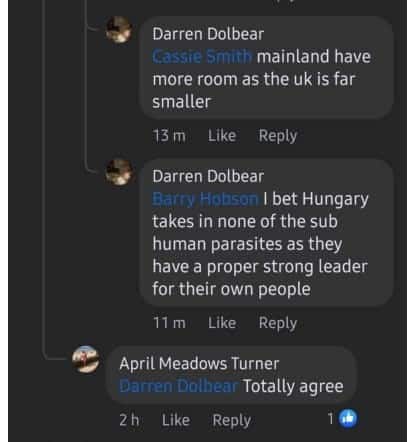
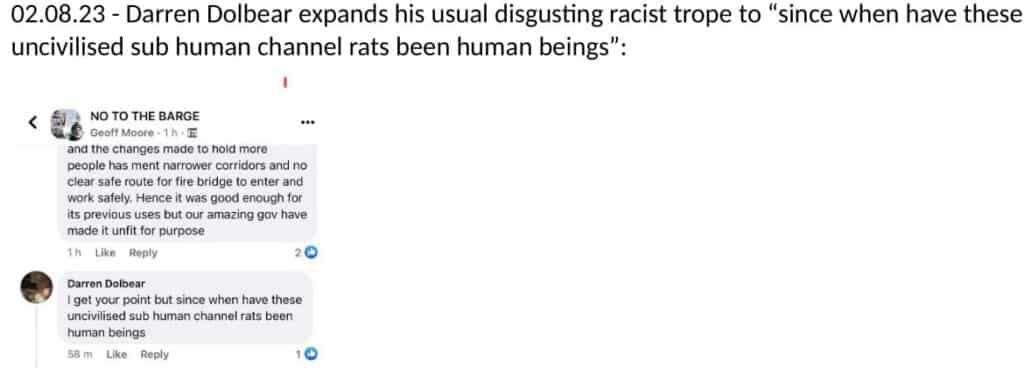
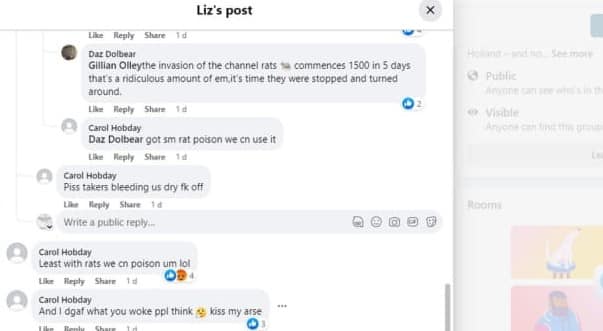
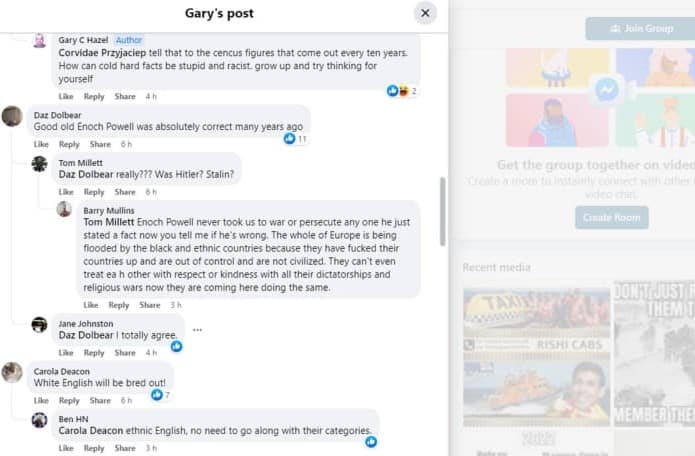
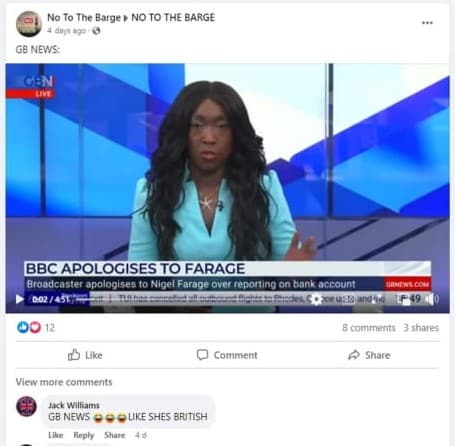
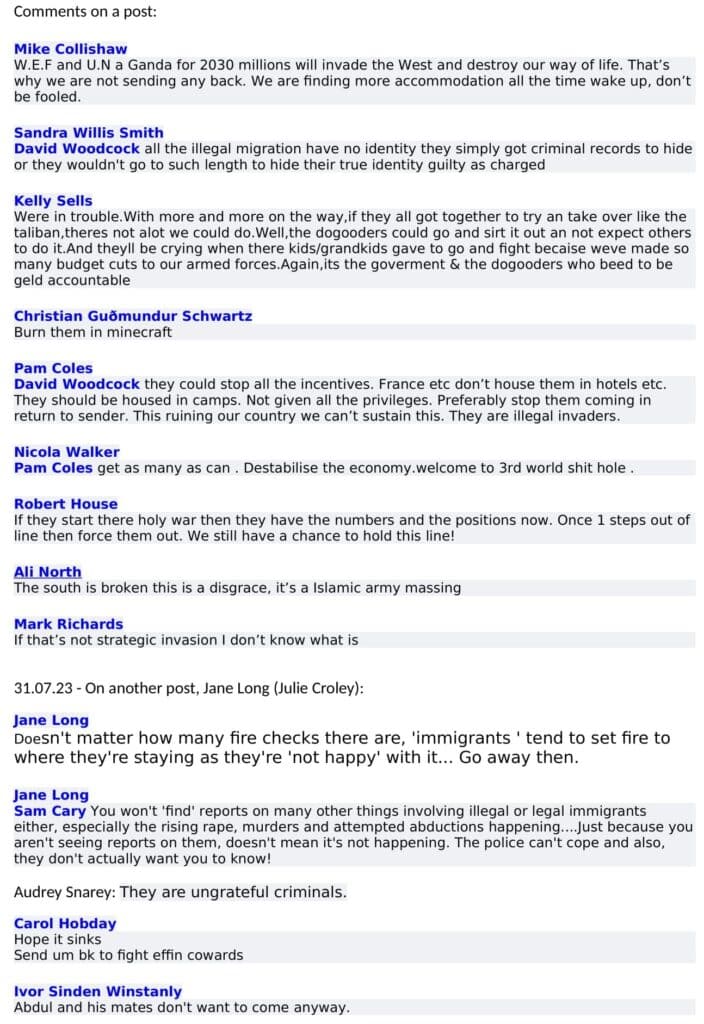
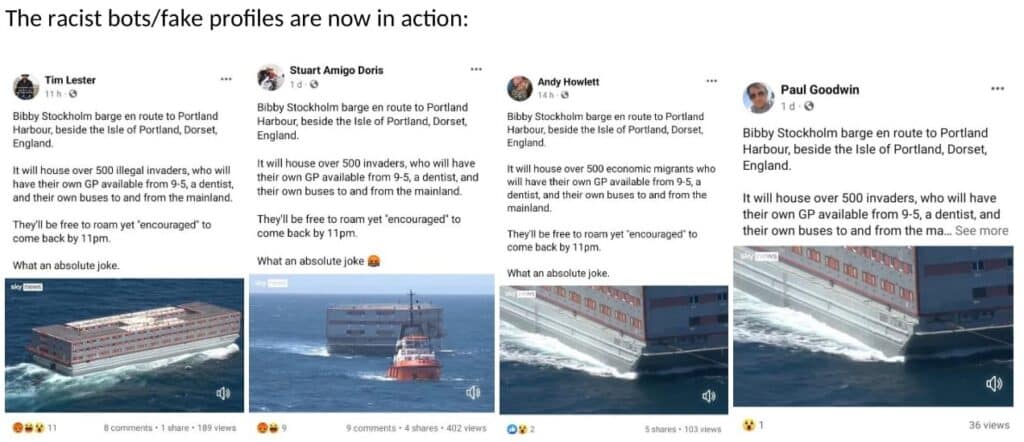
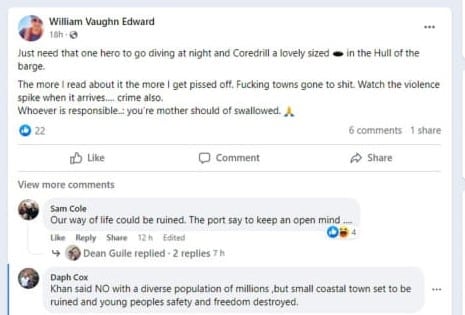
Here, we try to answer those questions and, in doing so, expose how three key elements – fear, grievance and racist hatred – have been utilised.  For the first time, we will publish people’s own words – including many appalling examples of racism – and document some of the key actors in a sorry campaign of hatred.

Some Background

On 5th April, 2023, the Home Office confirmed plans to house 506 people seeking asylum (safety) in the UK on a barge, the Bibby Stockholm, at Portland Port.  The privately-owned Portland Port had agreed to a lucrative contract with the government to house the barge without undertaking any public consultation.  Because y’know….. capitalism.  Money (for the few) talks and human rights walk – as do the feelings of local people. 

The Langham family who owns the Port made 19 donations to UKIP totalling over £70,000 and have connections to this Conservative government.  Former investment banker Jill May, sister of the late John Langham, was re-appointed to the BoE’s Prudential Regulation Committee in 2021 by Rishi Sunak. She is currently listed as owning 11.68% shares in Langham Industries Ltd.  As expected, May and Langham family members own the majority of shares.  The deal to house the barge is worth a reported £2.5 Million.

The barge itself has been modified to change its capacity from 220 people to 506 plus up to 40 staff!  The refugees will share small rooms with bunk beds.  The government ordered the small TV screens to be disconnected.  Held in a secure port, the barge is, without doubt, a quasi-prison. It was even described as such by South Dorset MP Richard Drax whose family made their own fortune from the slave trade.  Drax had very little warning from his own Party about the barge – perhaps indicating the contempt they have, even for their own MPs – and his protestations have been ineffectual.

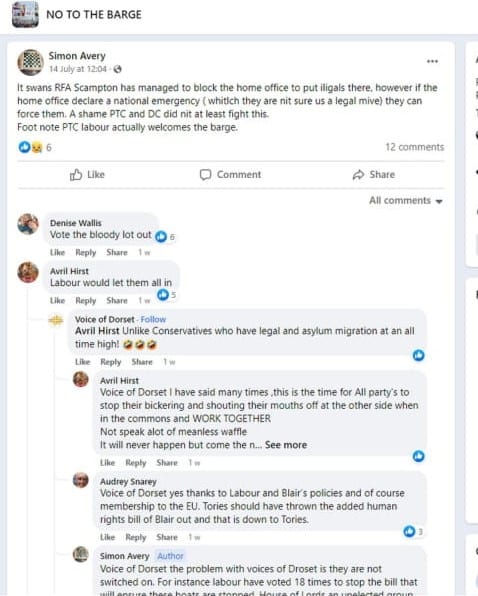
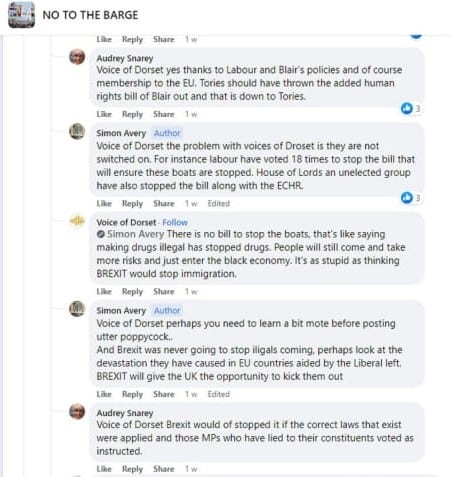
It seems everyone is against the barge!  Local MPs, Dorset and Portland Councils and Councillors, human rights groups and anti-racist groups such as Stand Up To Racism Dorset, and a campaign now known as ‘No To The Barge’.  The NTTB campaign began as a Facebook group named ‘Portland Immigration Barge Discussions (aka Barge Bitchin)’.  Later, the ‘Barge Bitchin’ was dropped and, in mid-June it was changed to ‘No To The Barge’.  It is this Facebook group (and its associated real-life campaign) that has been home to appalling levels of racism and Far Right activity. 

Fear

The initial and abiding reaction of people on the NTTB group is based upon fear and the spreading of fear.  Some of that fear is based upon a lack of experience of diversity: Portland is a small community of 13,500 people, 96.5% of whom are white.  The Muslim population is just below 1%.  It is in this environment that people on the NTTB group have spread disinformation and fear. 

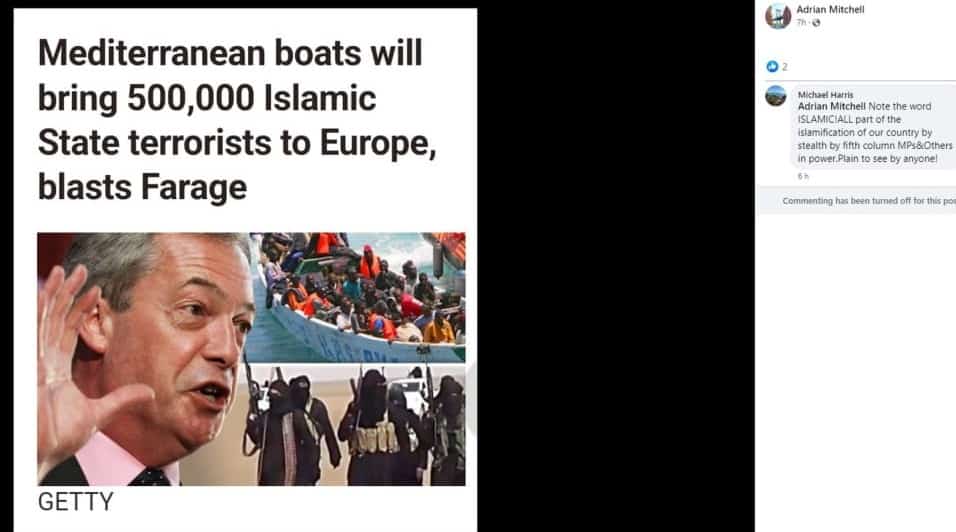
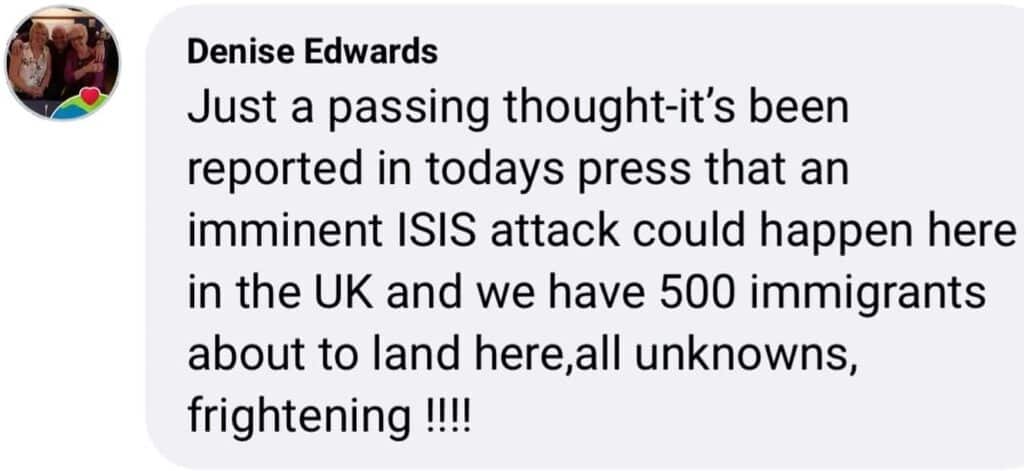
Most of that scaremongering is based around the notion that people seeking asylum are all (or mostly) criminals, rapists and murderers.  The idea that those to be housed on the barge pose a particular threat to women and children is highly prevalent. “Lock your daughters up” was the early cry!  As more and more Far Right supporters from around the UK have joined the group, the comments are increasingly about how Muslims are preparing to start a ‘religious war’ and will slaughter us all.  There has been a continual avalanche of posts and comments which have whipped up the fear to frenzied levels.

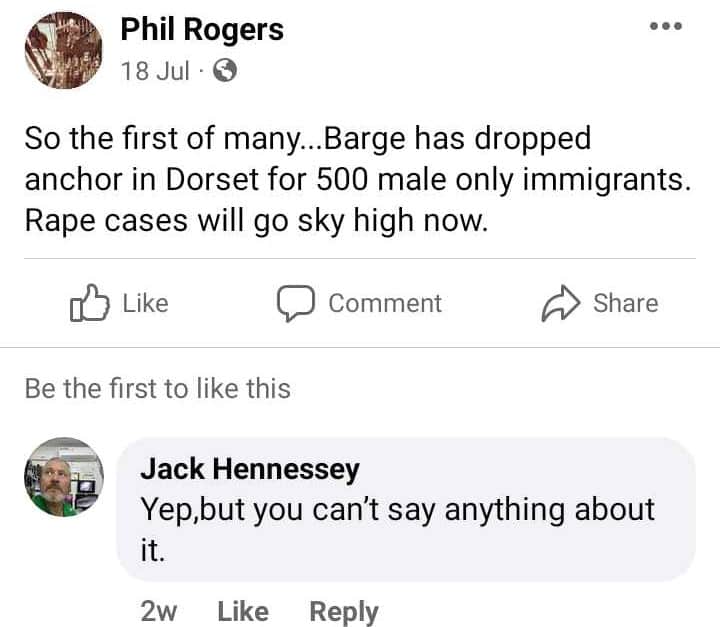
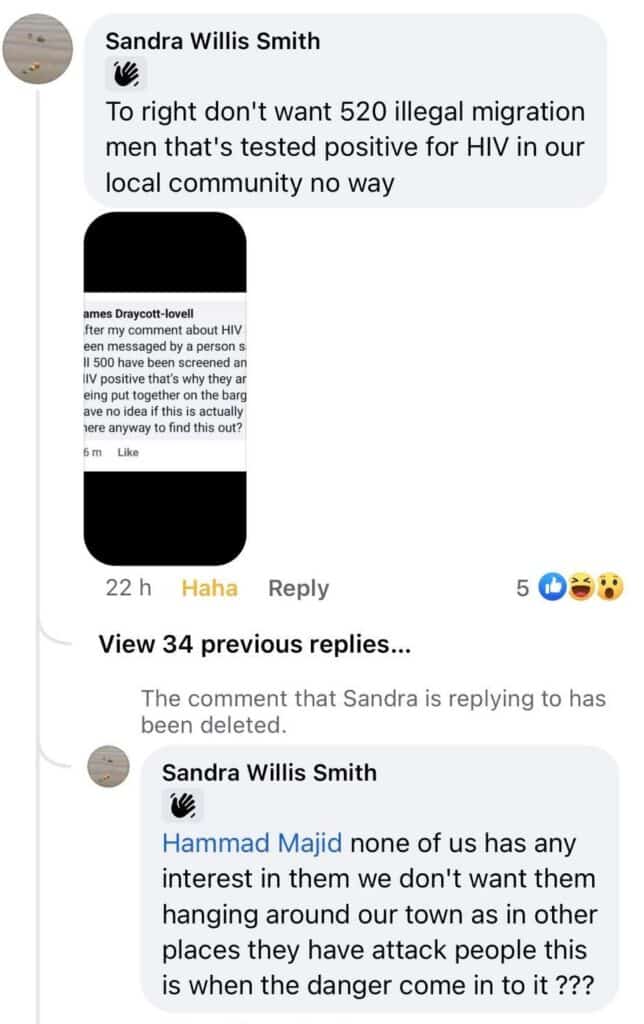
Here are some examples from the NTTB group (all quotes as written):

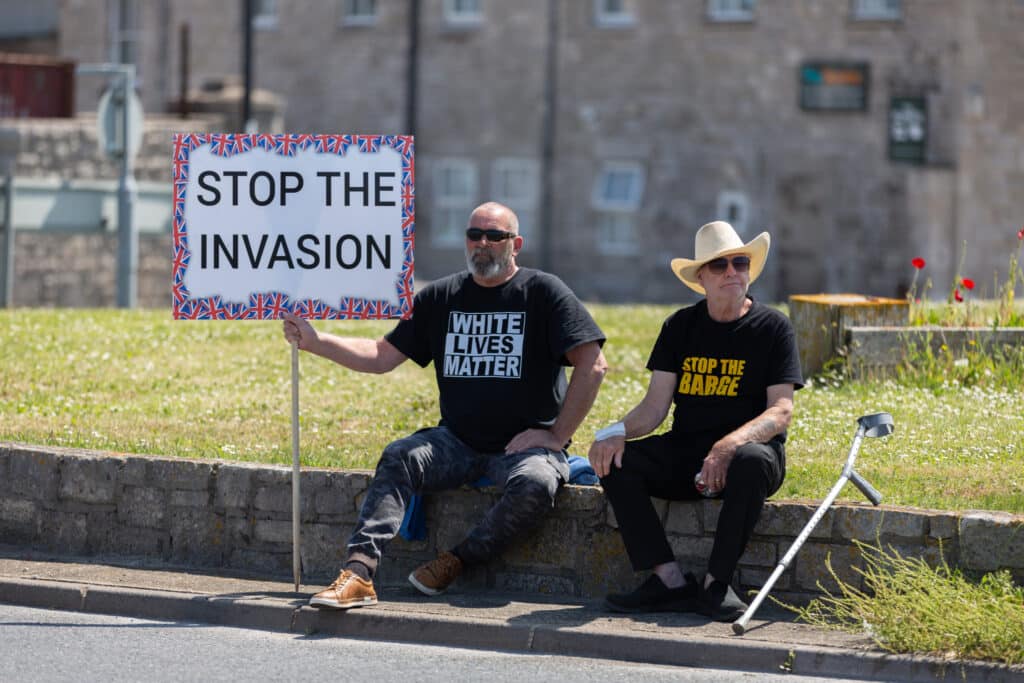
Julie Croley (who carried a ‘Stop The Invasion’ placard at the campaign’s events and whose husband Mike Croley regularly wears a ‘White Lives Matter’ T-shirt) talks of impending “sexual harassment, attacks and rapes”, of an “Islamic invasion” and states “We’re being turned into an Islamic country”

Bert Travers: “take lots of photos/videos of any potentially dangerous looking situations (chatting young girls up, near schools, causing trouble etc etc”)

Karen Lewis: “get CCTV on your bodies”

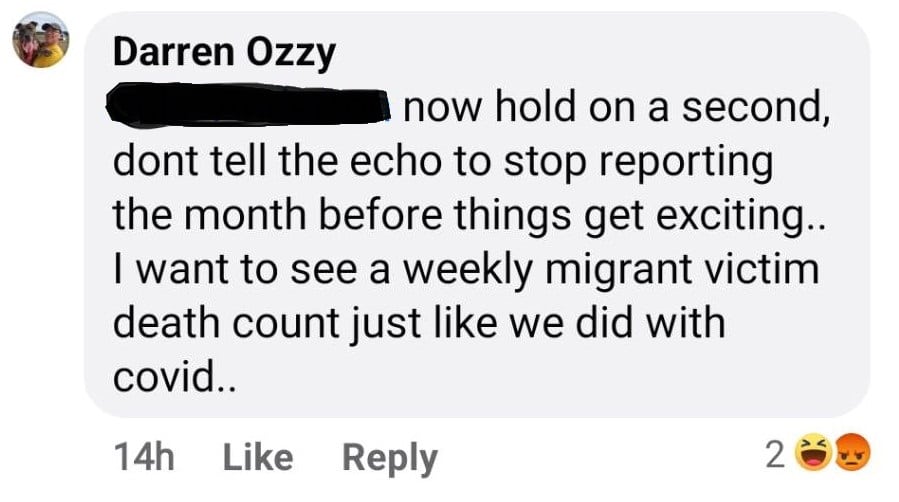
Darren Ozzy: “I want to see a weekly migrant victim death count just like we did with covid” and asks “What are the shops going to do when the attacks, rapes and murders begin?”

Stuart Chiswelstaff Breckell: “Would you put 506 wolves in a field with 13,535 sheep and hope for a happy ending”

Portia Duvall warns of “the violent sexual assaults on women and children on the streets”

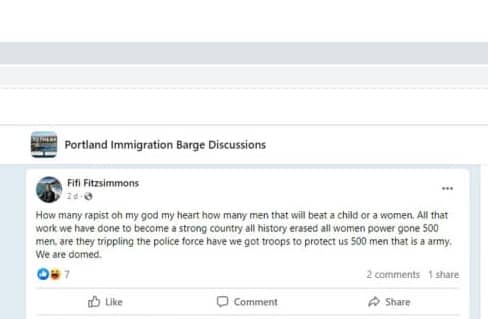
Fifi Fitzsimmons posts about “rapists” and “men that will beat a child or a woman” and adds “We are doomed”

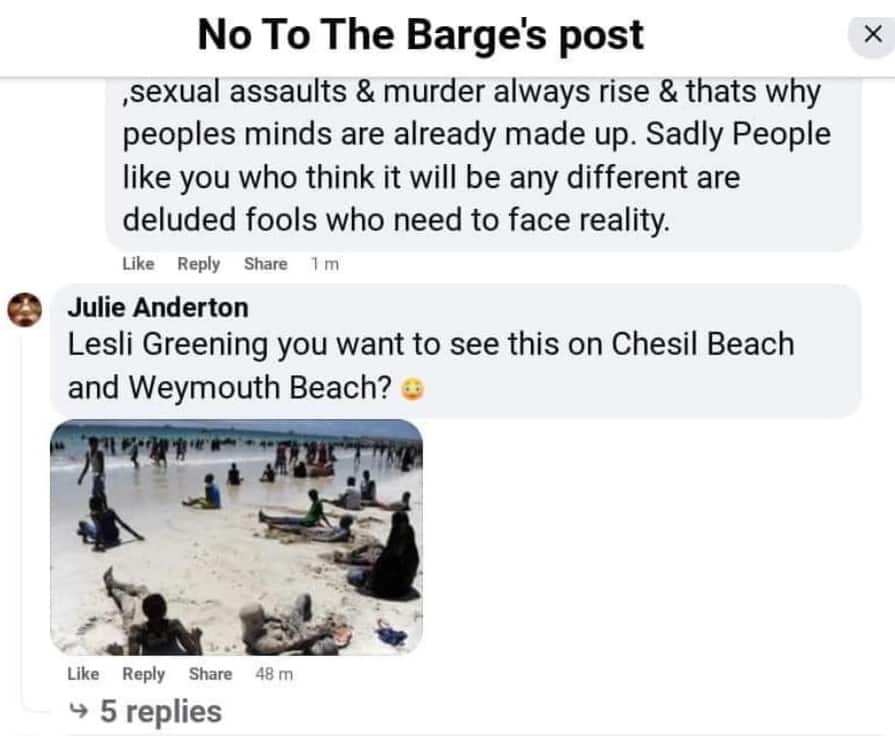
Julie Anderton: “There will be murders, rape and pillage!” “These 500 men will require 500 young, local ladies. They will take by force.” “Local lads will start fights with them but these migrants use knives.” “They will force their lifestyle on us including their religion. They hate us! THEY HATE US!”

Michelle Varney warns of “muggings” and Michael Mccarthy talks of “rape, robbery, muggings, attacks”

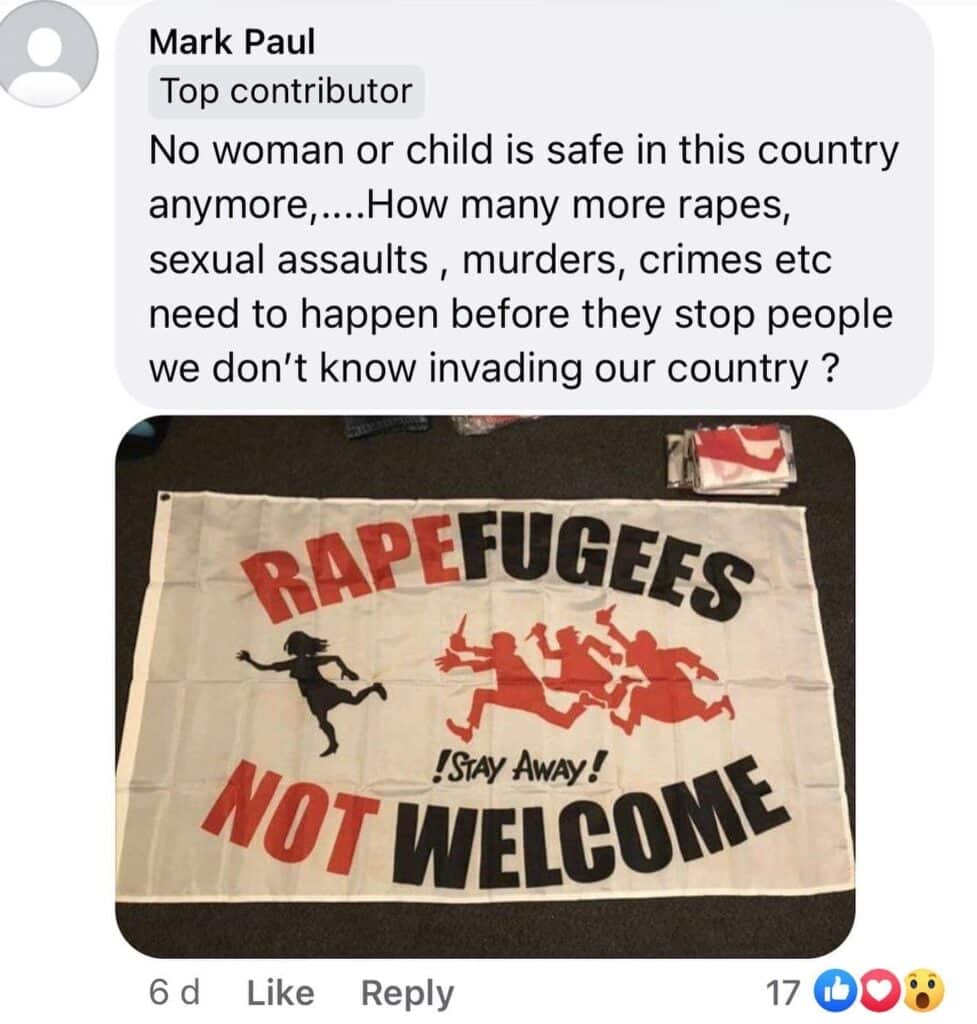
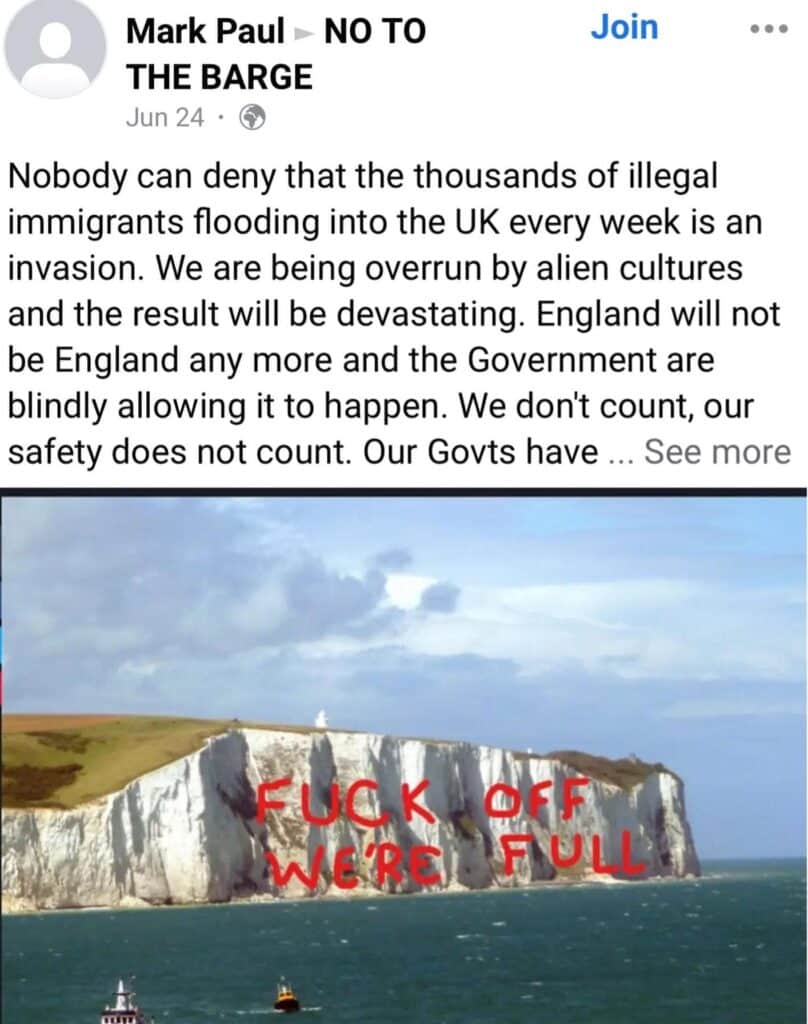
Mark Paul: “How many rapes, sexual assaults and murders need to happen?”

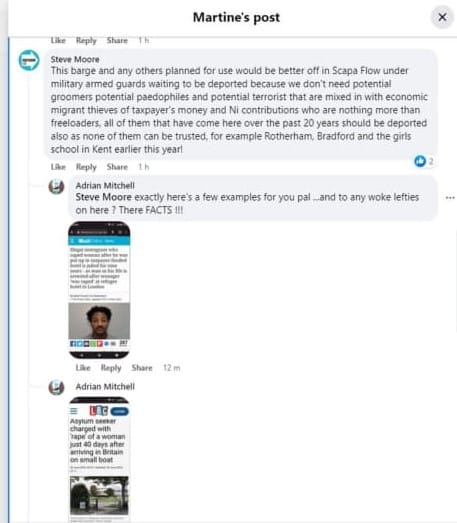
Steve Moore: “A high percentage will be potential groomers….. paedophile migrants. Keep your kids SAFE”

Lee Calvert: “What these retards don’t understand is we have 500 men! Coming from rapey stabby countries”

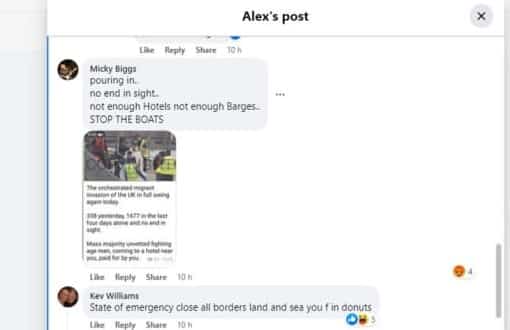
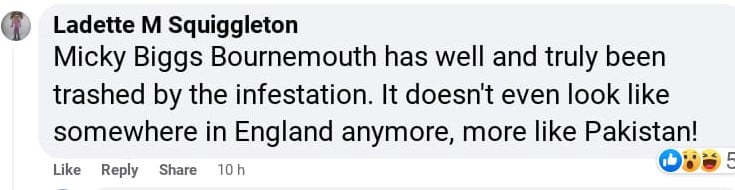
Micky Biggs: “These are pouring into Europe every day thousands of them not a woman or child in sight. Mostly ex prisoners and criminal economic migrants”

Elaine Bearne (as Fanny Adams): “The illegals steal pets”

Chaz Charlton: “heard they are putting a temporary musque in the bowl up the grove”

Sandra Willis Smith declares there are “no go zones for white people happening up and down the country” and that the asylum seekers “have all tested positive for HIV”

Margit Cotton: “We’re being invaded,” “50 years from now we’ll be a Muslim country”

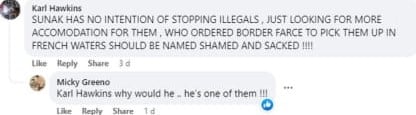
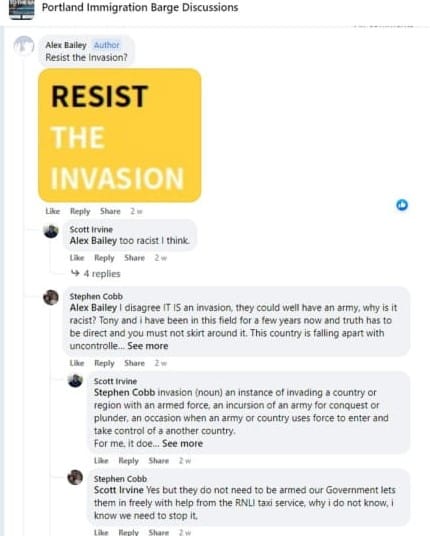
Micky Greeno: “This country has to stop this onslaught and invasion”

Phillip Davies declares we are being “Invaded by a Muslim army”

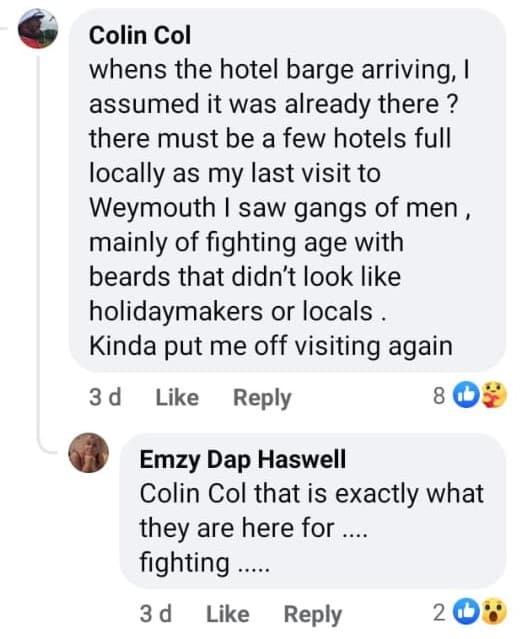
Chris Leggy Legg: “This is an army of fighting aged men”

Jackie Teague: “These men are gathering an army under the guise of asylum”

Sue Ayton warns we will be “killed off by these illegals”

Darren Jenkins: “For all we know they could have been chopping off heads a few months ago”

Allen Varney: “All ready for when they take over…. Only a matter of time”

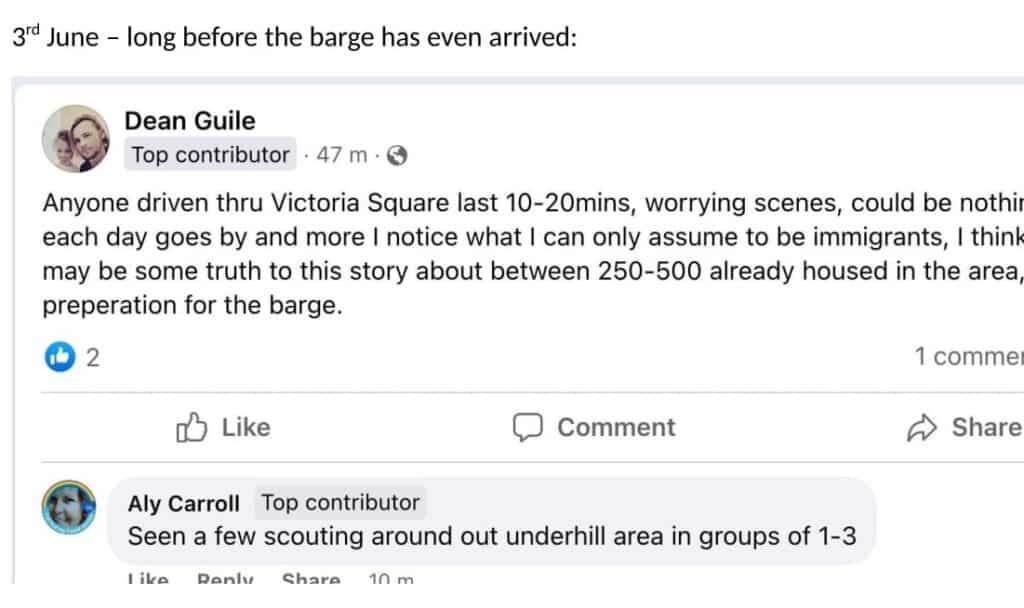
Ally Carroll: “We have a religious war brewing,” “these illegals, 606,000 in UK up to last year, are part of a global organised invasion,” “certainly a move to destroy against the indigenous peoples of GB”

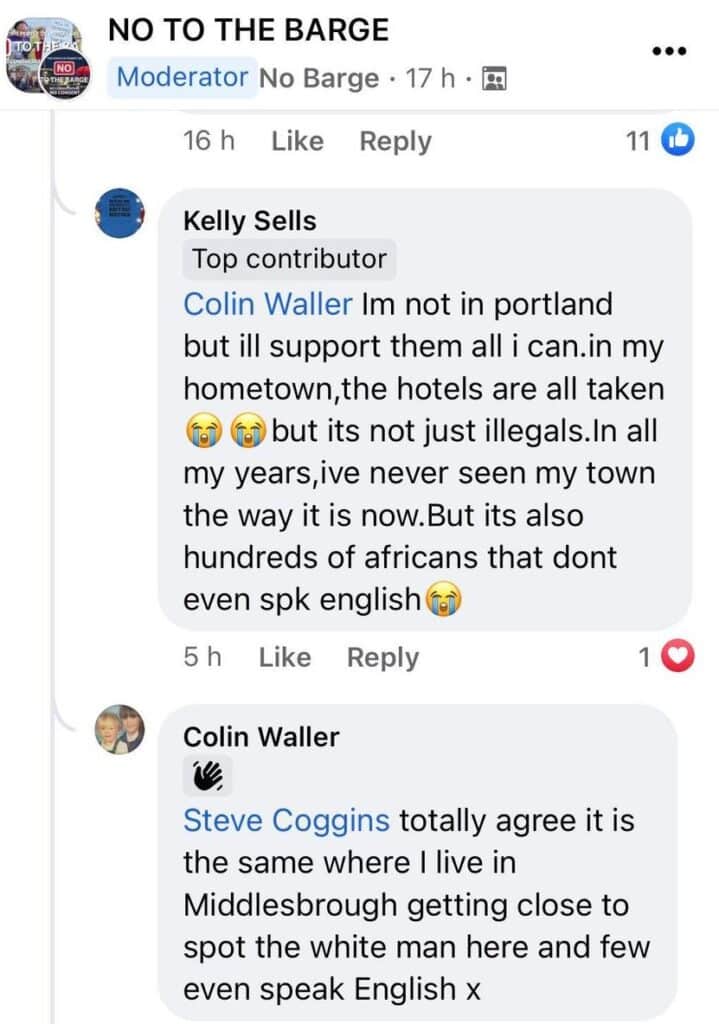
Colin Waller: “They are foot soldiers waiting for the call from Islam”

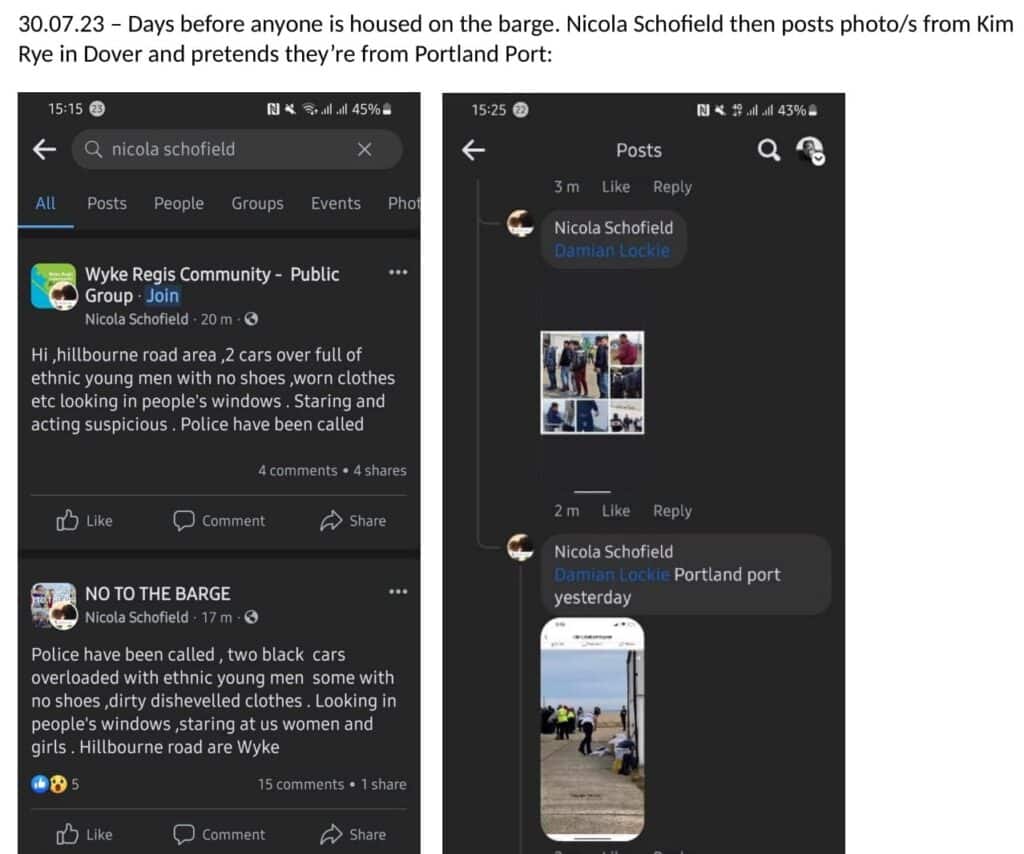
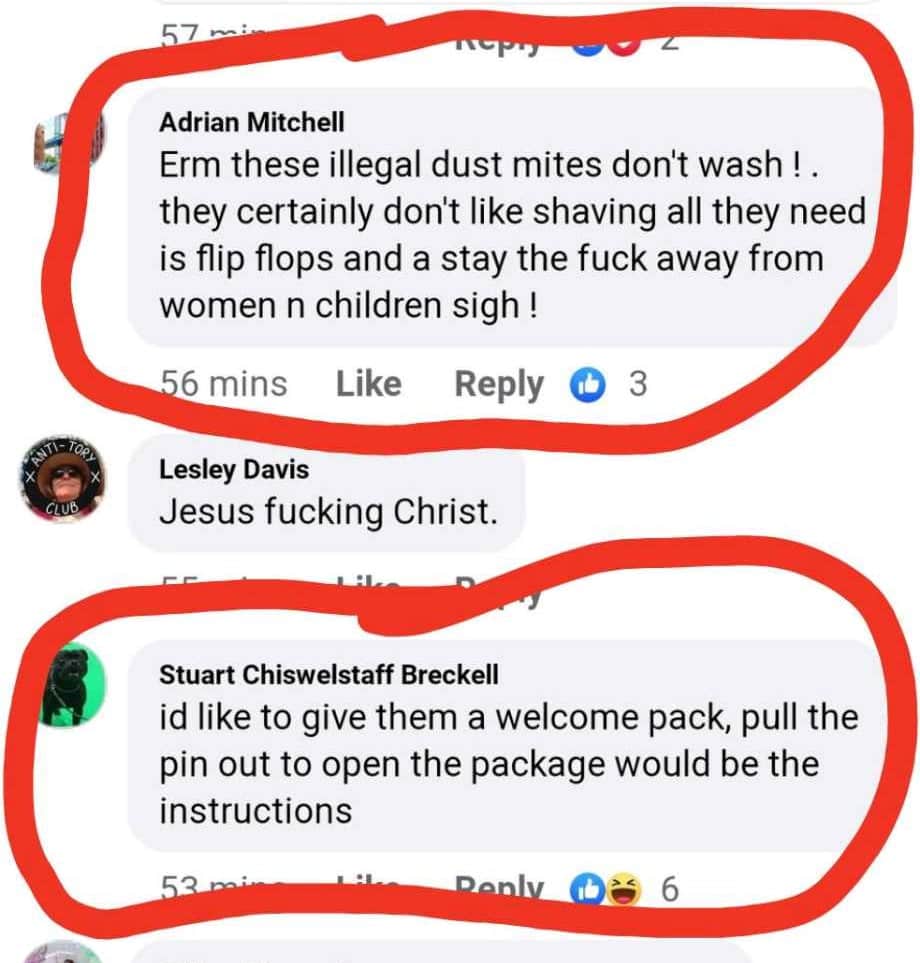
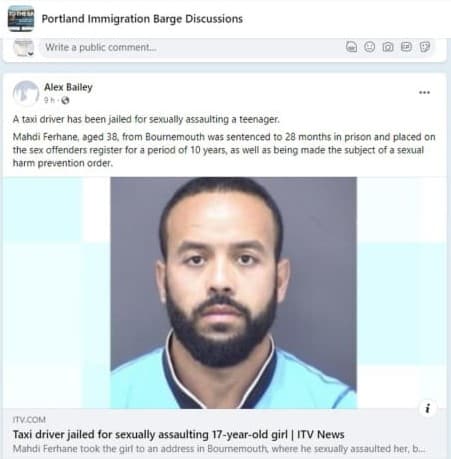
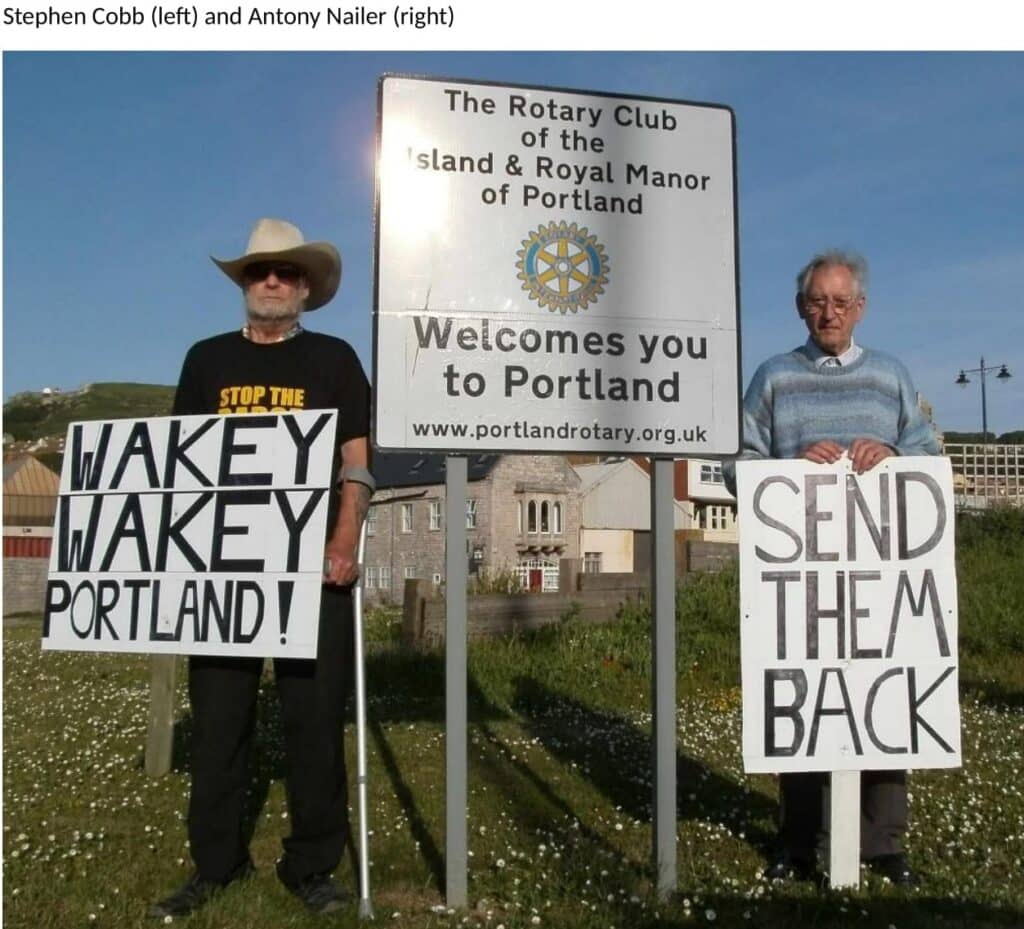
The fearmongering is amplified by numerous people including Adrian Mitchell, Stephen Cobb and campaign leader Alex Bailey posting a litany of screenshots of articles about non-white people committing crime, especially sexual crime.  Mitchell posts the same 6 screenshots repeatedly.  Of course, they never post any reports of white people committing the same crimes.

At one point, regular group contributors Stuart Chiswelstaff Breckell and Darren Ozzy even discuss how the recent Bournemouth beach tragedy was “almost certainly a migrant attack” and that the media and government are suppressing it!

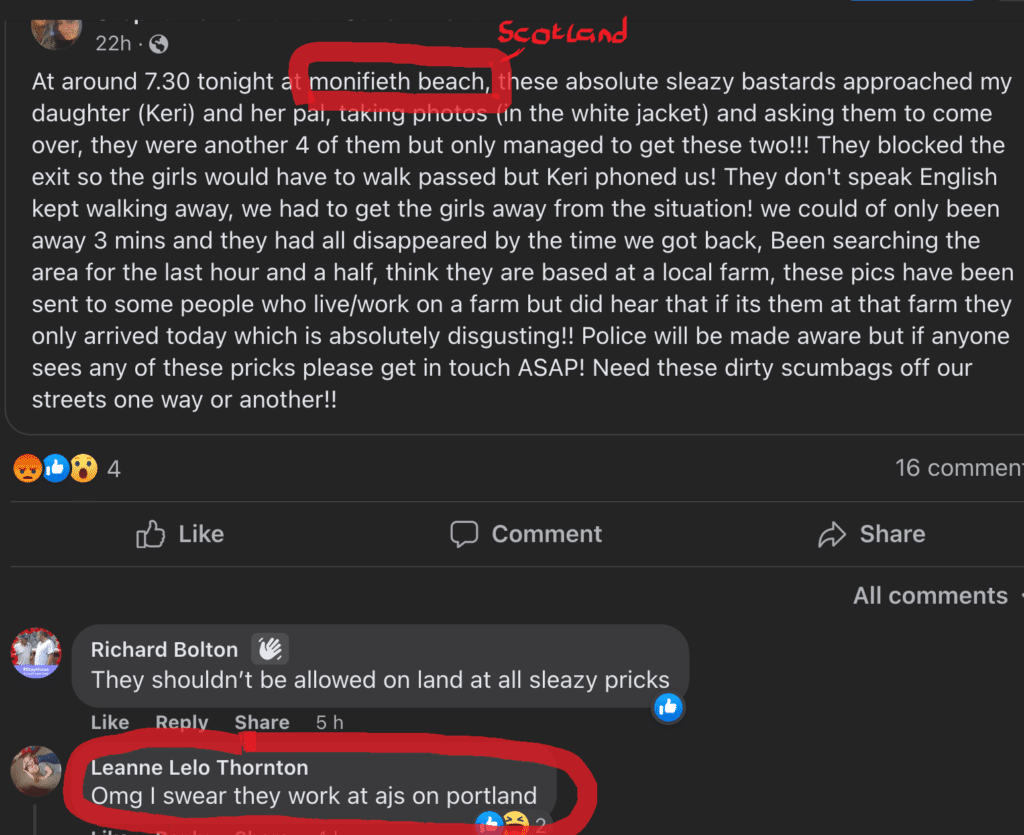
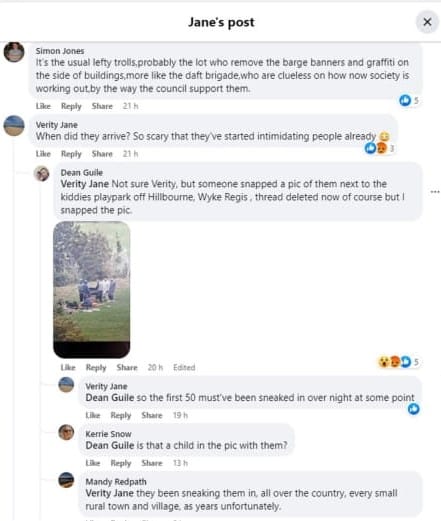
Shockingly, Asian holidaymakers have been followed and photographed with people stating that ‘they’re here already and staying in B&B’s!’  Bert Travers, sitting at home watching a webcam positioned on Weymouth seafront, posted a photo of Asian men using the toilets! He claimed that one of them didn’t come out and that young girls went in the same cubicle!  In the comments, people asked if it was people from the barge!

He posted a screenshot of the two men, which included several children in swim wear!

Gallery 1:
Grievance

Much as it was used by the Nazis in 1930s Germany, the second crucial element of this hate campaign is the fostering of a sense of grievance and resentment – in this instance, towards the asylum seekers. 

Weymouth & Portland is suffering.  13 years of Tory austerity has hit hard.  Several wards are in the top 10% or top 20% of multiple deprivation.  Wages are low and housing and other costs are high.  Council tax is one of the highest in the country and families are suffering with the ‘cost of the one-percent’s greed’ crisis.  Public services have been slashed and NHS services withdrawn or inaccessible.  Portland Hospital has been downgraded, losing its beds, its X-ray department and then its Minor Injuries Unit.

Clearly none of that is the fault of refugees!  Those things are the result of government policy: the actions of an authoritarian right-wing government who prioritise only the wealth of their rich friends and donors – increasingly through cronyism and fraud.

This is a government who have neglected its people and, locally, the effects are stark.  So, we must ask the question: why is it that the places where the government have chosen to place large asylum detention centres are mostly white, working-class areas where people are suffering from their neglect?  Clearly, with a lot of help from their friends in the media – especially the tabloid rags – and with the Home Secretary herself claiming that this is an ‘invasion’ of people coming here ‘illegally’, this putrid government knows it can shift blame from themselves to some ‘poor brown-skinned people’.

And so it is that the NTTB group has been filled with resentment.  This resentment often takes the form of outrage ‘no matter what’.  There are numerous examples of people being up-in-arms about one thing and when that thing is shown not be true, they are equally outraged by the alternative.

“They’ll get appointments with our already stretched GPs!”  *No, GP services to the barge are being provided by a specialist surgery from Bournemouth*  “Oh right, so they get specialist GP services on tap!”

“They’ll have nothing to do and will therefore commit crime!”  *No, a range of activities will be provided through the voluntary sector*  “Oh right, they get free activities. Our children don’t get free activities!”  

“They’ll be hanging around at bus stops on Portland. They’ll be attacking our women and children there!”  *No, there will be special buses which will take them from the Port*  “Oh right, they get a free taxi service, do they?!”

“They get £20-a-day of taxpayers money!”  *No, they get £9.58 per week (around £1.37-a-day) and it comes from the Foreign Aid budget*  “Oh right, if that’s all they get, they’ll be committing lots of crime!”

“Lots of them can’t even speak English!”  *Well, for those who don’t, English lessons are available*  “Oh right, they get free lessons. You can’t make it up!”

There are many more examples of this outrage no matter what.  And there’s even denial…..

“They’ll commit loads of crime!”  *Crime statistics show that asylum seekers commit crimes at a considerably lower rate than the general population*  “That’s because the police and the government cover it up!”  And then Adrain Mitchell will post the 6 screenshots for the hundredth time!

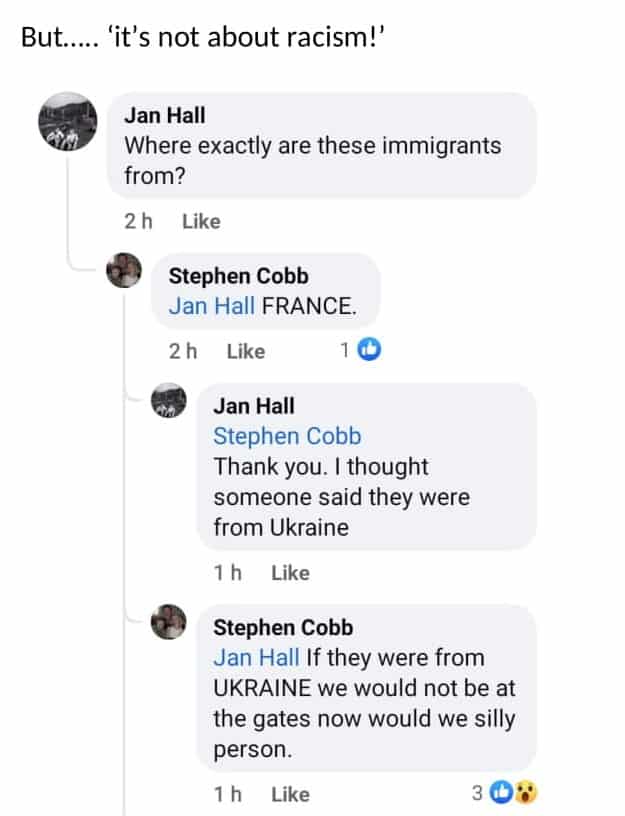
NTTB campaigners constantly say it’s not about racism; it’s about concern over public services, like the NHS.  However, when campaigner Sammy Wallace was interviewed by the BBC, the conversation went like this:

SW: We’ve not got enough NHS, dentists, doctors: we just haven’t got it, so we’re all struggling

Reporter: If those services were improved, would it be alright?

SW: (wry smile) No…. no…. no

Reporter: So it’s about something else?

SW: It’s about the men

It cut off there, but presumably the next question was: “The area has thousands of holidaymakers descending here every summer and cruise ships regularly dock at Portland Port carrying several thousand at a time.  What is it about *these* men?

Concerns about affordable housing, low wages, disappearing local services and the state of the NHS are entirely legitimate.  Blaming refugees is not.

Racism

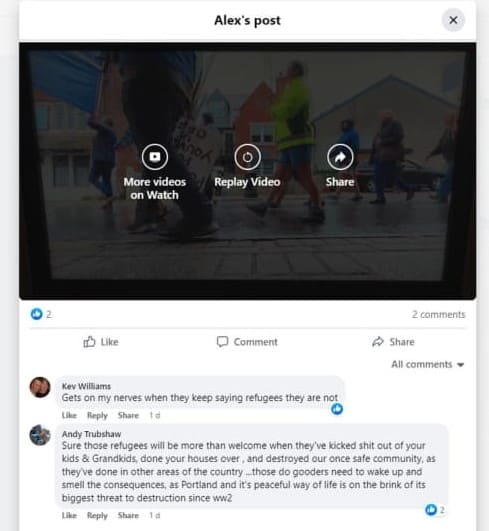
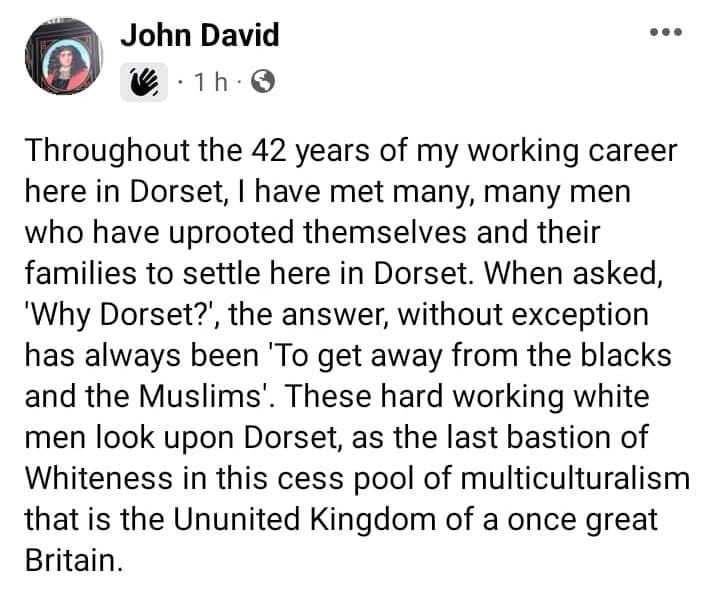
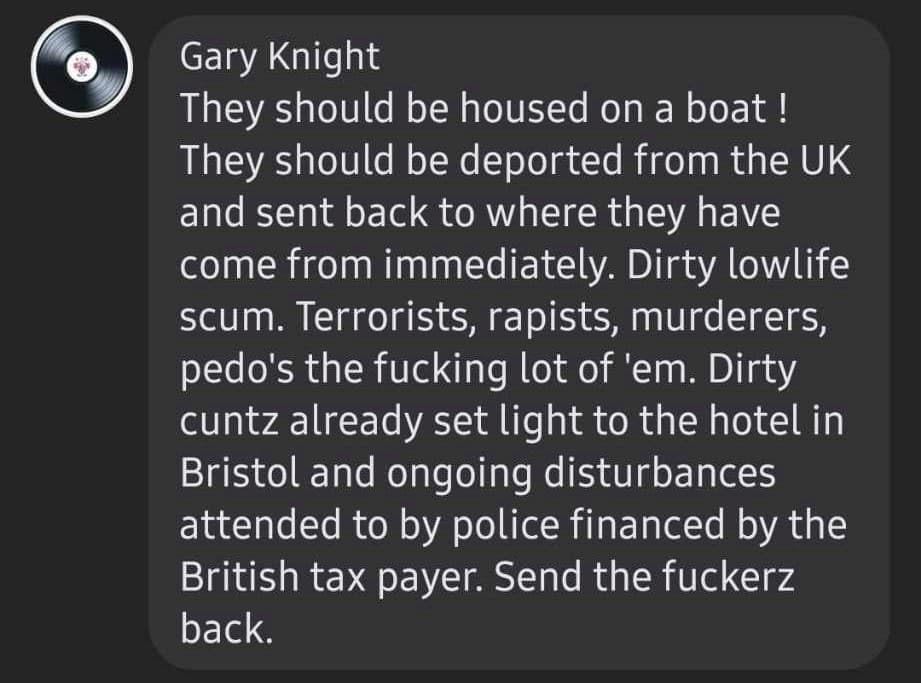
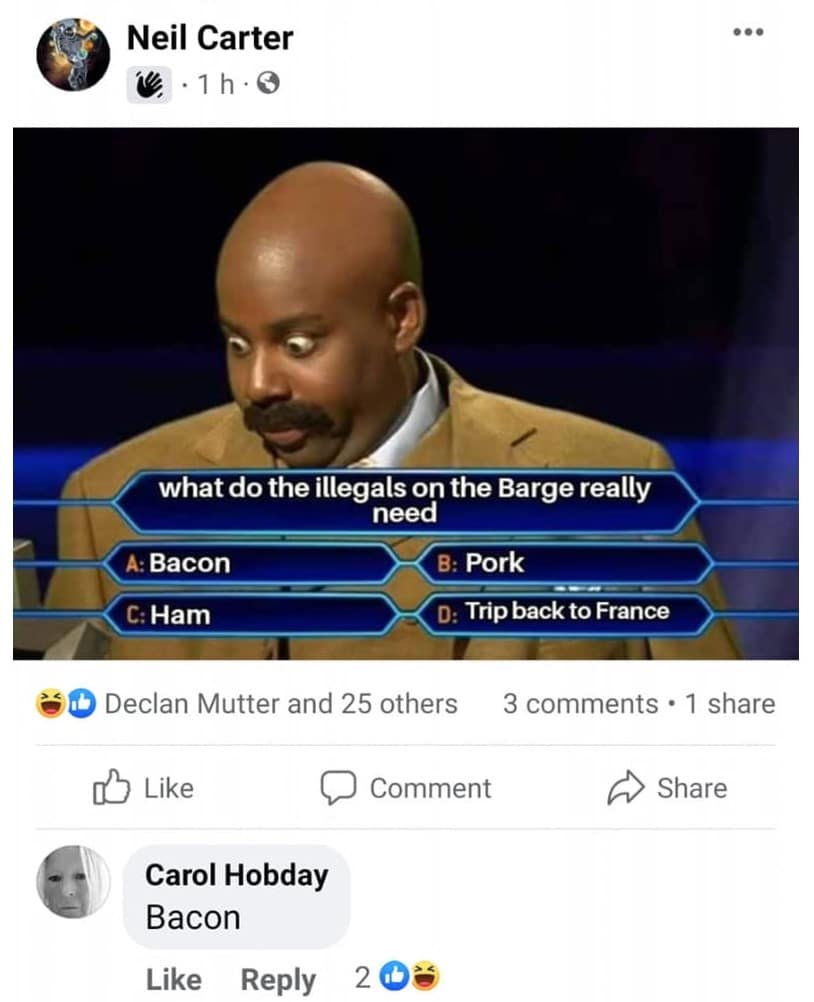
Members of the group are forever claiming there is no racism in the group and it’s not about racism.  They are lying and they know it.  There are literally thousands of examples of racism in the group, so I’ll merely share a small percentage and let the reader decide.

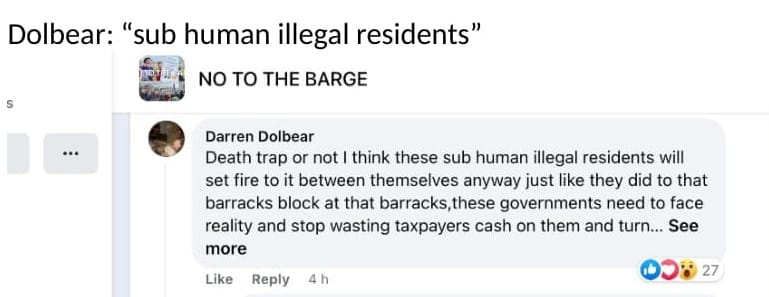
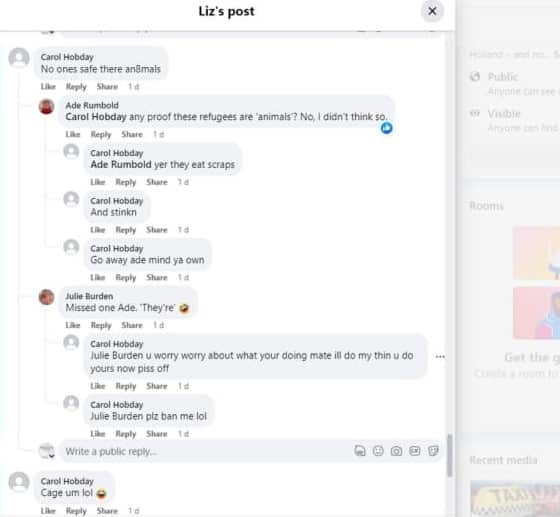
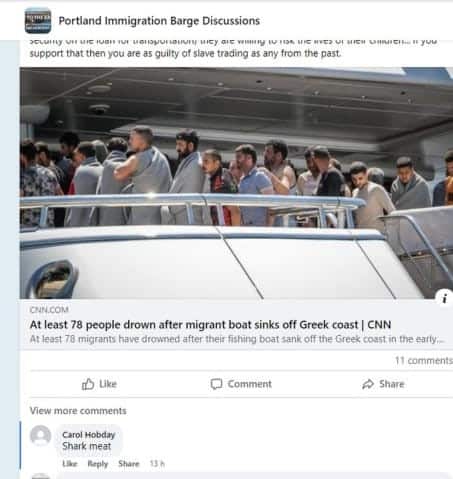
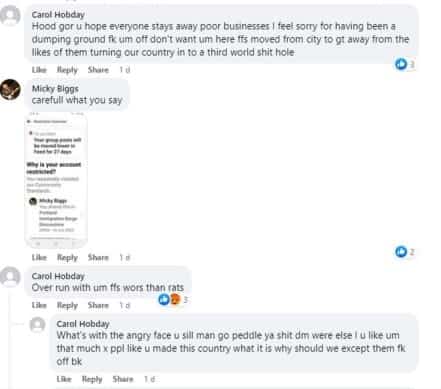
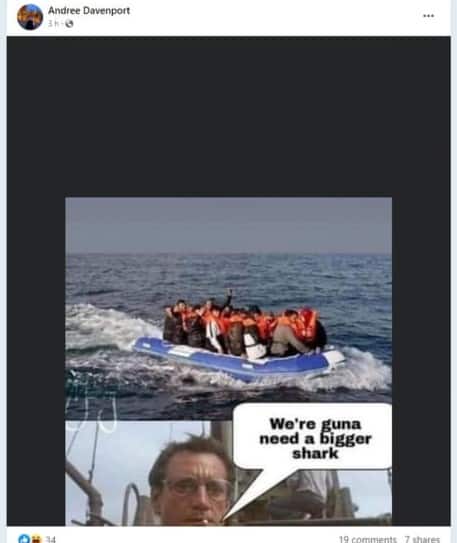
Beforehand, it’s worth noting that the default name in the NTTB group for the people seeking asylum is ‘illegals’.  That’s when they’re not being called ‘economic migrants’, ‘gimmegrants’, ‘criminals’, ‘enemy invaders’, ‘things’, ‘rapists and paedophiles’, ‘rapefugees’, ‘scum’, ‘vermin’, ‘channel rats’, ‘sub-human’ and even ‘uncivilised, sub human channel rats!’ 

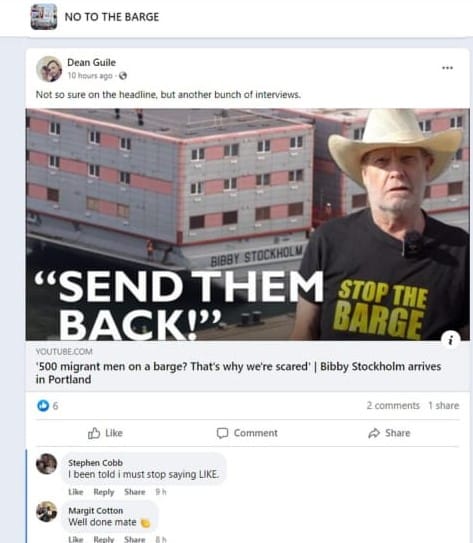
But yeah, Alex Bailey and Dean Guile have declared there’s no racism here, so…..

Alex Bailey: “500 plus fighting age men of unknown origin and criminal past” (alongside a Far Right Britain First video he posted!)

Adrain Mitchell: “Illegal dust mites”

Gary Knight: “Dirty lowlife scum.  Terrorists, rapists, murderers, pedo’s the fucking lot of them. Dirty cuntz. Send the fuckers back”

Ladette M Squiggleton: “infestation”

Mark Paul: “Illegal migrants flooding into the UK”, “being over-run by alien cultures”

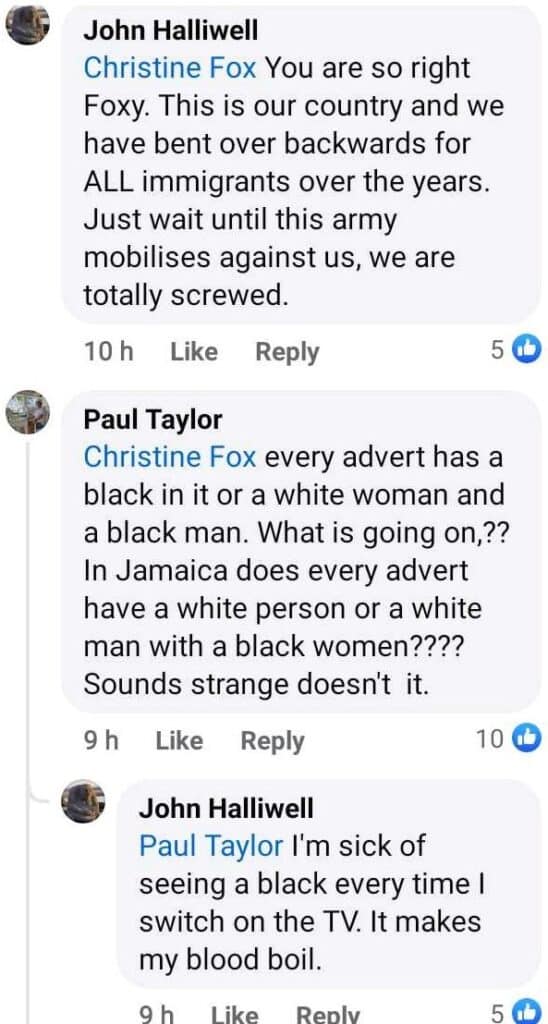
Paul Taylor: “every advert has a black in it or a white woman and a black man. What is going on??”

John Haliwell (in response): “I’m sick of seeing a black every time I switch on the TV. It makes my blood boil.”

(Then Dean Guile states that the ‘racism card’ is so over-used that racism doesn’t mean anything anymore!)

Michelle Varney: “They’re all fighting-aged Asian men”

Mark Paul: “Rapefugees”

Connor Spencer: “Rapists and pedophiles”

Stephen Redpath: “scrounging freeloading invaders”

Micky Greeno: “Freeloading scrounging benefit seeking chancers” (and then he called Rishi Sunak a ‘foreigner’). When Far Right activist Rod Harrison attacks Rishi Sunak, Greeno responds “He’s one of them”.

Graeme Kershaw: “vermin”

Gary C Hazel: “Ukrainians/Russians are evolved humans unlike the barge peeps”

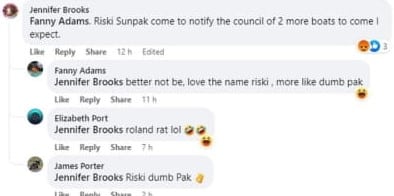
Elaine Bearne (as Fanny Adams) calls Rishi Sunak “Dumb Pak”, “The govt being Muslim are part of whats going on”

Micky Biggs: “Economic gimmegrants”. 

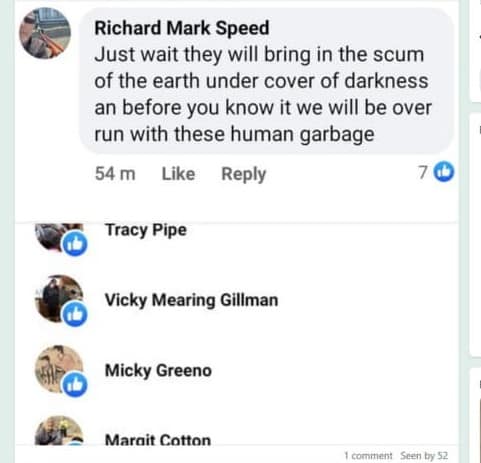
Richard Mark Speed: “Scum of the earth”, “human garbage”

(Then Alex Bailey is asked by his mate Jeff Moody on GBeebies about accusations of racism and he responds: “Those words, those terminologies, are never on my mind”)

Britishoscar JJ: “500 plus males with 3rd world brains”

Roger Forbes: “this scum”

Holty Bfc: “I would rather house 500 stray dogs than them”

Jay Capaldi: posts a video of a sickeningly racist song

Mark Pickering: “Paedophiles”

Aly Carroll: “Boat illegals”, “freeloading illegal gimmegrants”

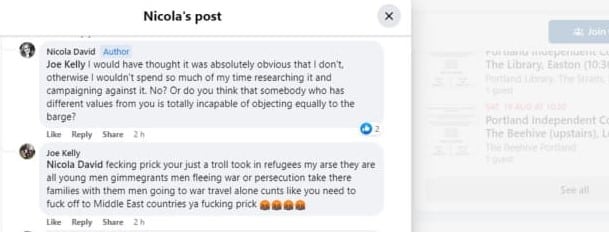
Joe Kelly: “Stealth invasion”, “invading army”, “scum” and “fucking gimmegrants”

Jon Burt: “My daughter was seeing a Nigerian and yeah I gave it the ‘Here boy go dig the garden will ya’ and so on which was having a bit of a giggle with him (now deemed really racist)”

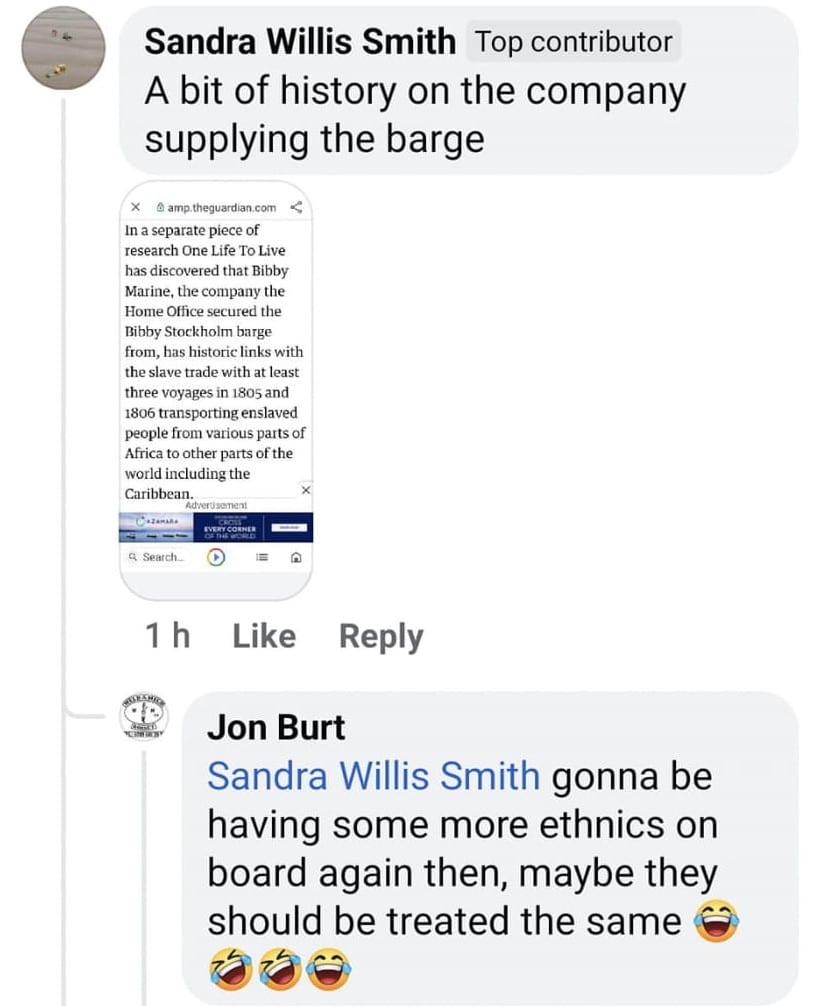
John Burt (again): When someone posts about the company the Home Office secured the barge from having historic links to the slave trade, Burt responds “gonna be having some more ethnics on board again then, maybe they should be treated the same.”

(Then Dean Guile insists racism is not a thing any more….. again)

Alan Croley (on a post about sewerage): “Serve it to them at dinner time”

Tracie Hobden: “When are the things actually arriving”

Beverly Ann Gardiner: “I don’t want the things in this country at all”

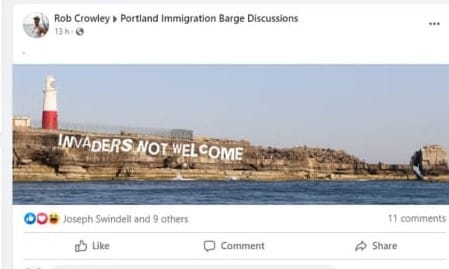
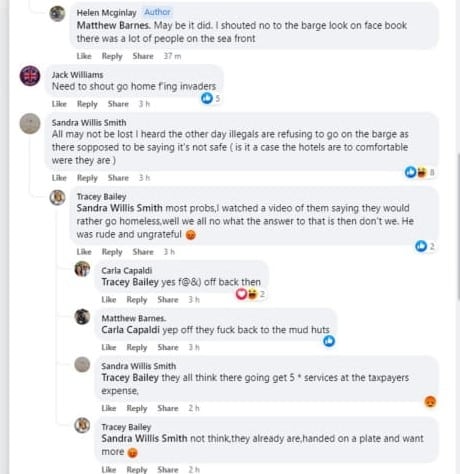
Jack Williams: “Need to shout go home f’ing invaders”

Carla Capaldi: “Yes f@&) off back then”

Mathew Barnes: “Yup off they fuck back to the mud huts”

Tracey Bailey: “Who the hell do they think they are in our country”

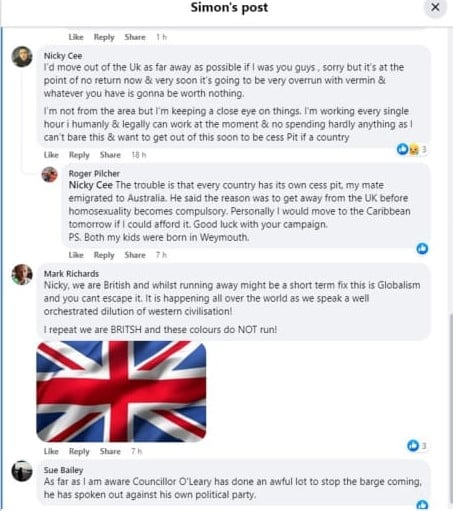
Nicky Cee: “very soon it’s going to be overrun with vermin”

Terry Topper Brown (on a post about fire regulations): “Let em burn”

(Then Alex Bailey and the other campaign leaders all say ‘there’s no racism here’)

Sue Bailey (Alex’s mother): “the gov’t will go down in history as the murderers of the GB race”

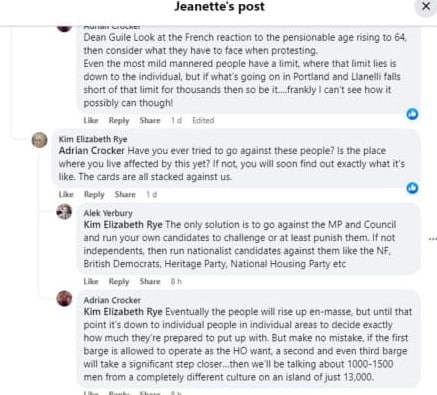
Kim Elizabeth Rye: “a bunch of scrounging chancers who are not refugees”, “foreign criminals”

Cindy Lou: “these animals”

Helen Mcginlay: “That’s what they do live in the fields and make a fire kill some animals and cook them”

Stuart Chiswelstaff Breckell: “channel rats”

Carol Hobday: “They shit on pavment”, “wors than rats”, “animals”, “stink” and “eat scraps”

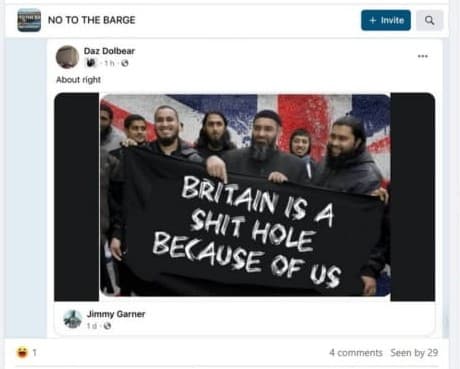
Daz Dolbear: “channel rats” (at least 20 times, usually with a rat cartoon/emoji), “uncivilised channel rats”, “dangerous channel rats”, “sub human channel rats” and eventually “Since when have these uncivilised subhuman channel rats been human beings”

Readers may well know the effects of such dehumanising language:

“Remember, it didn’t start with gas chambers. It started with politicians dividing the people with ‘us vs. them.’ It started with intolerance and hate speech, and when people stopped caring, became desensitized, and turned a blind eye, it became a slippery slope to genocide”.
(Auschwitz-Birkenau Memorial and Museum)

The NTTB campaign leaders – including Alex Bailey, Kate Robson, Steve Coggins, Stephen Cobb and Susan Pheonix – claim it’s not about racism and protest that there’s no racism to be seen.  They know full well that their group is an absolute cesspit of racism (and increasingly, Far Right engagement), and they have, essentially, done nothing to stop it.  They are complicit!

Shame on them!  They bring shame to our island!

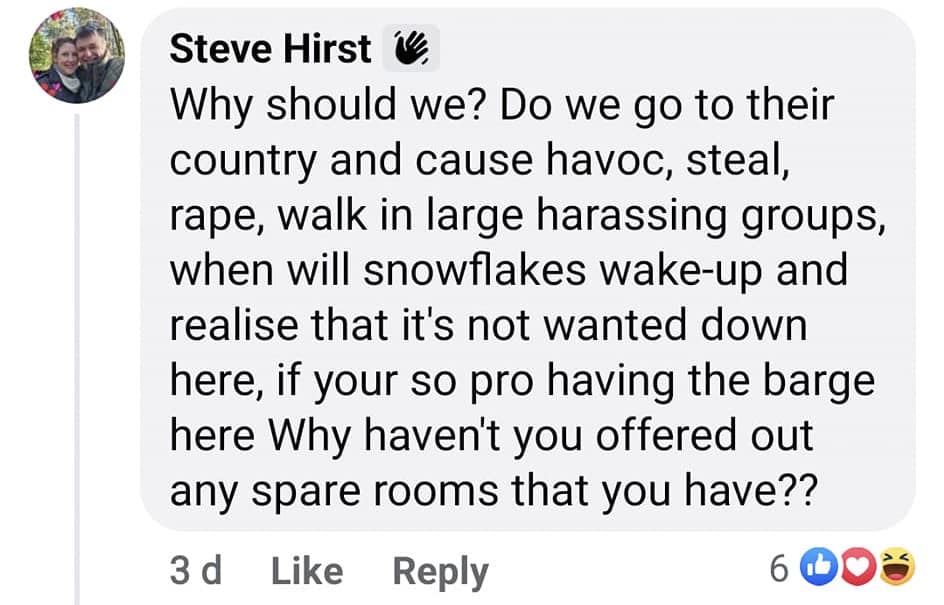
Gallery 2:
Threats

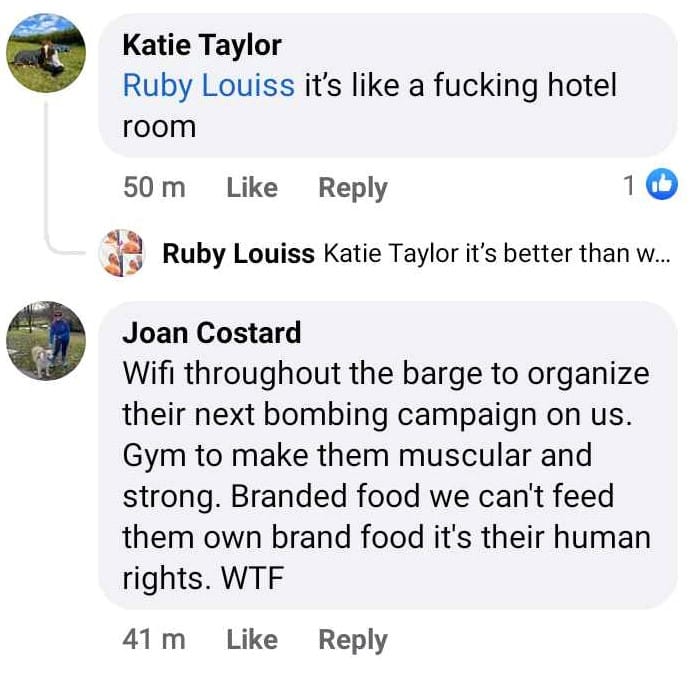
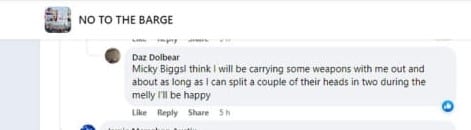
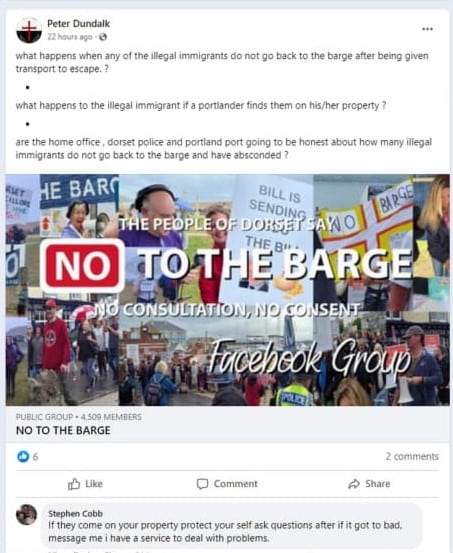
A consistent feature of the NTTB campaign group is the threats made in relation to the barge and its inhabitants.  Some may say that such threats are meant as ‘jokes’ but they add to the environment of hatred and animosity.

Stuart Chiswelstaff Breckell and Peter White both suggest adding a hand grenade to the refugee ‘welcome packs’ being made by locals.

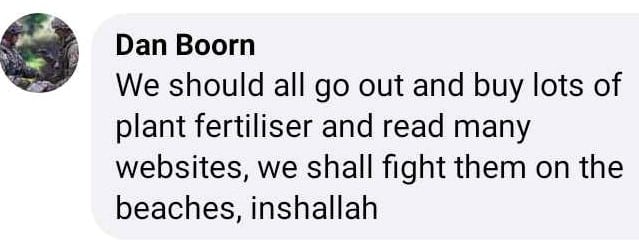
Dan Boorn suggests buying “lots of plant fertiliser and reading many websites” adding “We shall fight them on the beaches, inshallah”

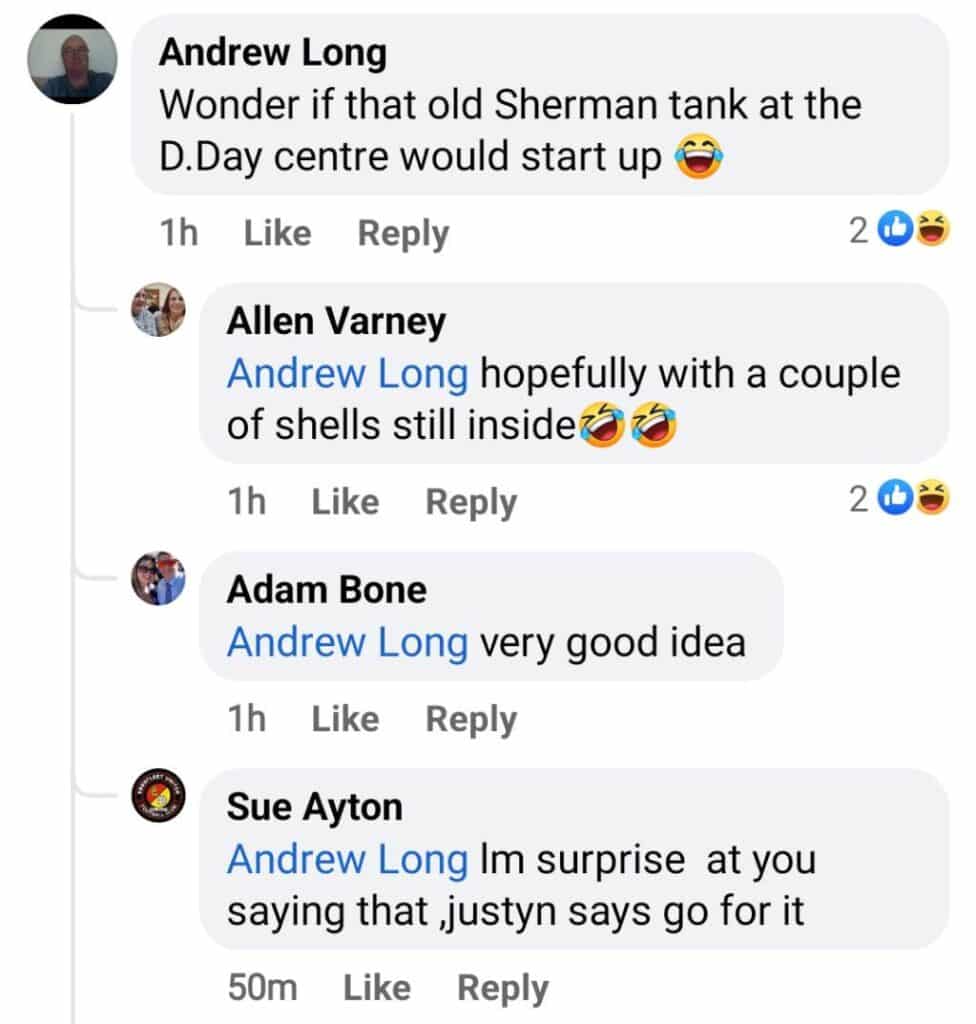
Andrew Long: “Wonder if that old Sherman tank at the D Day centre would start up” to which Allen Varney responds “hopefully with a couple of shells inside”

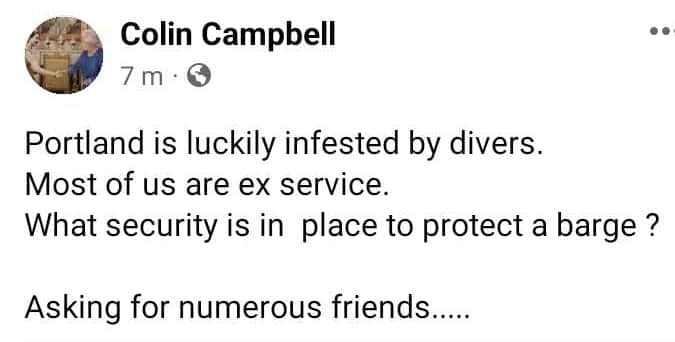
Colin Campbell: “Portland is luckily infested by divers. Most of us are ex-service. What security is in place to protect the barge. Asking for numerous friends….”

Sue Ayton declares that she’s “not worried about the barge going up in smoke with them on it”

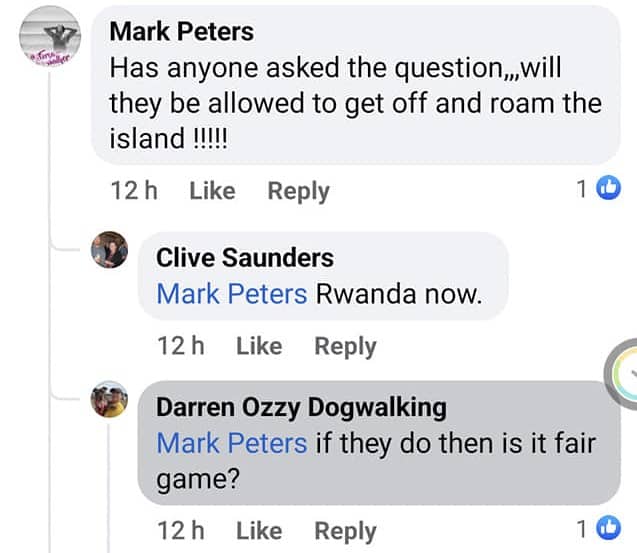
When Mark Peters asks “Will they be allowed to get off and roam the island!!!!” Darren Ozzy replies “If they do then it is fair game”

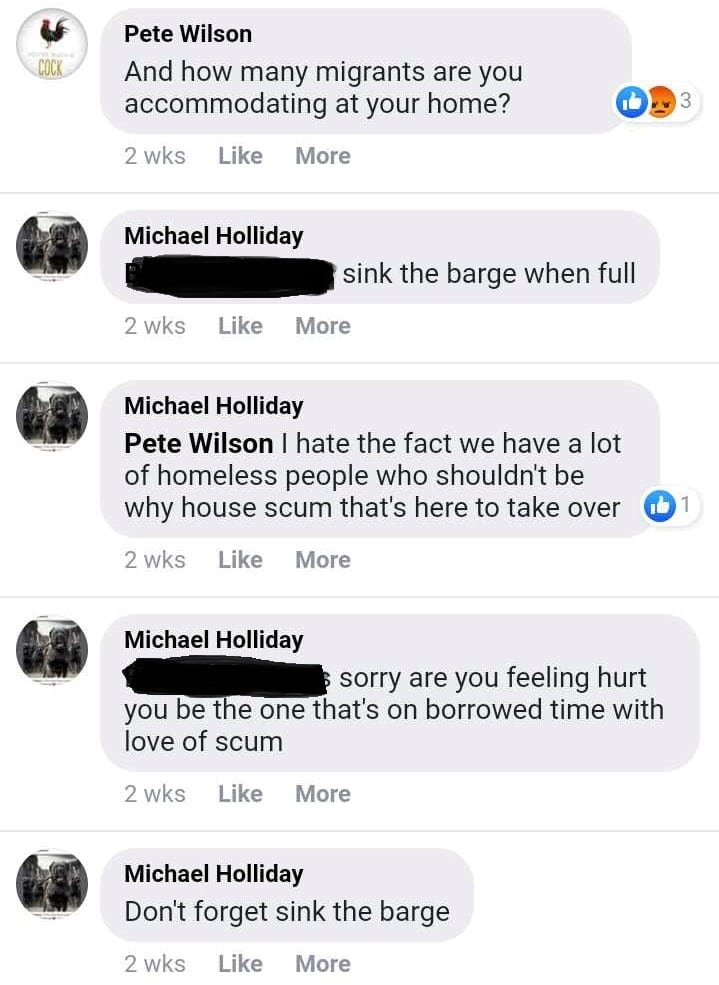
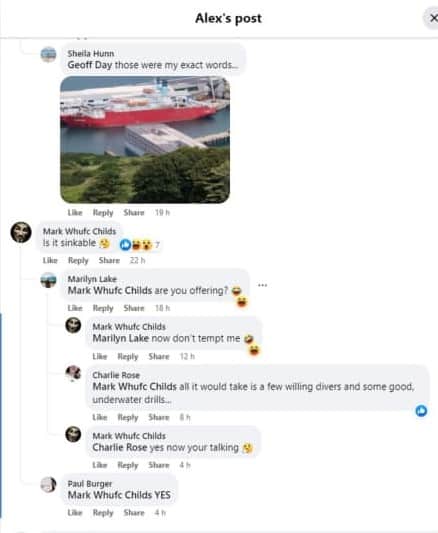
Mark Loader suggests sinking the barge (when it’s full) and Stepehen Guest suggests towing the barge to Lulworth ranges.

Jennifer Brookes: “Anybody got a speedboat and a Molotov cocktail. On a dark night.”

Richard J Taylor: “Anybody got the Royal Navy’s phone number maybe they can sink the damn thing”

Sandra Willis Smith: “Just cut the holdings let it float out to sea if we’re lucky the winter storms will do the rest for us”

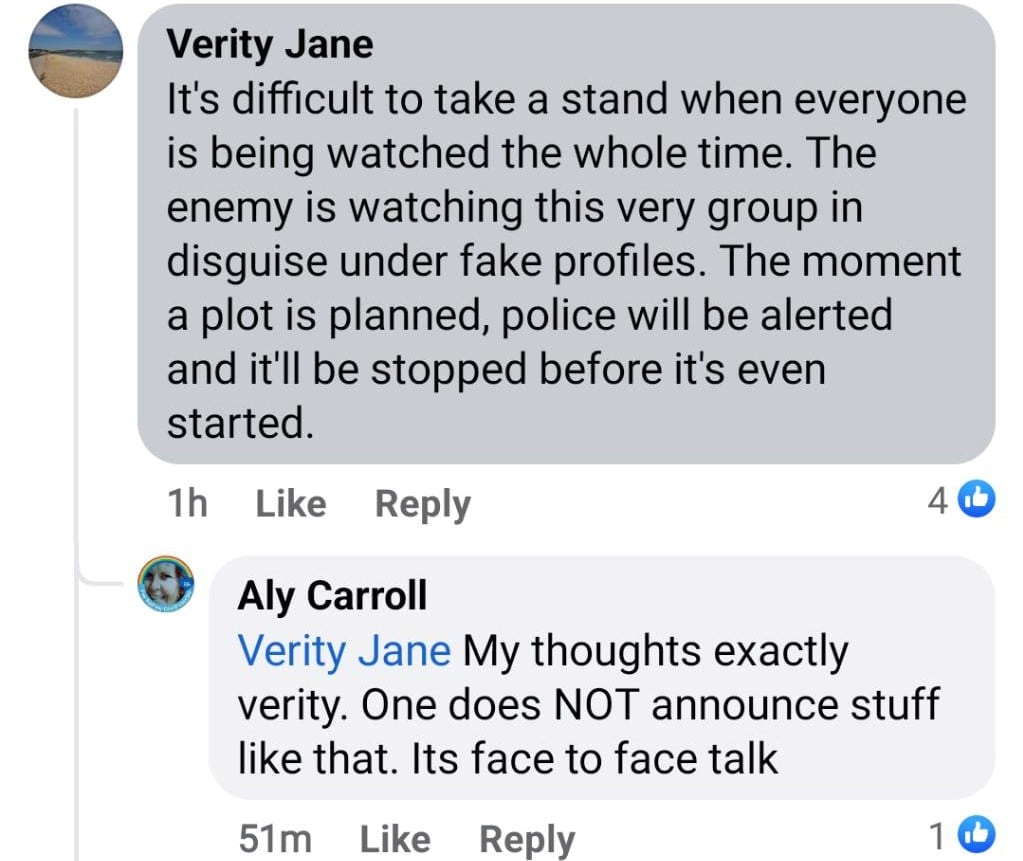
Verity Jane and Aly Carroll discuss how plans and plots should be discussed in person, rather than online where there are ‘spies’ and ‘police’.

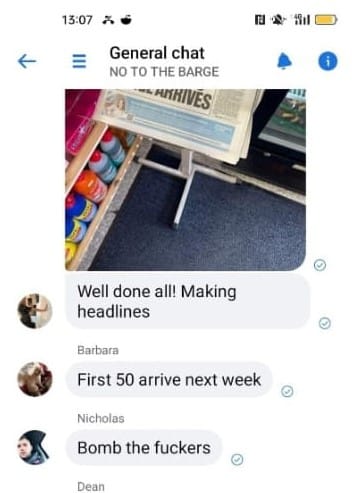
Nicholas Hough: “Bomb the fuckers”

Daz Dolbear: “I think I will be carrying some weapons with me out and about as long as I can split a couple of their heads in two during the melly I’ll be happy”

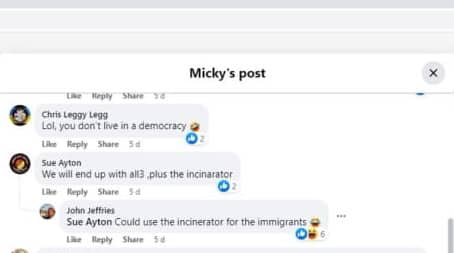
John Jeffries (on a post about the proposed waste incinerator): “Could use the incinerator for the immigrants”

I’ll just repeat that for anyone that missed it……

“Could use the incinerator for the immigrants”

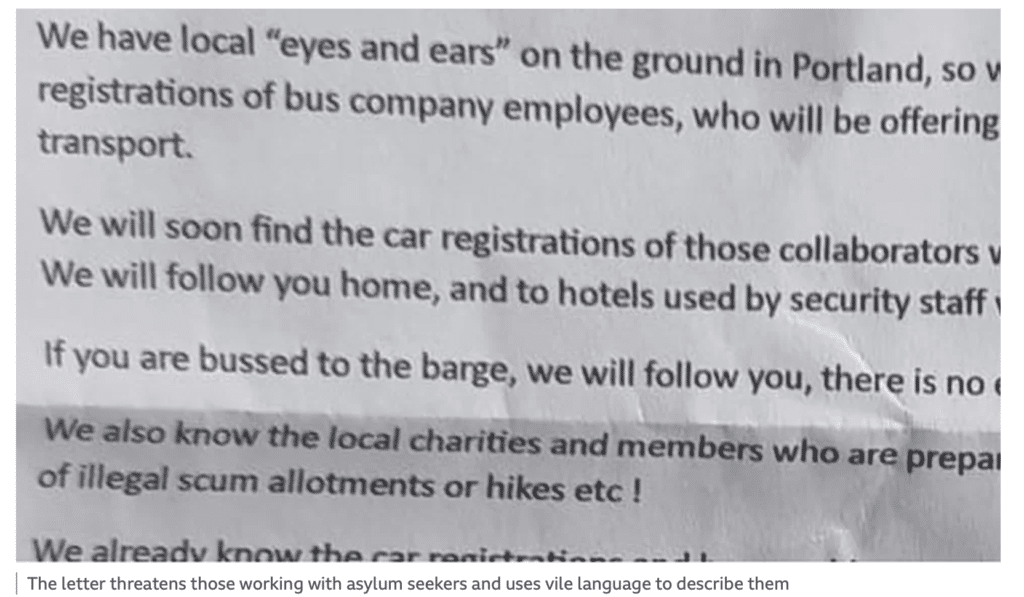
The threats haven’t stopped at the asylum seekers.  Abuse and veiled threats have been hurled at anyone who dares to challenge their racism as well as local anti-racists and Councillors. 

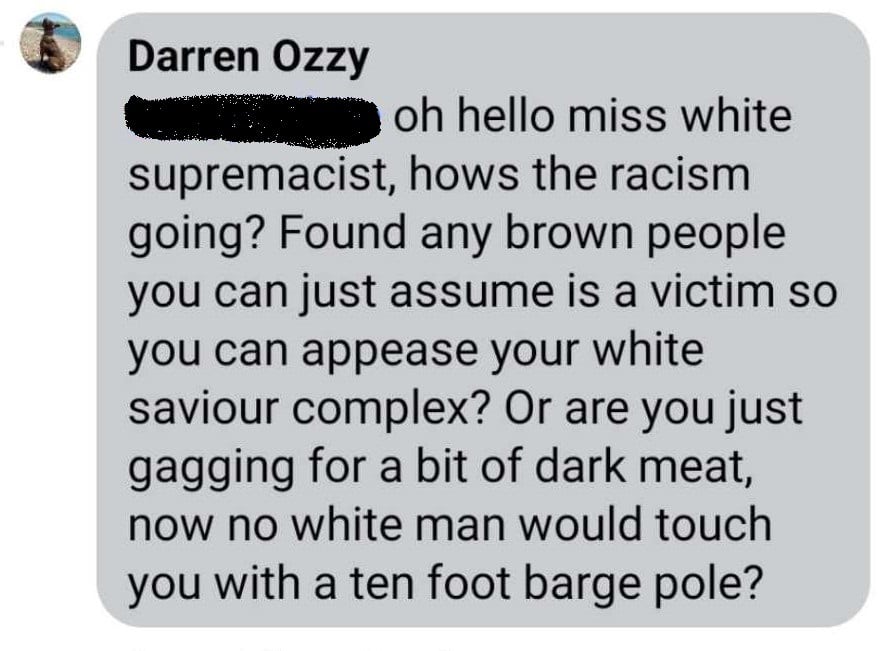
Darren Ozzy (real name Darren Johnston) and Micky Greeno have been particularly abusive to several local women, sometimes in public, sometimes sending vile private messages and saying they know where someone works.

Micky Greeno: “That (woman’s name) freak gets her moneys worth out of that Primark dress she wears”

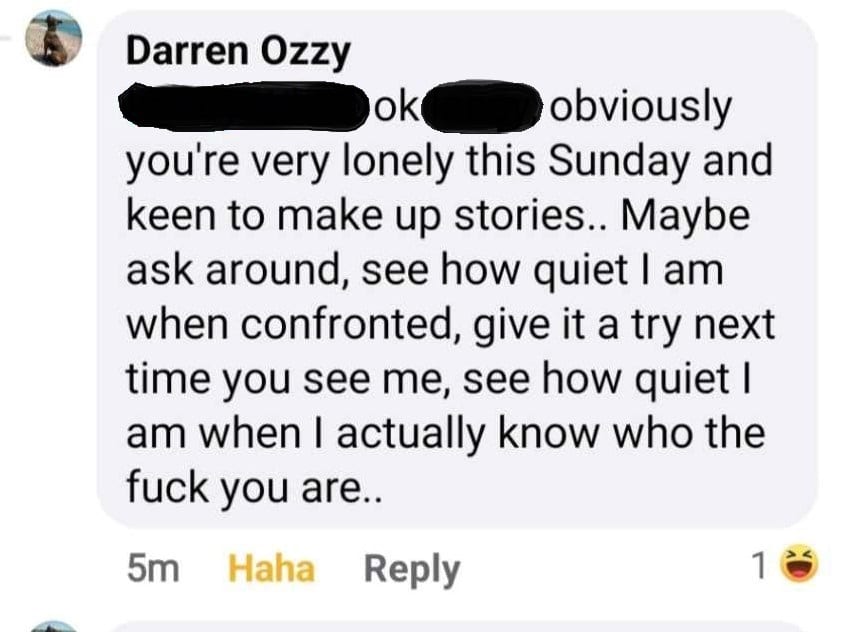
Darren Ozzy (Johnston): who shared screenshots of people he states are “in favour of the barge” alongside veiled threats and sent this: “Maybe ask around, see how quiet I am when confronted, give it a try next time you see me, see how quiet I am when I actually know who the fuck you are”, “Can’t farm Facebook likes when you’ve been raped and killed” and “Are you just gagging for a bit of dark meat now no white man would touch you with a ten foot barge pole?”

Chris Leggy Legg named two Portland women in a false and antagonistic diatribe about Stand Up To Racism Dorset.

Toby Carter: “Where do you live, Traitor?”

Paul Wagstaff: “You are a traitor to your country and it’s people”

Joe Kelly: “Cunts like you need to fuck off to Middle East countries ya fucking prick”

There have been disgusting and ill-informed attacks on Councils, individual Councillors and Stand Up To Racism Dorset members – in many cases, the very people who have, over many years, campaigned to save Portland Hospital, oppose the proposed waste incinerator, prevent public service cuts and keep affordable and social housing for local people.

Anyone challenging the racism online gets instantly labelled a ‘troll’, ridiculed, abused and, very often, removed from the group by that bastion of free speech Alex Bailey!  I myself was removed by Bailey some time ago for daring to speak out.

Most worryingly, a local 15-year-old girl has recently been called the ‘n-word’ on snapchat and, on the bus, a woman looked at her and said: “bet you’re from the barge!”

Gallery 3:
No To The Barge and The Far Right

The first six weeks of the NTTB’s existence saw predominantly local people join the group, albeit that links to, and videos from, Far Right groups were sometimes posted.  The last eight weeks has seen a considerable increase in people joining from around the UK, many of whom are also in various Far Right groups.  It has also been noticeable that many of the most vocal group members have moved to the area from elsewhere in the UK, including Alex Bailey who moved to Weymouth from Dover last year.  Many of these prominent members have stated that they moved here “to get away from them” as one person put it!

In June, Hope Not Hate published their latest exposé on ‘self-proclaimed migrant hunters’: 

https://hopenothate.org.uk/wp-content/uploads/2023/06/Migrant-hunters-resource-final-version-updated-June-23.pdf

It’s worth noting that:

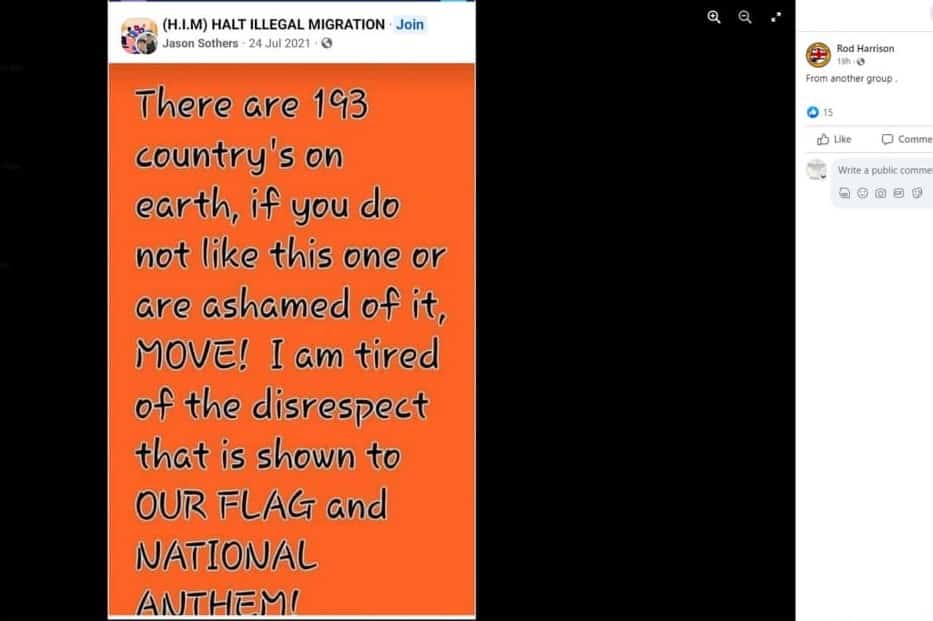
Page 2 – Patriotic Alternative – leafleted Weymouth in June.

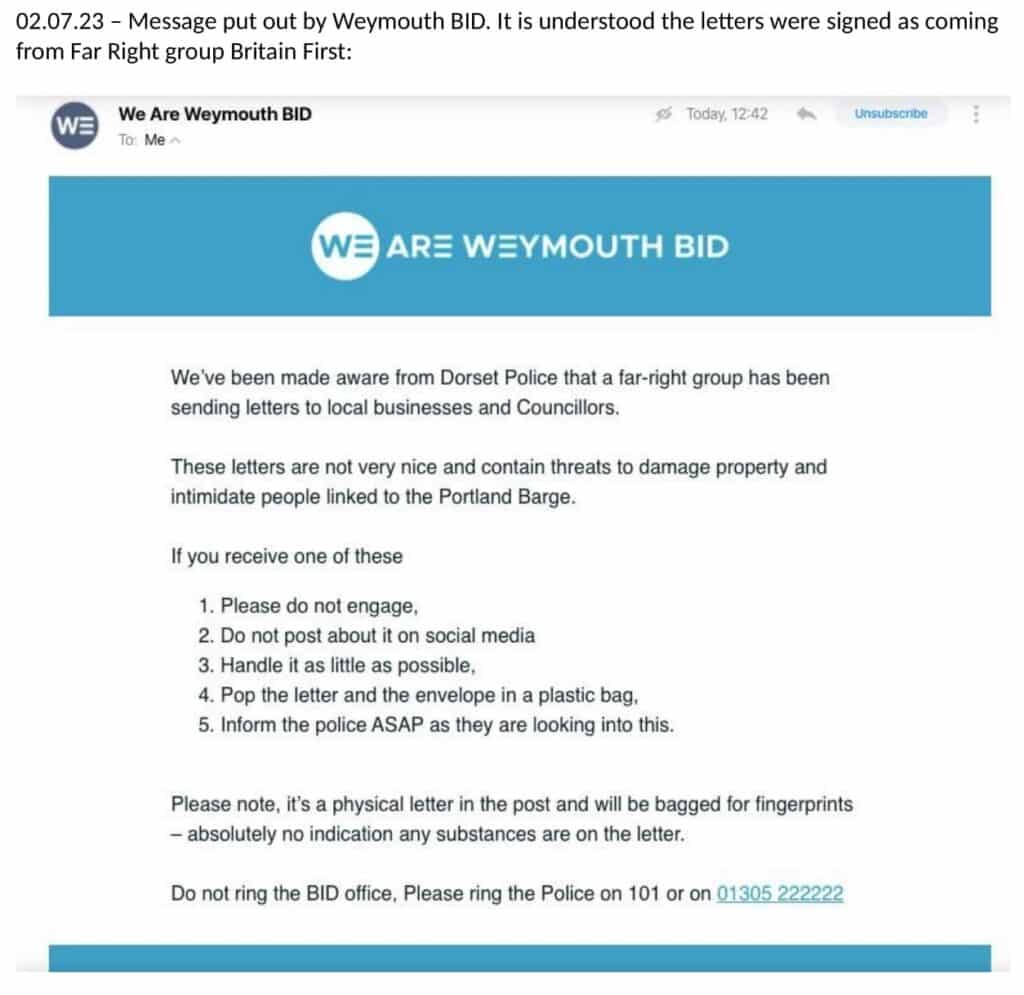
Page 3 – Britain First – the recent threatening letters sent to businesses and Councillors were signed from Britain First.  The fascist group have denied involvement.

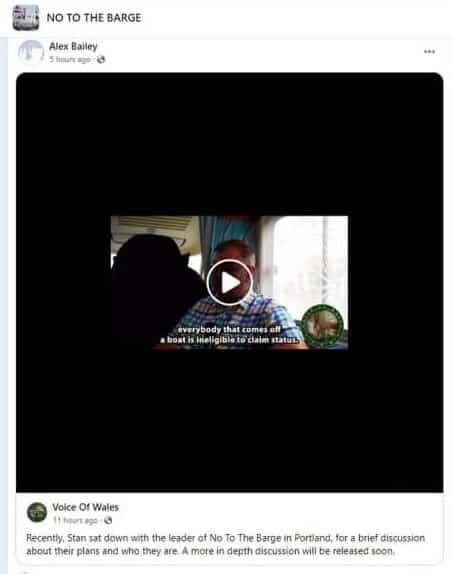
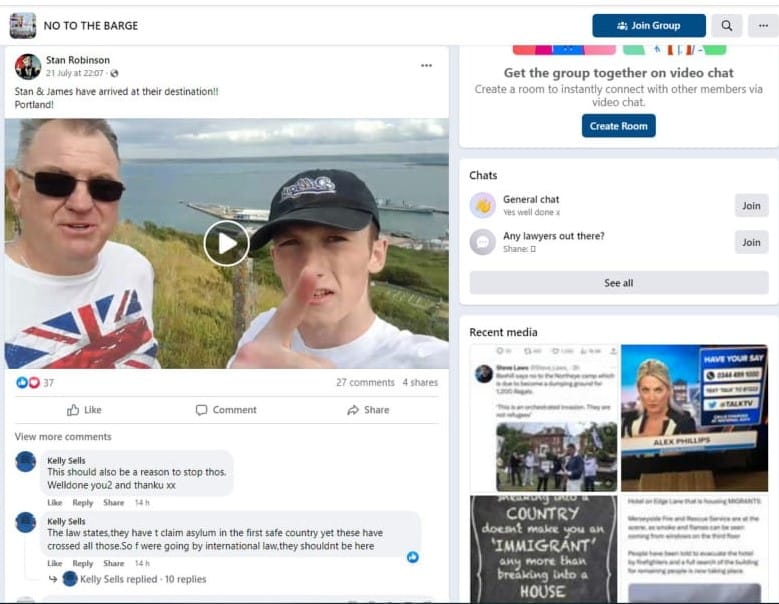
Page 4 – Voice of Wales – there has been loads of interaction between them and NTTB/Alex Bailey.  Stan Robinson and James Harvey (two VoW leaders) came to Portland for several days and met with, and interviewed, Bailey.  They have since conducted a second interview.  Robinson is posting on the NTTB group.

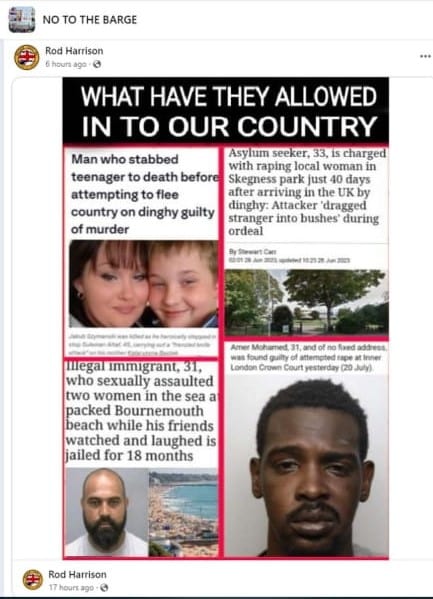
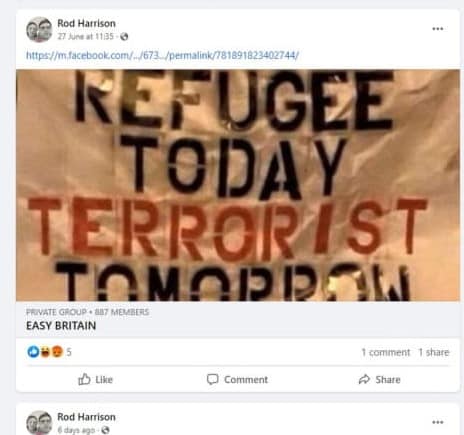
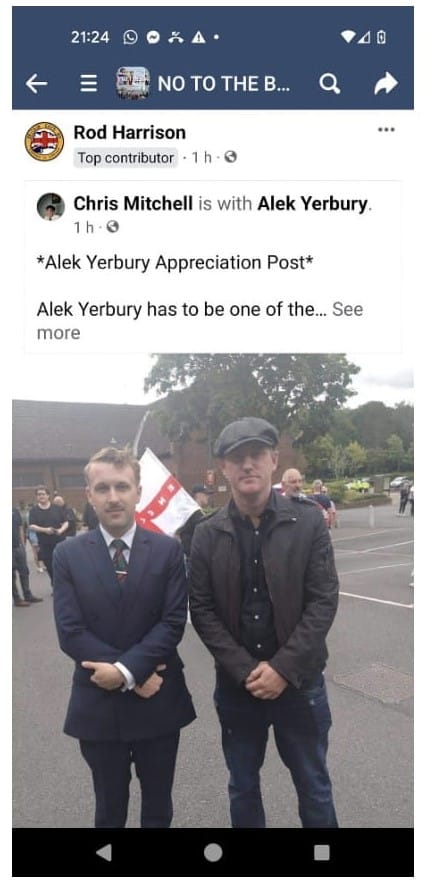
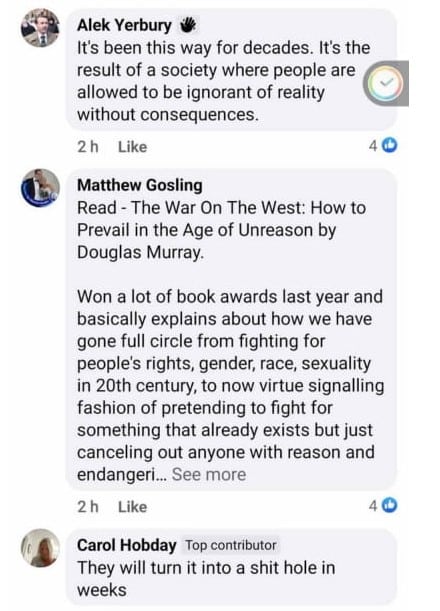
Page 5 – Alek Yerbury – Fellow Far Right activist Rod Harrison has been posting on the NTTB group for weeks and now Yerbury is posting.  Yerbury has also posted the NTTB group link on another Far Right group.  How sad that a proud military town is now giving any credence to a man who styles himself on Adolf Hitler!

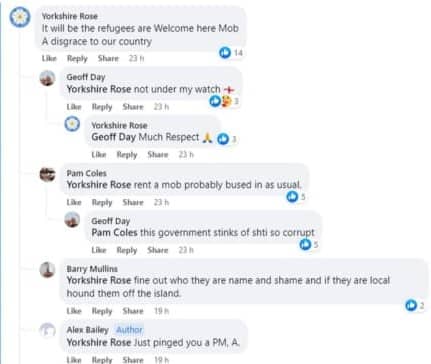
Page 7 – Amanda Smith (aka ‘Yorkshire Rose’) – posted to the NTTB group recently and Alex Bailey commented underneath that he had sent her a Direct Message.

NTTB members have posted links to, and articles and videos from, at least 16 different Far Right and extremist groups.  I will not name them here.  However, by example:

Mike Croley posted David Lane’s ’14 Words’, the most popular White Supremacist slogan in the world.  He also describes Far Right Patriotic Alternative as ‘Awake, not woke!”

Aly Carroll posted links to, and content from, several Far Right groups

Chris Leggy Legg posted a video of Stephen Yaxley Lennon (aka Tommy Robinson)

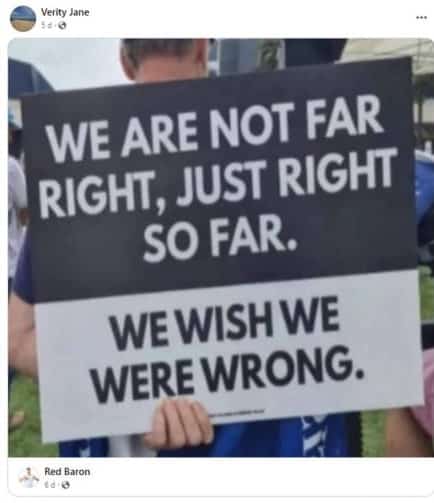
Verity Jane posted several Britain First videos…. and Alex Bailey and Darren Reynolds also posted one

Joanne Barlow, Andy Long, Elaine Bearne and others posted racist Far Right videos

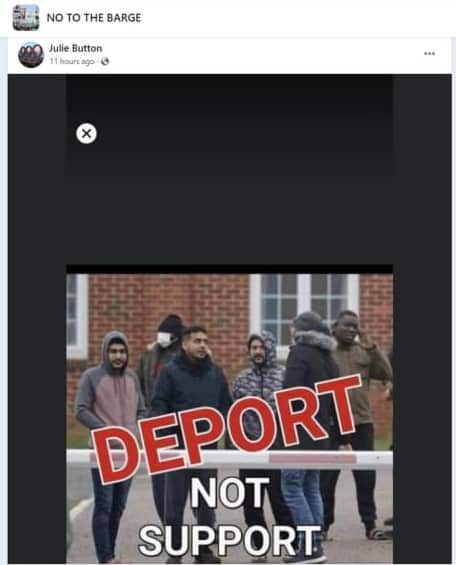
Julie Button posted from a Far Right group and Lisa Flann and Elaine Bearne shared posts by Alek Yerbury

NTTB Campaign admin Steve Coggins’ Facebook ‘likes’ include the Anti-Islam Alliance

Stephen Cobb states that he’s heard ‘Tommy Robinson’ is bringing a bus load of people to the NTTB protest (he didn’t) and then stated: “Shame Tommy Robinson has not got time to visit us”

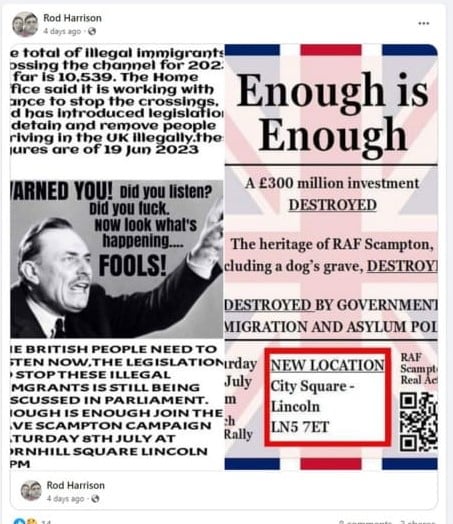
Along with other new members, Far Right activist Rod Harrison is invited to the NTTB protest by Steve Coggins.  After joining the group, Harrison posts 19 times in one week – the most prolific poster.  He regularly reposts Alek Yerbury posts from Far Right groups

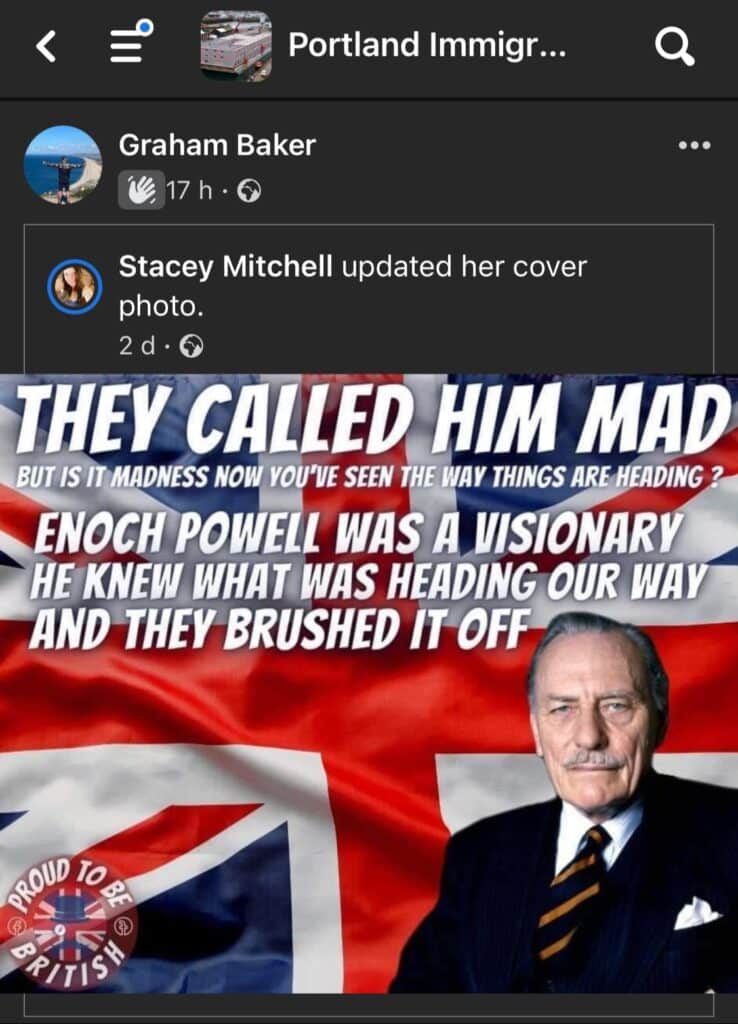
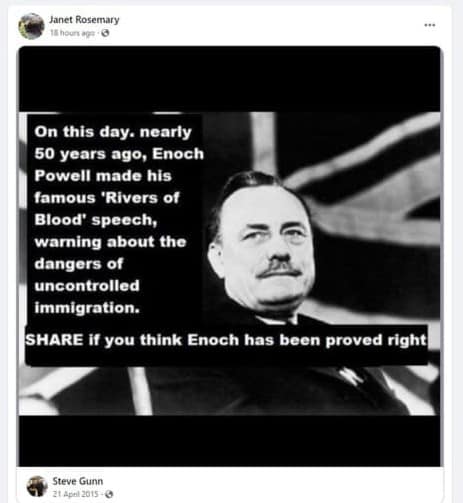
Janet Rosemary celebrates Enoch Powell’s ‘Rivers of Blood’ speech

Gary C Hazel posts about the Far Right ‘Great Replacement Theory’, the “genocide of the British People” and calls for “Civil War”

Mike Croley, Kim Gray, Robert House, Kevin Samuel Furniss and others post about the Far Right ‘Kalergi plan’.  There are lots of Far Right conspiracy theories around ‘Great Replacement’, ‘Agenda 2030’ and secret UN/WEF plans for a ‘New World Order’ – all relating to the ‘replacement of white people’

Along with other new members, Steve Coggins welcomes Hitler-wannabe Alek Yerbury to the group.  His first comment is to attack Stand Up To Racism

Stan Robinson from Far Right Voice of Wales posts regularly to the group

Anti-migrant campaigner Katie Elizabeth Rye from Dover encourages NTTB to join forces with other anti-migrant groups online, saying: “form yourselves into a much larger and much more threatening identity”

Facebook even joins in.  Based on NTTB’s strong links with Far Right groups, it suggests to me that I ‘might like’ a Far Right group where Yerbury is an admin.  I don’t!

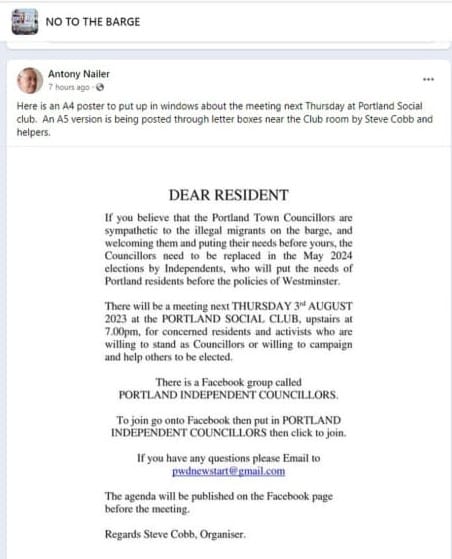
Worryingly, given their racism and proximity to the Far Right, the NTTB campaign has begun recruiting candidates to ‘replace those Councillors who they feel have not supported them.’  It is no coincidence that they have abused Councillors and misrepresented their words and actions to aid their electoral ambitions.  They say they are looking for people who will “help them to achieve their goals.”  I trust my fellow Portlanders will reject hate at the ballot box.

Gallery 4:

Alex Bailey

The NTTB campaign’s main leader so far has been Alex Bailey.  Whether he has aspirations to be a Far Right activist is unclear, but his willingness to be close to the Far Right is now evident.  His running of the NTTB campaign bears a very close comparison to Hope Not hate’s description of Patriotic Alternative’s modus operandi. 

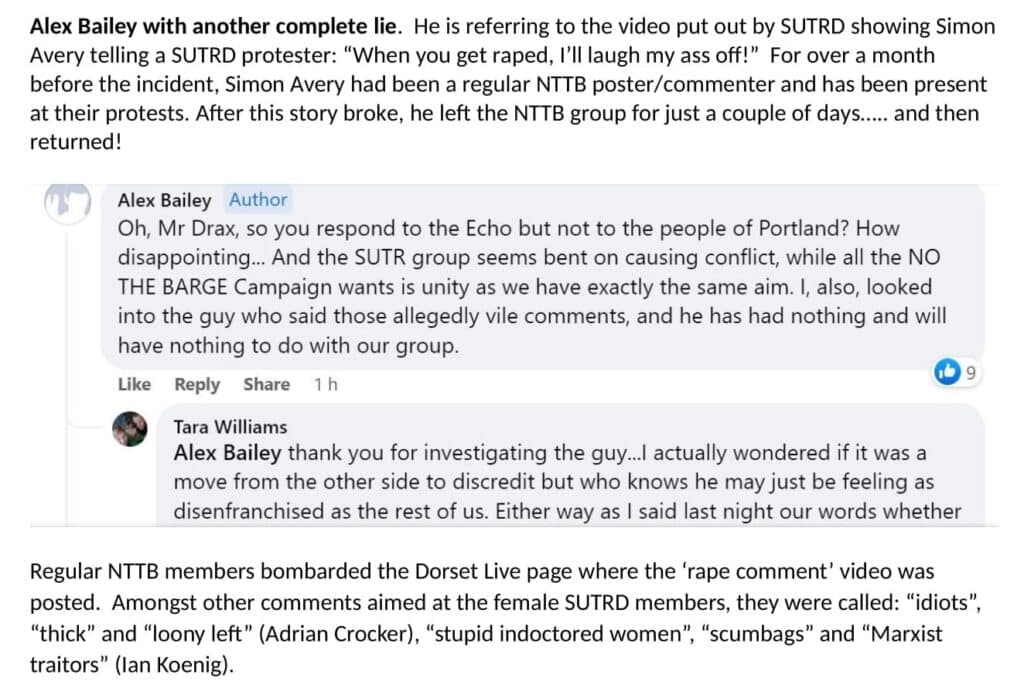
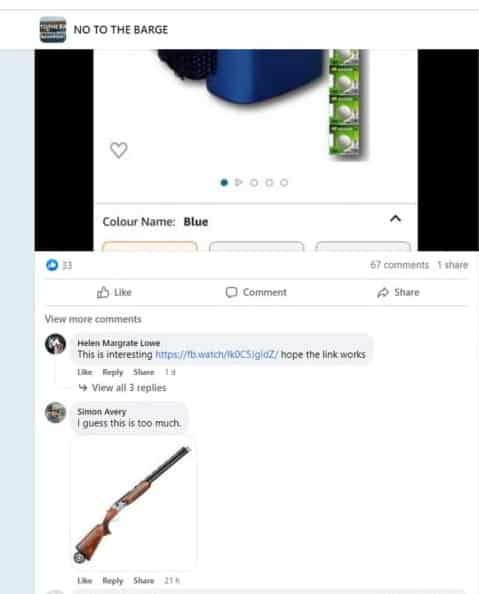
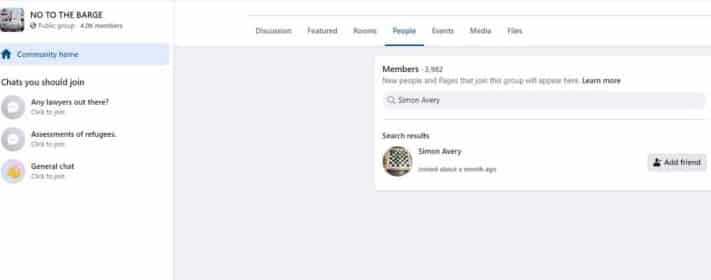
He appears to be a keen liar, deliberately and constantly referring to the local Stand Up To Racism group as ‘the racism group’ and a ‘hate group’ and claiming their protesters are ‘bused in!’  When NTTB regular Simon Avery told a SUTRD protester; “When you get raped, I’ll laugh my ass off”, the comment was caught on film and went around social media to widespread condemnation.  Bailey declared that he’d ‘looked into the man and he was nothing to do with their group!’  Avery had been a member of NTTB for over a month, had posted regularly and was at their protest!  Avery left the group for two days….. and then returned.

When Bailey had a falling out with Julie Croley, she declared publicly that he ‘was Far Right’ and intends to use the campaign to gain support for when he stands as an electoral candidate.  He then kicked her out of the group and told everyone she was unable to continue due to illness.  Bailey certainly has a politician’s knack for narcissism, deceitfulness, and self-promotion.  One would hope the electorate has had enough of that!

Interestingly, it seems there is further dissent within the ranks.  NTTB candidate organiser Antony Nailer recently criticised Bailey for not attending their first meeting (because he was being interviewed by a Far Right group), for deliberately pushing his post down their page and for his ‘self-aggrandizement.’  There are growing whispers that the people of Portland are cottoning on and feel he has been using them for his own ends.  Whilst not living on Portland, he constantly says he is ‘giving us our voice.’  It remains to be seen how long we’ll believe him.

The backlog of asylum cases that has created the problem in the first place is a (conceivably deliberate) failure of government.  Poor people escaping war, persecution, imprisonment, and torture are not to blame.  The blame lies squarely with a government who care for refugees about as much as they care for our communities.

When I stated at the start that our community had been ‘radicalised’ through fear, grievance and hate, there is some truth to that.  How else would a community so proud of fighting fascism in WWII be openly greeting fascists and their dangerous ideas?  However, the fact is that it is actually just a very small section of our community.  Most people on Portland (and in Weymouth) are not racist and the community at large has been doing amazing things to welcome and support refugees.  The majority of people, including those in the NTTB Facebook group, are decent, kind, charitable and welcoming and believe that refugees are human beings who, like all of us, deserve to live in safety.

Gallery 5:
Liz Bladon

Please SUPPORT US where you can: Award Winning Independent Citizen Media Needs Your Help. PLEASE SUPPORT US FOR JUST £2 A MONTH


Dorset Eye wins big at Independent Media Awards

Ten years after its launch, Dorset Eye has won the Independent Media Awards for Citizen Media, Regional/Local Outlet of the Year and Political Reporting of the Year. The awards which were officially announced on 26th March where some of the hundreds of independent media were recognised for their tenacity in bringing to the public’s attention many of the news… stories that the corporate media either seeks to ignore or distort.

Dorset Eye was a founding member of The Media Fund which has since morphed in to the Independent Media Association. Both were set up to create a cooperative culture within the media and to raise vital funds to help all members to grow and to be sustainable. Many have now joined the regulatory organisation IMPRESS created out of the aftermath of the Leveson Inquiry.

IMPRESS is the Independent Monitor for the Press and is an independent press regulator in the UK. It was the first to be recognised by the Press Recognition Panel. Unlike the Independent Press Standards Organisation (IPSO), IMPRESS is fully compliant with the recommendations of the Leveson Inquiry.

As a result of membership of both the IMA and IMPRESS Dorset Eye is fully compliant with the standards of media content in the UK and along with all other members is held to a higher standard than the corporate media are under the IPSO.

The recognition bestowed on Dorset Eye as a leading Citizen Media, in which the public are empowered and respected for their voice, is part of our journey to hopefully becoming normalised across the UK and beyond. Unlike the top down corporate media model that tends to propagandise and distract, citizen media is the only route to democracy in its definitive sense.

Citizen Journalism - Independent Media Association

We all experience information and we all impart our own prerequisite conditioning on to our perceptions and narrative. This must be understood as a given. For those who denigrate citizen media it is vital to remember that humans are not and never will be above subjective interpretation. Citizen media accepts that interpretation in all its complexities is the norm and does not seek to deny this. It also accepts that by publishing news and other content it is up to the reader to do their own research and that this is merely a starting gun for more knowledge and enlightenment.

We are also exceptionally proud to be recognised for our award as Regional/Local Outlet of the Year. Approximately half of all of our content comes from local people and local places and with nearly eight thousand contributors signed up to the site we consider that our first ten years has been a remarkable success.

Regional Local Outlet of the Year Award

At a time when the corporate regionals are struggling in terms of revenue and the quality of their provision the independent sector is very much on the rise. We are extremely grateful to the local people and organisations who are supporting us in ever increasing numbers. Their dedication to being part of the news media in a proactive sense is changing the landscape in a very positive way. The dramatic fall in sales of corporate newspapers reflects a culture in which many people refuse to be ignored and silenced.

Dorset Eye is also very proud of its recognition for political reporting and helping to uncover many of the clandestine elements of society that powerful figures and again the corporate media attempt to hide or obfuscate. A significant amount of our content is about political enlightenment and helping people to remove the smokescreen.

Dorset Eye also have a TV channel that celebrates its first anniversary in April in which it delves in to local, national and international issues with those in the know. Entitled ‘Ten By Six’ it explores those issues that the corporate media tend not to.

However, besides of all the positive news the main obstacle is funding. The government and the establishment generally perceive independent media as a threat to their grip on power and people’s consciousnesses and therefore financial support is very much more hard to come by than for the corporate media. With this in mind we reluctantly accepted advertising on the site but going forward we would much prefer to be a publicly funded non advertising experience. This leads us to finding ways of raising funds. We very much need to get to a thousand people who are prepared to support us by donating £2… a month. If we can get ten thousand people supporting us we can set up a news desk, training courses and many of the other exciting projects.

Finally we would like to say a Big Thank You to our readers and contributors. The effort and energy that they put in to creating content in particular helps shape what little democracy the state allows us. Without you we are nothing xx

The Dorset Eye Team

Please join us on social media:

Twitter: @dorset_eye

Facebook: https://www.facebook.com/TheDorsetEye

Instagram: Dorset Eye

Which Financial Markets Are Least Affected By the Pandemic?

We have finally seen off 2020 — a milestone most around the world will welcome — and we’re beginning to see light at the end of the coronavirus tunnel. That doesn’t mean we’ve reached the end of this international nightmare just yet. But vaccines appear to be on the way (yes, really this time), and that’s something!

We reported on the ‘UK Government Seriously Considering a Compulsory COVID-19 Vaccination Program’ and that will certainly spark fresh debate, and unease among those who don’t trust the vaccine. But that’s a bridge we can cross when we arrive at it. The mere fact that the government has reason to consider something like this is a positive sign that citizens will be able to be vaccinated before too long — possibly in the spring of 2021.

Naturally, the best part of all this is that we may be able to safely return to something resembling ordinary life. But another positive result might just be an economic uptick. It goes without saying that the global recession we in the UK have gotten more than a little caught up in was caused by the pandemic itself. And while the easing of that pandemic won’t automatically turn around major world economies, it should help in some regards. Widespread vaccinations and ongoing precautions will lead to more ordinary life; more ordinary life will lead to greater optimism and consumer activity; and optimism and consumer activity can lift an economy out of a difficult time.

If this all plays out more or less as described, it’s also likely to bring about an uptick in investment. But the interesting question is going to be which markets people are confident putting their money in. Understandably, the market collapses we saw back in the spring of this year left many feeling skittish about conventional investment. And hopefully those sentiments ebb away when it’s appropriate for them to do so! But in the meantime, as we look ahead to that light at the end of the tunnel, it’s worthwhile to consider which investments people may favour when they do start to invest again.

It may well be that the ones people gravitate toward will be those that have actually been least negatively affected by the pandemic to begin with. Following this line of thinking, three popular investment markets stand out.

Cryptocurrency

A year ago, cryptocurrency still seemed like a little bit of a fringe market. There was plenty of value going around, and plenty of investors got wealthy trading assets like bitcoin, ethereum, and the like. But the average person looking to establish a portfolio and build wealth still looked at cryptocurrency as something undefined, uncertain, and risky.

It may still be those things, but it is also — undeniably — among the trading markets that functioned best during the worst of the pandemic. While cryptocurrency prices did fall when the market all around the world first dropped off, the major coins bounced back rapidly and then kept climbing cryptocurrency has proven that it can withstand a recession, and some of the top assets in the category are now trading near all-time highs.

Forex

Forex is almost a difficult market to assess in broad strokes, because it is comprised of major currencies from all around the world. Clearly, we’ve seen some of those currencies struggle more than others during the pandemic and recession, such that investing in one currency might not have been as productive as investing in another. In forexthough, that’s not so different from ordinary circumstances.

In FXCM’s examination of forex trading, a section on how to make money in the market points out that because of the market’s depth and liquidity, “it is possible to implement almost any viable strategy” and find success. It also points out that traders can profit by being long or short on a given asset — essentially meaning currency value gains and losses can yield profits. Given these general conditions, it’s fair to say that fundamentally, the forex market has remained relatively unchanged.

Housing

This one has been baffling some analysts (as well as casual observers) for months. But it’s a simple fact at this point that the UK’s housing market has somehow avoided any sort of meaningful struggle throughout the difficult circumstances of 2020. In fact, when The Guardian looked into the housing market just recently, it determined that house prices actually jumped at the “fastest rate in four years.”

To be clear, some still expect to see a belated effect. Additional COVID-related controls this winter could slow down the market. And if this happens and we don’t see a return to normal as soon as we’re beginning to hope for, that slowdown could persist. In other words, keep a close eye on housing, as it could conceivably suffer a sort of late-stage pandemic effect. But for now, housing has to be mentioned among the investment markets that have withstood the year’s complications.

Beyond these markets, there’s considerably more uncertainty. Commodities have been all over the place (gold thriving, oil crashing, etc.), and need to be considered individually. Stock markets have largely recovered and according to BBC are soaring in the hopes of a vaccine, but could always turn at a moment’s notice in a time like this. But cryptocurrency, forex, and housing investment look to be relatively stable alternatives.

That does not mean that putting money into these markets will automatically net returns as we crawl our way out of this pandemic. Investing always involves risk, and in a time like this any piece of news can turn a market upside down in a hurry. If things do begin to turn around though, and people gravitate toward the markets that acquitted themselves well through the worst of 2020, these are the ones that will stand out.

Which Financial Markets Are Least Affected By the Pandemic?

PLEASE SUPPORT US FOR JUST £2 A MONTH

https://dorseteye.com/donate/

Not The News with Jolyon Rubinstein

Independent media are collaborating on a weekly series that will bring the investigative journalism so often missing from the corporate media.

Dorset Eye is part of the Bywire™ News Network @bywirenews and we are all collaborating on trying to uncover the real news as opposed to the manufactured news agenda delivered by the corporate mainstream.

As part of this ‘Not The News’ with Joylon will be a weekly investigation in to how those who hold the puppet strings intend to obfuscate and shroud us from reality.

Joylon will bring what you only rarely see on our TV’s and newspapers.

Jason Cridland

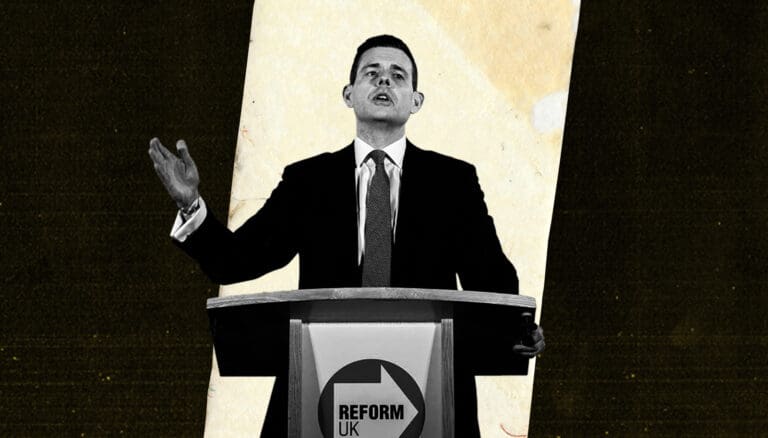
Reform UK Councillor Jailed for Decade of Coercive Control

A Reform UK councillor has been jailed for a campaign of coercive and controlling behaviour spanning nearly a decade, in a case that has triggered a by-election and renewed scrutiny of the party’s vetting procedures.

Taylor, 35, of Margate, was sentenced to 12 months’ imprisonment at Margate Magistrates’ Court on 20 February after pleading guilty to controlling and coercive behaviour. The court heard that the offending dated back to either 2014 or 2016 and continued over a sustained period during his marriage.

Prosecutors outlined a pattern of psychological abuse in which Taylor belittled his wife, undermined her confidence and sought to dominate her day-to-day life. He repeatedly demanded access to her mobile phone, scrutinising messages and contacts. He isolated her from friends and social circles, exerting pressure designed to cut her off from outside support.

More disturbingly, the court was told that Taylor made threats including saying he would hunt her “like prey” and burn her alive in the boot of a car. While the prosecution accepted there was no evidence he intended to carry out those threats, magistrates heard that their purpose was to instil fear and reinforce control.

Coercive and controlling behaviour has been a specific criminal offence in England and Wales since 2015, reflecting a broader understanding that domestic abuse is not limited to physical violence. Campaigners have long argued that patterns of intimidation, surveillance and isolation can be just as damaging, leaving victims feeling trapped and powerless.

Taylor had been elected as a Reform UK councillor in May 2025, representing Cliftonville. He was suspended by the party shortly after details of the allegations emerged. Following his guilty plea, he was expelled from Reform UK altogether.

As a result of his conviction and custodial sentence, Taylor will now lose his council seat, prompting a by-election in Cliftonville. The development has led to questions locally about the robustness of Reform UK’s candidate selection and background checks, particularly given the length of time over which the offending occurred.

Opposition figures have said the case raises serious concerns about due diligence, asking how conduct stretching back years went undetected prior to his election. Reform UK has yet to set out in detail what vetting processes were undertaken before Taylor was selected to stand.

For residents in Cliftonville, the immediate consequence is a fresh trip to the polls. For the wider political landscape, the episode is likely to intensify debate over candidate scrutiny and the responsibilities of parties to ensure those seeking public office meet the standards expected of elected representatives.

‘Sex Pest’ Matt Goodwin Causing Panic for Reform UK

Sexual harassment allegation is rumoured to be the tip of the iceberg.

Reform UK’s reflex response to controversy is now so predictable it has become a political strategy in its own right: deny, diminish, and denounce the messenger. The handling of a sexual misconduct complaint reported in the Guardian involving Matt Goodwin is simply the latest and most revealing example.

In 2025, a young employee at GB News lodged a complaint alleging that Goodwin had made inappropriate verbal remarks to her, including a comment about her appearance. Sources say she was deeply upset by the incident and that colleagues were disturbed by her distress. An internal inquiry followed. No formal disciplinary action was taken. Goodwin apologised once the complaint was raised. His lawyer has dismissed the matter as a “minor workplace issue” rooted in miscommunication.

But the political question is not whether a tribunal was convened or whether HR ticked the correct boxes. It is why, having been informed of the grievance, Nigel Farage pressed ahead with Goodwin’s candidacy regardless.

Farage, leader of Reform UK, was reportedly told of the complaint before Goodwin was selected for the Gorton and Denton by-election. According to one source, he brushed it off as “that is just Matt being Matt”. If accurate, that phrase encapsulates a culture of indulgence: behaviour that unsettles others is reframed as personality; concerns are trivialised as oversensitivity; reputational risk is calculated and absorbed.

This is not an isolated lapse in judgment. Reform UK has repeatedly selected candidates whose past comments and associations would raise alarms in any party serious about governance.

Goodwin himself has described giving “young girls and women” a “biological reality” check, language critics said flirted with authoritarian social engineering. In conversation with Jordan Peterson he lamented the “feminisation of higher education”, aligning himself with culture war narratives that portray equality as decline. He has questioned whether UK-born people from minority ethnic backgrounds are necessarily British — a statement that strikes at the civic foundations of modern citizenship. Upon announcing his candidacy, he was endorsed by far-right agitator Tommy Robinson, a convicted criminal whose support would be toxic to most mainstream campaigns.

At the local level, Reform UK has faced a rolling series of controversies over candidates’ historic social media posts, inflammatory rhetoric and conspiratorial claims. Rather than demonstrate rigorous vetting or disciplinary clarity, the party’s standard response has been to cry “smear”, blame hostile media, and portray itself as the victim of establishment sabotage.

That posture may energise a base that thrives on grievance. It does not inspire confidence in the party’s readiness for office.

Candidate selection is the clearest expression of a party’s values. It signals what conduct is tolerable, what rhetoric is acceptable, and what trade-offs are deemed worthwhile. In Goodwin’s case, the calculation appears stark: controversy is survivable, contrition optional, scrutiny suspect.

Reform UK insists it is cleaning up British politics. Yet its pattern suggests the complete opposite. It reflects a movement more interested in provocation than prudence, more comfortable with outrage than accountability and more inclined to dismiss complaints as smears than to ask why they keep arising in the first place.

Reform UK Forced to Suspend Campaign Manager for Gorton and Denton By-Election Because of Holocaust Denial and Antisemitism

The suspension of an interim campaign manager over allegations of antisemitic, misogynistic and conspiratorial social media posts should be a moment of deep reckoning for any political party that aspires to govern. For Reform UK, it looks uncomfortably like déjà vu.

Reform UK has confirmed that Adam Mitula, who had been assisting in the Gorton and Denton by-election campaign, has been suspended following complaints about his online activity. The posts in question reportedly included denial of Holocaust death tolls, the repetition of crude antisemitic slurs such as “I wouldn’t touch a Jewish woman”, the amplification of conspiracy theories from figures with a record of antisemitism, and false claims about transgender people.

This was not an obscure activist shouting into the digital void. This was an individual operating at the heart of an election campaign, assisting prominent figures and helping shape the message presented to voters. The fact that such views were apparently visible online before his appointment raises serious questions about vetting, judgement and culture.

Reform UK has stated that it acted swiftly once concerns were raised publicly. Jewish community leaders flagged the posts, and Jewish groups have welcomed the decision to suspend him. That response is, of course, the bare minimum. But the timing matters. The suspension came after exposure and public pressure. The obvious question is: why did it require external scrutiny for action to be taken at all?

Time and again, Reform UK insists it is a serious political force ready for government. Time and again, it finds itself distancing itself from individuals espousing extremist rhetoric. Time and again, the cleanup appears reactive rather than preventative.

This is not about one individual’s offensive posts alone. It is about a pattern. A party that repeatedly has to apologise for antisemitism, misogyny or conspiracy politics within its own ranks cannot plausibly claim that these are isolated “bad apples”. At some point, voters are entitled to ask whether there is a deeper problem in recruitment, culture or oversight.

Holocaust denial is not a minor faux pas. It is an assault on historical truth and on the memory of six million murdered Jews. Casual antisemitic slurs are not edgy humour. They are expressions of prejudice that have fuelled centuries of persecution. Spreading misinformation about transgender people is not robust debate. It is part of a wider climate of hostility that has real-world consequences.

If Reform UK wants to be treated as a party of government, it must demonstrate that it can prevent such individuals from reaching positions of influence in the first place. That means rigorous vetting, clear red lines and a culture that actively rejects hate rather than merely managing the fallout when it surfaces. It is obviously not a party of governement and it allows far too many sinister and openly racist, homophobic and misogynist people into its ranks. This explains why they are so desperate to get rid of the Equalities Act and human rights protections.

These episodes continue to overshadow its claims of professionalism and readiness for power. Politics is meant to be about ideas, policy and public service. When campaigns become entangled with antisemitism, misogyny and conspiracy theories, they cease to look like credible democratic movements.

They start to look like something far more chaotic and threatening and far less fit for office.

That’s The Way To Do It: Dorchester Man Found in Possession of a Knife in Prison Within Twenty-Four Hours

A Dorchester man has been jailed after being caught carrying a knife in public as Dorset Police continue their efforts to remove bladed weapons from the county’s streets.

Adrian Hurst, 32, of Dorchester, was sentenced to 12 months in prison after admitting possession of a knife blade in a public place. The court heard that he was found with a 7.9 cm Stanley blade in his pocket during a search carried out by officers in the early hours of Thursday, 19 February 2026.

Officers stopped and searched Hurst during routine patrols. Upon discovering the blade, he was arrested and later charged with possession of a knife blade or sharp-pointed article in a public place. He appeared at court later that same afternoon, where he pleaded guilty to the charge and was immediately sentenced.

Under current legislation, the maximum prison sentence for carrying a knife is four years. Where a knife is used to commit a crime or to injure someone, the penalties can be significantly more severe. In this case, while the blade was not used to harm anyone, the court was satisfied that simply carrying it in public warranted a custodial sentence.

Dorset Police has made clear that it takes a zero-tolerance approach to knife crime, regardless of whether there is evidence of intent to use the weapon. The force says removing knives from the streets remains a key priority in maintaining public safety.

Detective Sergeant Kate Bleese, of Dorset Police, said: “Although Dorset has low rates of knife crime and is a safe place to live, it is important that we continue our efforts to remove knives from the streets.

“Hurst was in possession of a knife in a public place and this is unacceptable. We are pleased he is now behind bars and facing justice for his actions.”

The force’s strategy to tackle knife crime extends beyond enforcement. Officers regularly take part in national campaigns aimed at reducing the carrying of bladed articles; carry out proactive patrols and stop searches; and conduct test purchase operations at retailers selling knives to ensure they are complying with the law. Educational presentations are also delivered in schools to highlight the risks and consequences associated with carrying weapons.

Police are urging members of the public to come forward with any information or concerns about someone carrying a knife. Reports can be made directly to Dorset Police via its website.

Information can also be provided anonymously to Crimestoppers on 0800 555111. Officers stress that even small pieces of information could help prevent serious harm and ultimately save a life.

Retailers can visit this website for guidance on selling knives: www.nbcc.police.uk/knifeguidance 

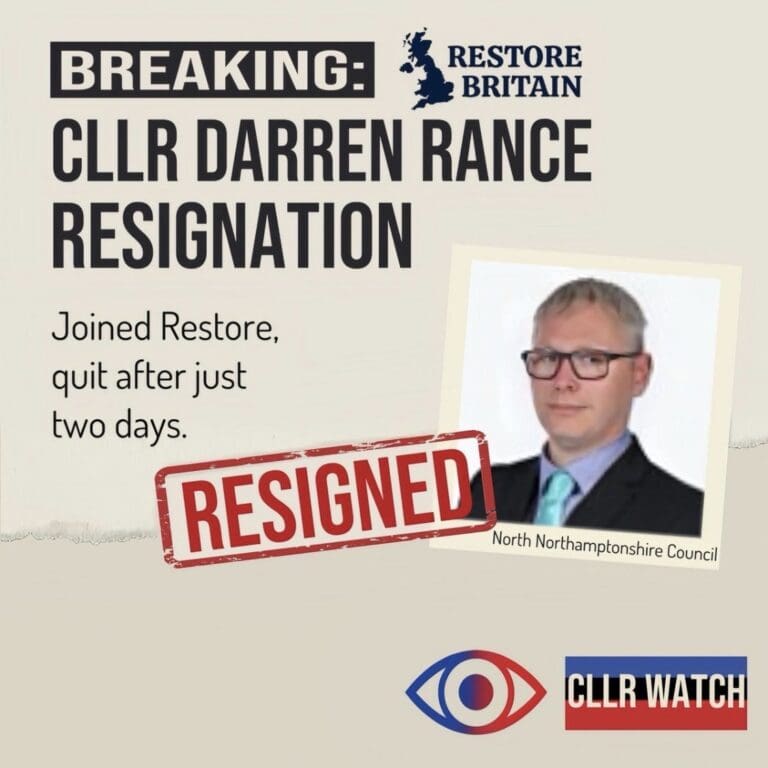
Mirror, Mirror On the Wall Who is the Most ‘Sinister’ of them all, Darren Rance?

Councillor Darren Rance appears to have perfected a very modern political manoeuvre: leap first, read the manifesto later.

In a statement announcing his decision to leave Restore and seek readmission to Reform UK at North Northamptonshire Council, Rance declared that Restore was “far more sinister” than he first thought. This, after admitting he joined them without properly realising what they stood for.

One might reasonably ask: isn’t working out what a political party stands for the absolute minimum requirement before signing up?

Rance claims he was “bombarded with desperate messages” and “reluctantly joined”. Yet within a day, he had supposedly uncovered a darkness so profound that he felt compelled to flee back to Reform. It’s a remarkable turnaround; not so much a political journey as a political day trip.

There is, of course, a wider issue here than one councillor’s restless feet. Voters elect representatives on the understanding that they have convictions, judgement and a basic level of due diligence. Switching allegiances once might be explained away as growth or reflection. Switching between parties, described even by critics as hard-edged populist outfits, begins to look less like principle and more like opportunism.

Rance’s criticism of Restore as “sinister” raises eyebrows precisely because of where he is heading back to. Reform has hardly built its brand on gentle centrism. Its rhetoric, positioning and alliances have placed it firmly in the combative wing of British politics. To depart one insurgent-style movement in favour of another suggests not a change of heart but a preference of flavour.

It also invites uncomfortable speculation. If Restore is truly as troubling as Rance now claims, why was he so quick to join? And if he was so easily persuaded once, what prevents him from being persuaded again? Politics is not meant to resemble a revolving door between pressure groups.

More mischievously, some observers will inevitably wonder whether this episode serves another purpose. When a councillor joins a rival grouping briefly, absorbs its internal discussions, and then departs in haste, it doesn’t take a conspiracy theorist to raise the possibility, however tongue-in-cheek, of intelligence gathering. (Notice the oxymoron?). Was this political buyer’s remorse? Or an ill-judged reconnaissance mission? There is no evidence for the latter, of course. But the optics are hardly reassuring.

What is clear is that this kind of volatility corrodes public trust. Local government depends on steadiness. Residents concerned about housing, planning, bin collections or social care are unlikely to feel reassured by ideological musical chairs. They expect competence, not factional drama.

There is also the small matter of accountability. If Restore is “more sinister” than advertised, specifics would help. What policies? What actions? What statements? Vague denunciations after the fact sound suspiciously like reputational damage control. Throwing around ominous adjectives without detail may stir headlines, but it does little to inform the electorate.

Ultimately, the episode paints a picture of political culture at its most brittle: hastily formed alliances, thin vetting and grand statements issued almost as quickly as they are contradicted. If this is the calibre of judgement being exercised, residents might reasonably question whether their far-right councillors are driven by conviction or convenience.

Rance may yet be readmitted to Reform and continue as if nothing happened. Politics has a short memory when it suits. But voters have longer ones. And they may reflect that before choosing between parties alleged to be “sinister” and those hardly renowned for moderation, it would be wise to ask a more fundamental question:

Who exactly is doing their homework and who is simply choosing the least uncomfortable rancid option on the shelf?

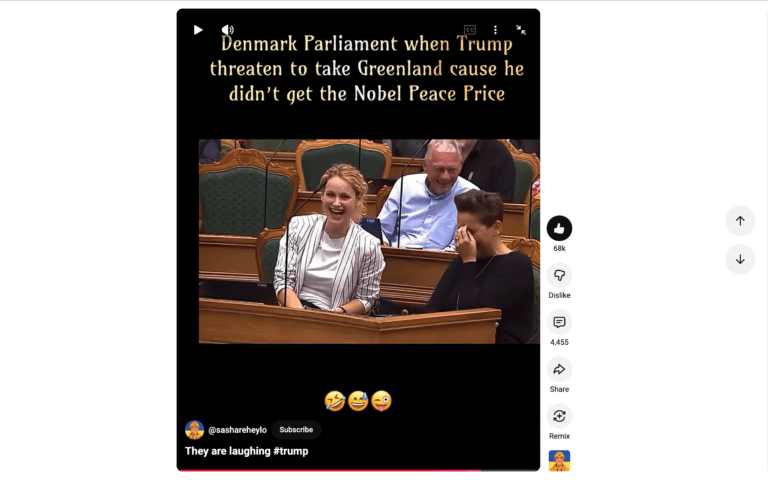
The Danish Parliament Reacts to Trump’s Threat to Take Greenland When Not Awarded the Nobel Peace Prize

0

If you cannot at least smile at this, then make an appointment with your GP.

Everyone united in a political chamber in hysterics is a wonderful thing, especially when the target is a lying sociopath.

Man Sought Following Threats to Kill Shopworker in Poole

Officers investigating a public order incident in Poole are appealing for witnesses and anyone with relevant information to come forward.

Dorset Police received a report at 3.45pm on Friday, 13 February 2026, concerning an incident at the Three phone shop in High Street. It was alleged that a customer became aggressive towards a member of staff inside the store.

According to police, the man is reported to have made threats to kill during the confrontation. While the incident is understandably distressing for those involved, officers confirmed that no physical contact took place and no injuries were sustained.

The suspect has been described as approximately five feet ten inches tall, with short dark hair. At the time of the incident, he was reportedly wearing blue jeans, a black top and a bumbag featuring distinctive red stripes.

Sergeant Mark Rice, of Dorset Police, said officers are treating the matter seriously and are pursuing lines of enquiry to establish the identity of the individual involved.

“No one deserves to be subjected to abuse in their place of work and we are carrying out enquiries to identify the person responsible,” he said. “I would ask anyone who has information about the incident or the identity of the man involved to please come forward.”

Incidents involving threats or abusive behaviour towards retail staff have been a growing concern nationally, with police forces and shop workers’ unions highlighting the impact such behaviour can have on employees’ wellbeing. While no one was physically harmed in this case, officers are keen to stress that threats of violence are taken seriously and can constitute criminal offences.

Police are particularly interested in hearing from anyone who was in the High Street area at the time and may have witnessed the incident or captured footage on a mobile phone or dashcam that could assist the investigation.

Anyone with information is asked to contact Dorset Police online or by calling 101, quoting occurrence number 55260021824. Alternatively, information can be provided anonymously via the independent charity Crimestoppers, either through its website or by calling Freephone 0800 555 111.

Why Whale Watching in Kona Could Be the Best Vacation Experience for Your Kids

Hawaii’s Big Island is home to some of the clearest waters and calmest bays in the Pacific, and Kona, on its western shore, is particularly known for its gentle ocean currents and sheltered coastline. These conditions make it an ideal destination for families, offering safe and accessible opportunities for observing marine life, including whale watching.

Whale watching in Kona could be the best vacation experience for your kids because it offers a fun, safe, and educational adventure. Private whale watching near Kona gives children the chance to witness these magnificent creatures up close, sparking curiosity and creating unforgettable family memories.

What Makes Kona Ideal for Families

Kona offers easy ocean access without long boat rides. This matters when traveling with children who may get restless or uncomfortable. The whales often come close to shore, which increases the chance of sightings. Kids stay engaged because action happens quickly and feels constant.

Why Kids Are Instantly Captivated

Seeing a whale closer for the first time creates instant excitement. Children react with surprise, joy, and endless questions. Unlike museums or structured lessons, this experience feels natural. Learning happens because kids are curious, not because they are told to pay attention.

Learning Without Feeling Like a Lesson

Whale watching introduces children to marine life in a real-world setting, where they can see firsthand how whales migrate, communicate, and care for their young. This type of learning stays with them longer because it is tied to emotion; kids remember what they feel, not just what they hear.

The Value of a Calm, Smaller Group Experience

Large crowds can overwhelm children. A quieter setting allows them to focus on what is happening around them. Some benefits of smaller group tours include:

1. More space to move and feel comfortable

2. Clear explanations tailored for kids

3. Less noise and distraction

Families often feel more relaxed during a private whale watching near Kona tour because the pace feels unhurried.

Emotional Growth Through Shared Moments

Watching whales encourages patience and careful observation. Kids learn to wait, watch, and appreciate quiet moments in nature. These shared experiences also strengthen family bonds, as everyone reacts together, creating memories built on shared wonder.

Safety and Comfort Parents Appreciate

Parents often worry about safety in ocean activities. Whale watching in Kona follows strict guidelines to protect passengers and wildlife. Boats are designed for comfort and stability. Shade, seating, and smooth rides make the experience easier for children of all ages.

A Break From Screens and Schedules

Whale watching pulls kids away from phones and tablets. Their attention shifts naturally to the ocean and the animals around them. There is no need to entertain or redirect them. The experience does the work on its own.

Easy to Fit Into Any Family Trip

This activity does not require a full day. Most tours last just a few hours, which works well for family routines. It leaves plenty of time for beaches, rest, or casual exploring. Parents avoid the stress of overpacked schedules.

Why Parents Enjoy It Just as Much

Adults often find the experience calming and meaningful. Watching whales in open water creates a sense of perspective and peace. Parents also value that their kids are learning without pressure. Everyone enjoys the moment at their own pace.

Key Takeaways

1. Whale watching in Kona combines fun, learning, and nature

2. Calm waters make it comfortable for children

3. Smaller group experiences help kids stay focused

4. Children learn naturally through real-world observation

5. Shared moments strengthen family connections

6. It fits easily into a relaxed vacation plan

Winds of Change: Could Green Energy Change the Fortune of Two ‘Forgotten Towns’?

Richard Shrubb is a Transport & Energy Analyst | Writer on EVs, Charging Infrastructure & Supply Chain Decarbonisation | Research & Thought Leadership for B2B Audiences

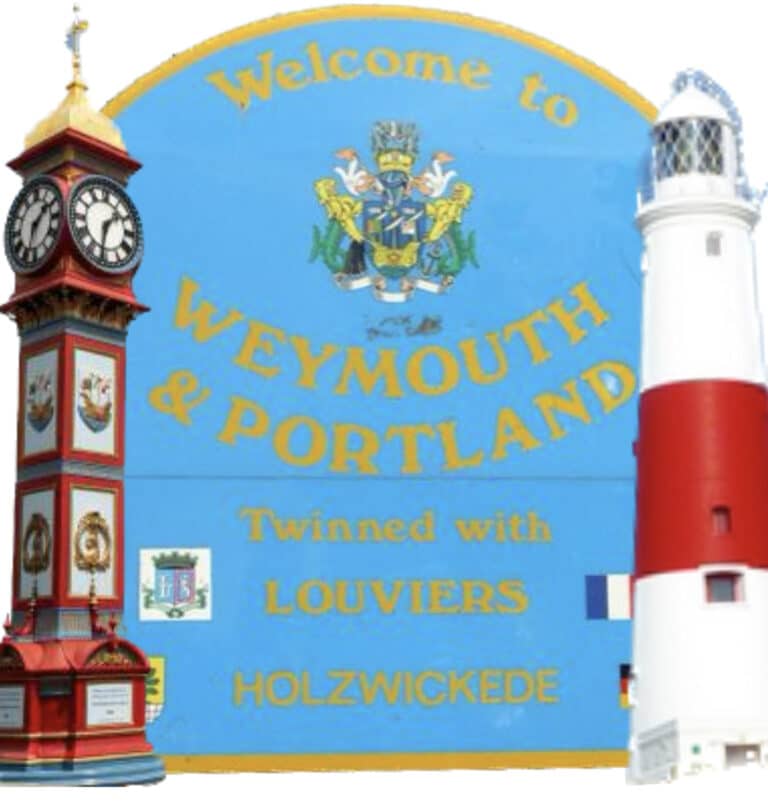
Weymouth and its neighbouring Isle of Portland once benefitted from the Royal Navy’s presence in Portland Port, with up to 6,500 well-paid jobs in the area. When the Navy left the area, its economy went into sharp decline. Could wind energy revive the area’s fortunes?

Forgotten Towns

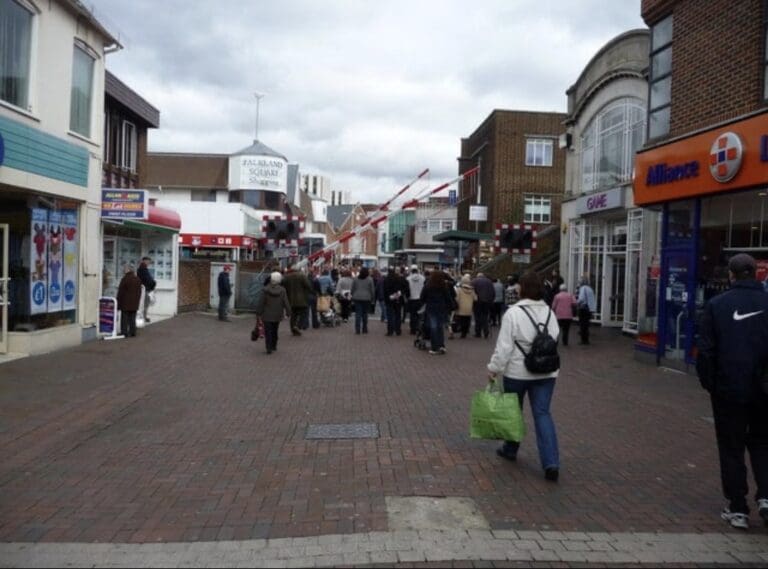
Weymouth’s last day in the sun was when the Olympic sailing events came here in 2012. Until then it had become an ‘end of the line’ seasonal tourist economy with high poverty rates and associated social issues such as drug abuse, poor housing and high unemployment.

In 2022 Prof. Philip Marfleet et al. published a report called Forgotten Towns that briefly touched on the economy’s history. Prior to the Royal Navy leaving, the report stated in the 1990s, “combined defence employment (direct and indirect) accounted for 41 percent of jobs in Weymouth & Portland. In the Travel To Work Area (primarily Weymouth, Portland and Dorchester), 6,465 employees relied directly or indirectly on the Ministry of Defence and its contractors.”

These jobs weren’t menial. Marfleet et al. stated, “There was a high level of trade union organisation in workplaces, with the result that rates of pay and conditions of employment were comparable to those in establishments across the UK.”

After the RN left, the report continued “By the end of the decade all but a handful of defence-related jobs had gone – a change that exceeded in scale and speed the closure of many major industrial complexes in the UK, such as coalfields, steelworks, and manufacturing plants. The change was abrupt and had profound consequences. Between 2007 and 2017, the economy in Weymouth & Portland contracted by 13 percent (measured by Gross Value Added) – an extraordinarily rapid rate of decline”.

What does this mean in practice? A personal viewpoint

I live in Wyke Regis, the village you drive through to join the causeway that links Portland to the mainland. I’ve long had an interest in social affairs and am now married into a working-class family that’s lived here for at least five generations.

What does an economy look like that has had its heart ripped out 31 years later?

While there are traces of the military-industrial complex left here, it is a shadow of what it was. The majority of the best jobs locally are the manual trades – electricians, plumbers, gas fitters and brickies, to name a few. Pop into The Smugglers pub on Portland Road – the only pub for a mile in any direction – and you will find that the majority of the regular drinkers are tradesmen and women. They’re on good money by and large and form the beating heart of the local economy.

The Smugglers used to be one of four pubs, but including The Old Castle, it is now one of two within a comfortable walking distance in Wyke. The other two struggled on for a while but just didn’t have the punters to keep going. The Ferrybridge has been demolished and in its place a block of apartments priced well beyond what locals can afford is being built on Portland Beach Road overlooking the harbour.

You can’t eat the view, they say. Not everyone in Wyke and Portland has enough money to spend £100+ in the pub on a Friday or Saturday night. I’m aware of uncomfortable rates of:

  • Drug and alcohol abuse
  • Child neglect and abuse
  • Unemployment and welfare dependence
  • Poor housing
  • Acquisitive crime
  • Poor education attainment levels
  • Homelessness

Weymouth’s shopping centre has almost as many empty shops as it has ones in operation. Large numbers of retired people and second homeowners pump up house prices beyond what locals can afford. Consequently, in a moribund economy largely dependent on tourism, those who remain cannot afford decent housing. Bright kids who can get an education tend to leave, with those remaining left to look for the seasonal tourism economy and low-paid service sector jobs.

Winds of change?

Portland Port hasn’t always been popular among local residents. The infamous waste incinerator project will bring a smokestack belching pollution into Weymouth Bay and create congestion as large lorries drive through central Weymouth with their loads of waste, creating relatively few jobs. Most residents don’t want it. But what if the port could revive the local economy for a similar reason it once did with the Royal Navy?

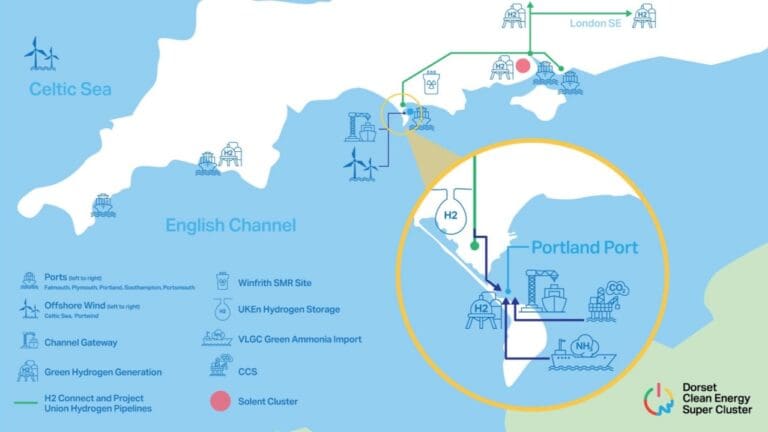
Morwind and Portland Port have been funded by Dorset Council and the Crown Estate to look into a wind farm dock on Portland. The Dorset Clean Energy Super Cluster stated, “The proposed Channel Gateway facility is designed to service the offshore wind energy sector, including the manufacturing of components such as concrete substructures, the integration and assembly of large-scale components, marshalling and staging areas for deployment, and operations and maintenance support”.

According to Dorset Council, the Channel Gateway has the potential to:

  • Transform Dorset into a centre for wind construction & manufacturing
  • Create 1,500-2,000 direct jobs and as many again in the wider supply chain
  • Unlock long-term clean energy opportunities in offshore wind,
  • Attract billions in private investment and deliver a significant boost to regional productivity

Cllr Nick Ireland, Leader of Dorset Council said: “Funding for the Channel Gateway Project is a major opportunity for the UK and will bring investment and energy to Dorset. We’re working with our unitary neighbours at Somerset, Wiltshire and BCP councils through the Wessex Partnership to boost regional growth, and with The Crown Estate, we plan to support offshore wind supply chains, creating jobs, social value and economic growth for local communities.”

What would this mean? Dare to dream…

Up to 2,000 direct jobs remain, just a third of that of the Royal Navy in the 1980s. But these jobs will be well-paid and generally high-skilled. The indirect jobs are important too – another 2,000 that will service those working there. This could mean:

  • More opportunities for the young in the form of apprenticeships and prospects
  • Less economic dependence on the tourism trade
  • More hope, leading to reductions in drug and alcohol dependence
  • Less welfare dependence
  • Reduction in poverty-associated crime
  • More thriving pubs!

One thing that seems to come with economic success is more success. More skilled employees requires better educational establishments, and the presence of more skilled people will attract more businesses beyond Portland Port. Though not in itself as big a presence as the Royal Navy, the Channel Gateway could prime the pump for the local economy to breathe again.

Earth conscience – a footnote

Discussing with locals on Portland, there is some worry that important marine habitats could be destroyed around the east of the island to create the new dock and facility. Though less likely with the expensive flats being built where the causeway touches the mainland, there could be impetus to call for a new bypass around Wyke, destroying the wetlands of the Fleet Lagoon.

The economy is important, but checks and balances need to be maintained so money doesn’t come before the environment. Though you can’t eat the view, the view is home to wildlife that still needs protecting at all costs. As such, while hopeful for the potential of this project, it should be done with locals’ consent and not (as with the incinerator) without it. Not all value is in money, and that needs to be remembered.

Anyone Who Believes that Andrew Mountbatten Would Be Allowed to Spill the Epstein Beans is Insane

Ever since the ‘death’ of Jeffrey Epstein in a Manhattan jail cell, a stubborn belief has persisted in certain quarters: that one day Andrew Mountbatten might decide or be compelled to “spill the Epstein beans” and expose a web of powerful figures allegedly entangled in the financier’s orbit. It is a wonderful idea for the masses. A disgraced insider, cornered and resentful, finally revealing all. A dramatic reckoning. A cascade of indictments. The powerful humbled.

But the belief that such a moment would ever be allowed to happen misunderstands how elite systems function. If Epstein’s network truly extended into the highest tiers of politics, finance, intelligence and royalty, as court documents, flight logs and testimony have long suggested, then the stakes are not personal. They are systemic. And systemic interests do not volunteer their own destruction.

Andrew’s association with Epstein is well documented. He maintained contact with him after Epstein’s 2008 conviction in Florida. He stayed at Epstein’s properties. A now-notorious photograph showed him with Virginia Giuffre in London. His 2019 interview was widely regarded as catastrophic, a public relations disaster that compounded the damage. Ultimately, he stepped back from royal duties and later reached an out-of-court settlement in a US civil case, paid for by his mother, the Queen, while denying wrongdoing.

What followed was instructive. The scandal has been narrowed. Contained. Personalised. Andrew was repositioned as the problem. His titles were removed. His public role shrank. The wider institution, the British Royal Family, remained intact. The Crown did not wobble. The constitutional settlement did not collapse. The state did not convulse.

That outcome was not accidental. It reflected a basic principle of institutional survival: isolate a liability. Large, entrenched structures do not permit crises to metastasise beyond control if they can help it. They identify the pressure point, remove or sideline it and move forward.

To imagine Andrew freely revealing damaging information about others is to imagine a rupture that would threaten far more than his own reputation. If powerful politicians, financiers, business leaders or intelligence-linked figures were implicated in criminal wrongdoing, the consequences would be seismic. Markets would react. Governments could fall. Diplomatic relationships would strain. Trust in institutions — already fragile, would fracture further.

History shows that when such stakes are involved, investigations tend to migrate towards areas that are serious but survivable. Financial irregularities. Security concerns. Conflicts of interest. Procedural misconduct. These are manageable forms of scandal. They can be litigated without dismantling the broader architecture.

Allegations of trafficking, exploitation and systemic abuse at elite levels are different. They cut to the core of moral legitimacy. They imply complicity not just by individuals but by gatekeepers who knew, ignored or enabled. And here lies the crux of the public suspicion: the belief that “they all knew”. That if Epstein was moving in rarefied circles for years, hosting gatherings attended by the influential and well-connected, then it strains credulity to assume ignorance was universal.

Whether that suspicion is justified in specific cases is a matter for evidence and courts, not conjecture. But the structural incentive to avoid wide-ranging exposure is undeniable. Power protects itself. Not through cartoonish villainy, but through bureaucracy, legal strategy, narrative management and distraction.

Consider the asymmetry. Andrew is not an independent political actor with nothing to lose. He is a member of a hereditary institution intertwined with the British state. The monarchy’s legitimacy rests on public confidence and constitutional continuity. Any revelation that seriously implicated other senior figures, particularly within allied governments or major corporations, would not simply embarrass individuals. It would destabilise relationships that underpin trade, security and diplomacy.

Even outside the royal sphere, elite networks are dense and interlinked. Business leaders sit on boards with politicians. Donors fund campaigns. Former officials move into corporate roles. Media organisations depend on access. Law firms represent multiple high-profile clients. In such an ecosystem, a full and uncontrolled disclosure from a central figure could have cascading effects. The incentive, therefore, is to limit exposure to the smallest possible circle.

This is not unique to one scandal. It is how modern institutions have historically weathered crises. Corporate cover-ups, intelligence failures, financial collapses—again and again, the pattern repeats. Identify the most visible offender. Remove them. Express contrition. Reform procedures. Move on.

It is also important to recognise the role of legal settlements. Civil cases, particularly in the United States, often end without admission of liability. They provide closure for claimants while avoiding prolonged public trials. For institutions and individuals with resources, settlement can be preferable to disclosure. The cost is financial; the benefit is containment.

Those who insist that Andrew could simply “tell everything” overlook the constraints that surround him. Legal agreements may include confidentiality provisions. Advisers, lawyers and institutional figures would strongly resist any course of action that magnified liability. Even if he wished to speak freely, he would face formidable legal and political barriers.

There is also the question of credibility. A belated confession that implicated others would be scrutinised intensely. Motive would be questioned. Evidence demanded. Without documentary proof, claims could be dismissed as self-serving or retaliatory. The idea of a single, explosive revelation that brings down an entire network presumes both intent and capacity that may not exist.

Meanwhile, public appetite for a grand unmasking speaks to a deeper malaise: a profound distrust of elites. After financial crises, parliamentary expenses scandals and years of perceived double standards, many citizens assume that the powerful operate by different rules. The Epstein saga, with its air of privilege and impunity, fits neatly into that narrative.

But distrust alone does not guarantee disclosure. In fact, it may encourage tighter control. When confidence in institutions is low, those institutions have even stronger incentives to avoid destabilising shocks.

The more uncomfortable possibility is not that a dramatic confession is being suppressed at every turn, but that the truth is messier and less theatrical. Networks of influence often rely less on explicit conspiracies than on shared interests, mutual discretion and the quiet understanding that exposure would damage everyone involved.

Andrew’s fall from grace has already served a purpose. It demonstrated that association with Epstein carried consequences. It allowed the institution to draw a line. Whether that line represents full accountability is hotly debated. But it reflects a strategy: absorb the impact, prevent contagion.

In the end, the belief that Andrew would be allowed, politically, legally or institutionally, to detonate a revelation implicating numerous powerful figures requires one to assume that those figures lack both foresight and influence. History suggests otherwise.

Power rarely dismantles itself voluntarily. It fragments, adapts, and survives. The fantasy of a single insider pulling back the curtain appeals to a public hungry for justice. Yet systems built over decades, supported by wealth, law and global relationships, are not easily undone by confession.

If there are truths still concealed within the Epstein saga, they are far more likely to emerge slowly, through documents, litigation, investigative journalism and incremental disclosures, than through a dramatic moment of televised catharsis.

Anyone waiting for Andrew Mountbatten-Windsor to bring the whole edifice crashing down will almost certainly be extremely disappointed. Any likelihood that he or anyone else would do that would mean a terminal and abrupt conclusion. You know what I mean.