

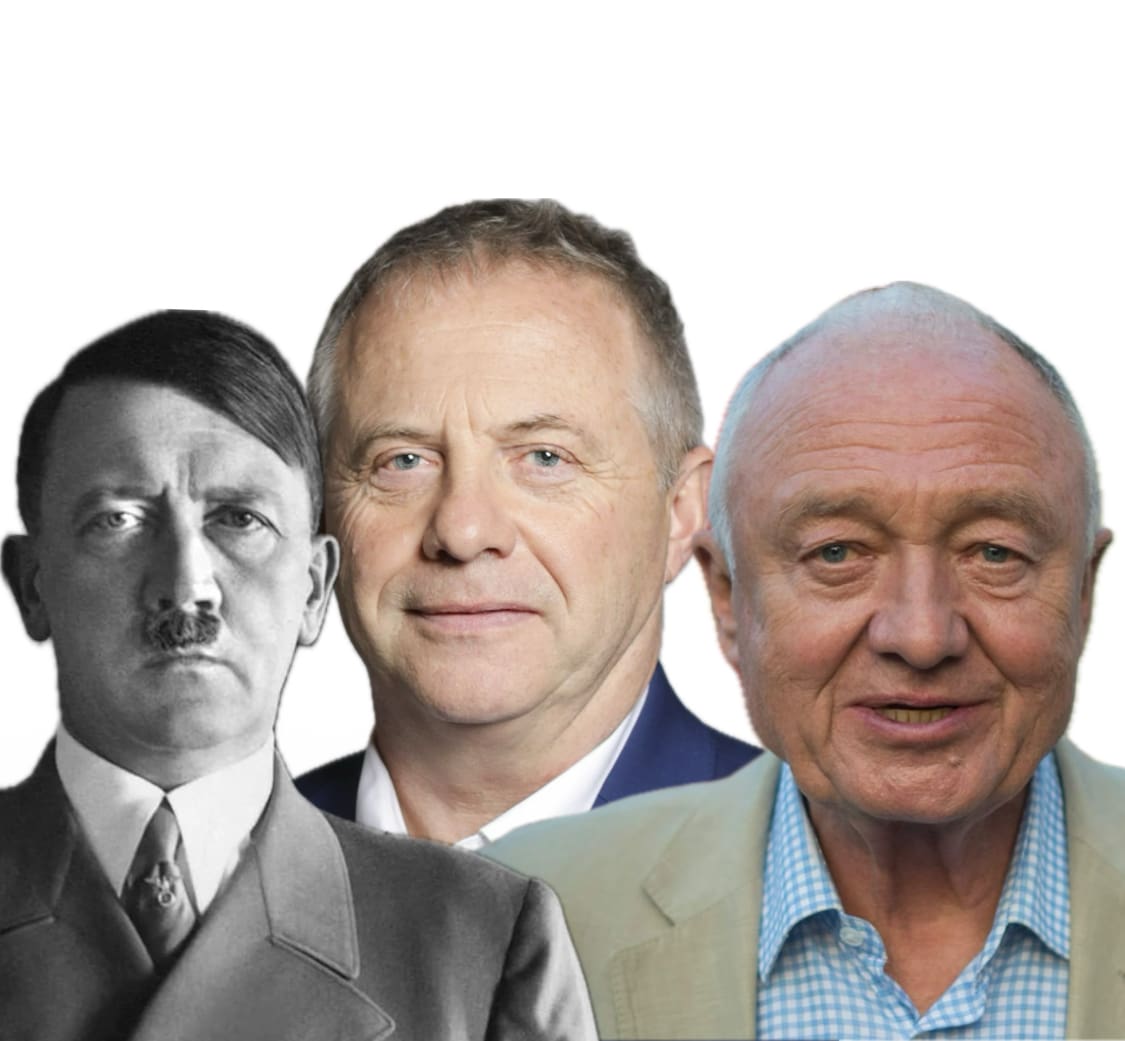
Remember when Ken Livingstone kept his calm in the face of these ignorant idiots playing politics and mutilating historical facts?
More about the repulisive John Mann later but let us focus on what actually happened in the 1930’s and not the Zionist revisionist bullshit that those who are paid propagandists spew whenever the shekels are shovelled into their accounts.
The history of the Jewish people during the 1930s and 1940s is overwhelmingly one of persecution, mass murder, and desperate flight. Within this broader narrative, however, lies a deeply complex and contentious chapter: the period when the Nazi regime sought to expel Jews to Palestine, and Zionist organisations, facing an existential threat, engaged in limited, pragmatic negotiations to facilitate this emigration.
This history sits uncomfortably in the collective memory of the Holocaust and the founding of Israel. It involves a collision of two seemingly opposed ideologies—one bent on racial expulsion and eventual annihilation, the other on national liberation—whose strategic interests briefly, and fatefully, aligned.
The Nazi Policy of Expulsion
Upon coming to power in 1933, the Nazi regime’s primary goal regarding the Jews was not initially systematic genocide, but forced emigration. The aim was to make Germany Judenrein—cleansed of Jews. This policy of persecution, designed to make life in Germany untenable, was formalised through a series of laws, most notoriously the Nuremberg Laws of 1935.
For this policy of expulsion to succeed, the Jews needed somewhere to go. Here, the Zionist vision of a Jewish national home in Palestine presented a potential solution, albeit for entirely different reasons. The Nazis saw Zionism as a convenient tool: it advocated for Jewish settlement outside of Europe, thereby aiding their goal of expulsion.
This convergence of interests led to the Haavara (Transfer) Agreement of 1933. Negotiated between the German Zionist Federation and the Nazi government, the agreement allowed Jews emigrating to Palestine to transfer a portion of their assets in the form of German goods. The mechanism was complex: Jewish emigrants would deposit their money in a special account in Germany; this capital was then used to purchase German manufactured goods, which were exported to Palestine and sold by the Jewish-owned Haavara company. The proceeds, in Palestinian currency, were then given to the emigrant upon their arrival.
For the Nazis, Haavara broke the international Jewish-led boycott of German goods and provided a boost to the Reich’s export economy during the Great Depression. For the Zionist leadership in Palestine, the Yishuv, it was a desperate pragmatism. It allowed tens of thousands of German Jews—and their capital—to reach Palestine, thereby strengthening the demographic and economic foundations of the future Jewish state.
The Role of Zionist Groups
Zionist groups were thus faced with an agonising moral dilemma. On one hand, any negotiation with the Nazis was abhorrent. On the other, with the world’s borders largely closed to Jewish refugees (as starkly demonstrated by the 1938 Evian Conference), Palestine represented one of the few possible havens.
The Haavara Agreement was championed by practical Zionists like David Ben-Gurion, who believed that saving Jews and building the Yishuv was the paramount objective, even if it meant dealing with the devil. Other Zionists, particularly Revisionists on the right, vehemently opposed the agreement, viewing any negotiation with the Nazis as a betrayal.
Throughout the 1930s, this pragmatic strand of Zionism continued to seek ways to extract Jews from an increasingly hostile Europe. Even after the events of Kristallnacht in 1938 and the clear radicalisation of Nazi policy, some Zionist officials engaged in further negotiations, such as the controversial S.S.-affiliated Gestapo office for Jewish Emigration under Adolf Eichmann in Vienna, which used Zionist representatives to help accelerate forced emigration.
It is crucial to state that these dealings occurred before the Final Solution was formalised. The Nazis were still in an “expulsion” phase, and the Zionists were operating under a framework of rescue, however limited and morally fraught their methods.
The Holocaust and the Case for Statehood
The outbreak of war in 1939 and the implementation of the Final Solution from 1941 onwards rendered the Haavara model obsolete. Emigration was replaced by extermination. The Zionist leadership, now largely based in British Mandate Palestine, shifted its focus to lobbying the Allies, supporting rescue attempts, and, in some cases, planning armed resistance.
The systematic murder of six million Jews in Europe fundamentally altered the moral and political calculus for the Zionist movement. The Holocaust served as the ultimate, tragic vindication of the Zionist argument: that without a sovereign state where Jews controlled their own immigration and defence, they were perpetually vulnerable to annihilation in the diaspora.
Zionist leaders, including Ben-Gurion, used the unfolding catastrophe to powerfully illustrate the necessity of a Jewish state. The plight of Jewish refugees trapped in Europe, and later the survivors housed in Displaced Persons camps, became a central pillar of their argument before international bodies like the United Nations. The question “Where else can they go?” was posed with devastating force, particularly in the face of continued British restrictions on Jewish immigration to Palestine under the 1939 White Paper.
In this sense, while no Zionist willed or exploited the Holocaust, its horrific reality provided an unanswerable humanitarian and political impetus for the creation of Israel. The 1947 UN Partition Plan and the subsequent declaration of the State of Israel in 1948 were direct consequences of this post-war reckoning. The world, shamed by its complicity and inaction, now viewed a Jewish homeland as both a necessity and a form of historical justice.
A Legacy of Moral Complexity
The story of Nazi-Zionist transfers is not one of collaboration, but of a temporary and deeply cynical convergence of interests between two mortal enemies. The Nazis wanted to expel the Jews; the Zionists wanted to save and gather them. For a brief period in the 1930s, these opposing goals created a narrow, morally ambiguous space for negotiation.
The legacy of this period remains deeply controversial. Critics point to it as evidence of Zionist collusion with the Nazis, while defenders see it as a painful but necessary rescue effort in the face of global indifference. What is undeniable is that the Holocaust itself, the very event the Haavara Agreement had sought to avert on a smaller scale, ultimately became the defining tragedy that galvanised international support for the Zionist aim of a sovereign Jewish state. It is a history that continues to demand sober reflection on the impossible choices faced by those confronting absolute evil.
The supreme irony of his career is his anointment as the Tory government’s independent adviser on anti-Semitism. This is a man who, for years, was a central figure in the very factional wars that created the toxic environment he now claims to police. As a backbencher, he was not a healer but a principal combatant in Labour’s internal strife over the issue. His infamous public ambush of Ken Livingstone in 2016, see above, while catnip for the media, was the act of a political street-fighter, not a dispassionate arbiter of justice. It was grandstanding, pure and simple—designed not to foster understanding, but to create a viral moment and bury a rival.
This is the core of the Mann paradox: he spent years contributing to a culture of accusation and suspicion, only to be handed the keys to the very department he helped to weaponise. To his critics on the left, he is a hypocrite of the highest order, a man who used the genuine, serious issue of anti-Semitism as a cudgel with which to beat his internal party enemies. To many moderates and even some on the right, his approach often seemed less about solving the problem and more about keeping the pot boiling for his own political advantage.
The Constituency MP Who Seemed to Disdain His Constituents
Beyond the national stage, his local reputation is equally telling. Mann cultivated the image of the plain-speaking, no-nonsense man of the people. In reality, this often translated as an intolerance for dissent and a startling lack of political grace. Stories abounded of his bullying and innappropriate behaviour.
https://committees.parliament.uk/publications/7026/documents/72978/default
This was most spectacularly demonstrated in the Brexit saga. As the MP for a constituency that voted overwhelmingly to Leave, Mann transformed from a Labour man into a Brexit evangelist, becoming one of the most vocal supporters of the cause. While he claimed this was him respecting the will of his people, it came across to many as an abandonment of his party’s platform and a capitulation to the most extreme elements of the Brexit debate. When he chose not to stand in the 2019 election, it was seen by many as an admission that his position was untenable; the man who had tied his flag so tightly to the Brexit mast had no appetite to weather the storm that followed.
A Legacy of Division, Not Delivery
So, what is Lord Mann’s political legacy? He leaves no great law named after him, no transformative policy borne of his efforts. His legacy is one of division and acrimony. He is a political bruiser who mistook confrontation for principle and aggression for strength.
His elevation to the Lords was the final insult to his detractors—a reward for a career of disruption, a cushioned berth for a man who positioned himself as an outsider. The boy from Leeds who became a peer: it’s a classic British tale of the anti-establishment firebrand being seamlessly absorbed by the very establishment he claimed to challenge.
John Mann is unpopular not because he was always wrong, but because his methods were so consistently corrosive. He operated with the subtlety of a sledgehammer and the empathy of a doorstop. In the end, he is a fitting monument to our fractured political age: a man who made a career out of identifying enemies, only to find that in the process, he had repulsed those with a soul.







