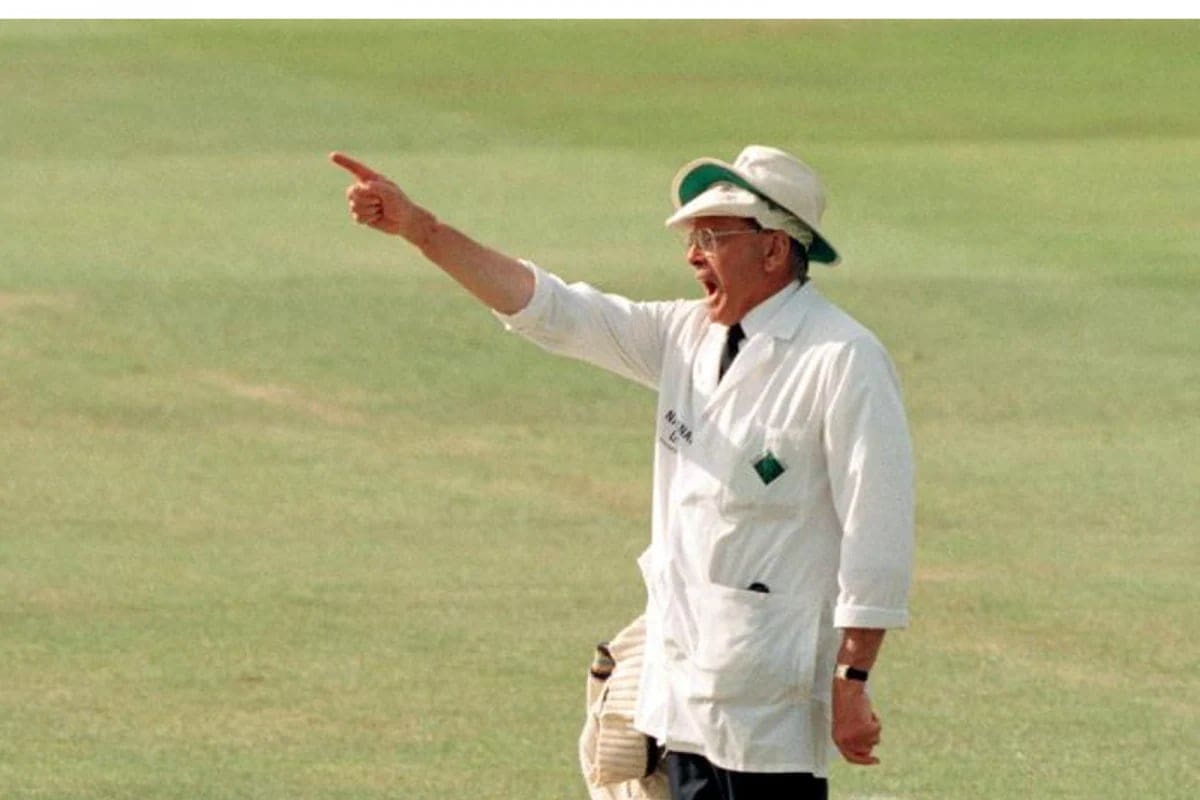
Harold Dennis “Dickie” Bird MBE OBE, the most famous and beloved umpire in the history of cricket, has died peacefully at home at the age of 92. The announcement was made by Yorkshire County Cricket Club, with whom he was synonymous throughout his long and illustrious life.
In a statement, the club said: “It is with profound sadness that The Yorkshire County Cricket Club announces the passing of Harold Dennis ‘Dickie’ Bird MBE OBE, one of cricket’s most beloved figures… He is synonymous with Yorkshire Cricket, where he has been one of the most loyal supporters.”
Describing him as “one of the most prominent umpires of his era,” the club paid tribute to a man who “will be truly missed by all at the club, having spent an incredible amount of time in support of everyone here and will be remembered as one of the greatest characters in Yorkshire’s history.”
Bird’s career as an international umpire spanned nearly three decades, during which he became an institution. He stood in 66 Test matches and 69 One Day Internationals, including three World Cup finals. His authority and fairness were beyond question, earning him the respect of players across the globe.
But it was his unique character, rather than just his decisions, that made Dickie Bird a household name. With his trademark white cap, anxious manner, and wonderfully expressive face, he was a personality as central to the drama as the batsmen and bowlers. He was a man of endearing quirks and memorable phrases that became part of cricket’s folklore.
The Quirks and the Quotes
Bird was famously superstitious. He would never step on the boundary rope, believing it to be bad luck, and would always carefully hop over it. Before a match, he would often turn all the coins in his pocket heads-up for good fortune. His nervous energy was legendary; he would fret about the weather, fidget with the bails, and was known for his distinctive, slightly panicked run onto the field at the start of play.
His interactions with players were a source of constant amusement and affection. He was known to offer calming words to nervous cricketers, famously telling a tense batsman, “Just watch the ball, son. It’s red and round. Tha’ can’t miss it.” When a bowler’s foot was hovering dangerously close to the front line, his cry of “Steady, Gunga Din!” would ring out across the ground, a reference to the fictional water carrier from Rudyard Kipling’s poem.
Perhaps his most famous saying was his instruction to the bowler when play could resume after a delay. He would point dramatically and declare, “Right, let’s get the show on the road!” This phrase became so synonymous with him that it was the title of his autobiography.
His legend was built on a series of unforgettable incidents that highlighted his quirky charm: the bomb scare at Lord’s, where he calmly observed proceedings while sitting on the covers in the centre of the pitch; the burst water pipes at Headingley that led to an entertaining exchange with a frustrated crowd; and the first recorded instance of ‘good light stopped play’ thanks to the reflection from a Trent Bridge greenhouse.
Blessed with a genial nature, Bird’s popularity transcended the sport. His 1997 autobiography sold over a million copies, making it the nation’s biggest-selling sports book. He became a cherished television personality and a travelling raconteur. In a story he delighted in telling, his one-man show once drew a bigger audience in Leeds than the superstar singer Shirley Bassey.
Harold Dennis Bird was born in Barnsley in 1933. A knee injury at 15 ended a promising football career with Barnsley FC, steering him towards cricket. He honed his technique at Barnsley Cricket Club, where he forged a lifelong bond with two of Yorkshire’s other favourite sons: the future England opening batsman Geoffrey Boycott and the broadcaster Michael Parkinson.
After a modest playing career, he found his true calling when he took up the white coat in 1970. His service to cricket was recognised with an MBE in 1986 and an OBE in 2012. In 2014, he was named President of The Yorkshire County Cricket Club, a role he held with “pride and distinction.”
Dickie Bird was more than an umpire; he was a treasure. He embodied the spirit, humour, and enduring charm of cricket. The sight of his familiar cap and the sound of his Yorkshire accent reassuring a bowler, “That were straight, that were!” after a confident appeal, are etched into the memory of a generation. His passing marks the end of an era. He leaves behind a legacy of laughter, integrity, and an indelible mark on the summer game he loved so dearly.