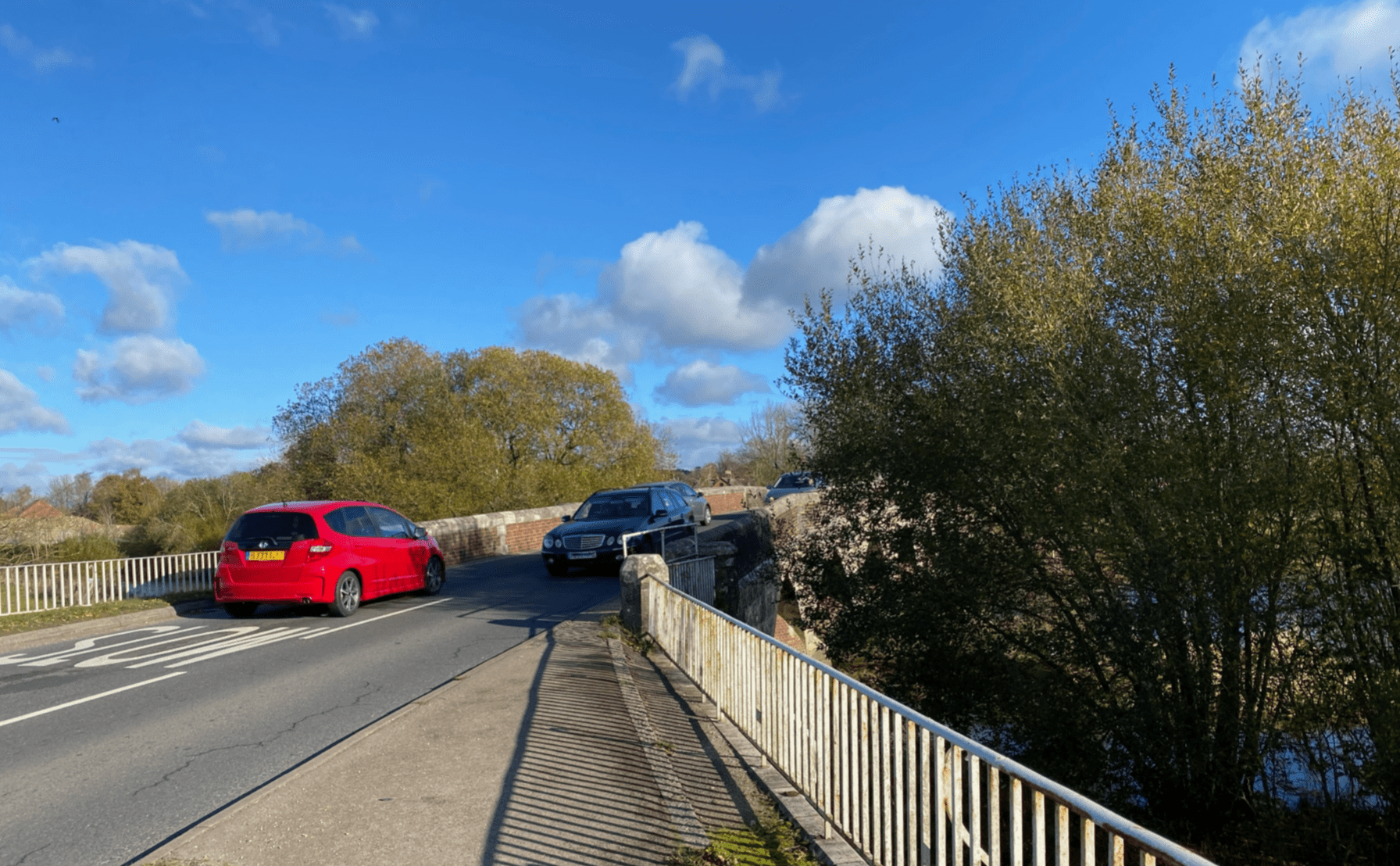
Temporary traffic management will be placed on Julian’s Bridge in Wimborne from Tuesday 26 May 2026 to test a safer way for people to cross the bridge on foot.
Many people say they want a safer pedestrian route across the river between Corfe Mullen and Wimborne, so the trial will create space for a temporary footway by restricting vehicles to a single lane.
Before exploring alternative or more complex options, we need to test whether traffic signals and a single‑lane layout can work in practice on this bridge
We will run the trial from Tuesday 26 May until Friday 3 July, with vehicles using a one-way signal-controlled shuttle system.
Julian’s Bridge is a Grade I listed structure and currently carries two‑way traffic within a relatively narrow carriageway. This means people who are walking or wheeling, for example, with mobility aids, need to share space with vehicles.
The trial arrangement will enable people to cross the bridge without having to step into the road or rely on the refuges along the side of the carriageway to avoid vehicles.
A survey will be online from 26 May and paper copies will be available at Wimborne and Corfe Mullen libraries. The survey will close in September 2026.
Cllr Jon Andrews, Dorset Council’s Cabinet Member for Place Services, said:
“Julian’s Bridge is an important historic structure, but we understand people’s concerns that crossing it on foot can feel uncomfortable and even unsafe.
“This trial allows us to test a practical option that could make a real difference for pedestrians while keeping traffic moving. By running it during a busy period, we’ll gather valuable evidence about what works and what doesn’t.
“We’re grateful to residents and road users for their patience while we carry out the trial. The feedback and data we collect will help us decide what, if anything, could be taken forward as a longer-term solution.”
The bridge has an average carriageway width of around 5.4 metres (just under 18 feet) and Dorset Police has recorded injury collisions where pedestrians have been struck by vehicles.
Reducing traffic to a single lane should also lower the risk of vehicles striking the historic parapet. Parapet strikes can lead to full bridge closures while repairs are carried out, causing significant disruption for motorists and local journeys.
A new, separate bridge (like the one at Canford Bridge) is, at present, unlikely to be approved due to the Grade I Listing of Julian’s Bridge.
When the trial ends, Julian’s Bridge will return to its previous layout.
The results of the public survey, together with traffic and safety data collected before, during and after the trial, will help inform any plans for pedestrian provision at this location.
While the trial is underway, we will carry out routine repairs and maintenance on the bridge. Doing this at the same time avoids the need to install traffic management for maintenance work at a later date.
Because the bridge and surrounding roads are busy, some delays between Lake Gates and Wimborne are expected during the trial. We will closely monitor queue lengths, traffic speeds, journey times and changes to local traffic patterns. We will adjust the temporary signals where possible to reduce impacts.
The trial has deliberately been scheduled to include the busy Wimborne Folk Festival, when both pedestrian and vehicle demand are high, to provide a realistic test of how the layout performs during peak conditions.
See further details and the background to the trial
Tree management
In mid‑May, we plan to cut back willow trees on the southern bank near the bridge. A full bird nest assessment will be carried out the day before work is due to start. If any active nests are found, the work will be postponed until after the bird nesting season. This tree work is not linked to the bridge trial.
There is a risk of the willow trees restricting visibility for people approaching the bridge. Prolonged wet weather over the winter meant it was not possible to access the nearby field with the heavy equipment needed to carry out the work earlier.